
Natural Language Processing (NLP) is a core technology behind AI freelance writing because it’s what lets AI tools work with language in practical ways: summarizing sources, pulling key details from messy notes, improving clarity, and generating usable drafts you can shape into client-ready work. It helps bridge the communication gap between humans and machines, enabling AI tools to support writers rather than slow them down.
Why this matters for freelancers: if you use AI for research, outlining, drafting, editing, SEO cleanup, or repurposing, you are already relying on NLP. You do not need to “study NLP” like a developer, but understanding what it’s good at helps you (1) choose tools, (2) keep quality high, and (3) stay in control of voice and accuracy.
Quick clarification: NLP is the language-processing layer (understanding, extracting, transforming text). Generative AI tools are one application that uses NLP techniques plus large language models to produce text. When freelancers say “AI writing,” they usually mean tools powered by NLP.
NLP now underpins many everyday applications, like virtual assistants, language translation, and chatbots, making our interactions with technology more seamless, intuitive, and valuable for content creation.
Where NLP Shows Up in Real Client Work
Here are the most common freelance writing tasks that rely on NLP, even if the tool never uses that term:
- Research compression: summarize long sources into usable notes, extract key points, compare sources, and pull quotes or stats for verification.
- Draft acceleration: turn a brief + outline into a first draft faster, then revise with your voice and structure.
- Editing passes: clarity, tone, grammar, concision, and consistency improvements.
- SEO support: keyword placement suggestions, topic coverage checks, and intent-aligned headings.
- Repurposing: turn a blog into a LinkedIn post, email, script, or FAQ section without rewriting from scratch.
The key is this: NLP speeds up text-heavy steps, but it does not replace judgment. You still choose the angle, verify facts, and make the final draft sound like a human wrote it for a specific reader.
A Short Context: How NLP Evolved (Without the History Lesson)
The evolution of NLP has been marked by significant milestones, from early rule-based systems to the machine-learning models we use today. Early developments in the 1960s, such as MIT’s SHRDLU, helped demonstrate that computers could manipulate language in constrained environments. Recent advances in machine learning and deep learning have pushed NLP into mainstream tools used for writing, editing, search, and summarization.
NLP plays a critical role within the broader AI framework, often working with other AI technologies like computer vision and robotics to produce more holistic intelligent systems. For freelance writers, the practical takeaway is simpler: NLP is the reason modern tools can read, rewrite, summarize, and generate text at a useful quality level.
Everything I’ve shared here—and more—is in my book, available on Amazon. Click the link if you’re ready to take the next step.
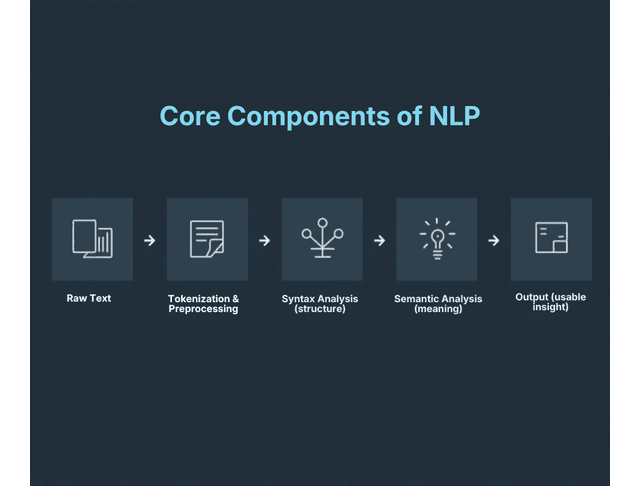
Core Components of NLP
NLP has several essential elements that work together to process and understand human language. Tokenization and text preprocessing convert raw text into smaller, manageable units, such as words and sentences. This step is crucial as it prepares the text for further analysis by removing noise and standardizing the data. For example, tokenization involves splitting text into words or phrases. At the same time, preprocessing might include:
- Converting all text to lowercase.
- Removing punctuation.
- Eliminating stop words like “and” or “the”-common words that do not carry significant meaning in a given context.
Syntax and semantic analysis follow, examining the structure and meaning of sentences. Syntax analysis involves parsing sentences to understand grammatical relationships, while semantic analysis focuses on the meaning and relationships between words. It helps construct parse trees representing a sentence’s grammatical structure, identify parts of speech, and determine their dependencies. Semantic analysis, conversely, ensures that the NLP system understands the text’s meaning. It involves comprehending the context of words, resolving ambiguities, and identifying named entities, specific objects, people, or locations, and their relationships. For instance, in a news article, ‘Barack Obama’ would be a named entity. This dual-layered approach enables the system to understand the words and the intent and context behind them.
Machine learning models, including transformers and recurrent neural networks (RNNs), are central to modern NLP. Transformers, like those used in models such as BERT and GPT-style systems, utilize attention mechanisms- a technique that lets the model concentrate on other parts of the input sequence when predicting each part of the output sequence. This helps the model understand the context of a word based on its surrounding words. It makes them highly effective for tasks requiring an understanding of context and nuance.
RNNs, particularly Long Short-Term Memory (LSTM) networks, excel at processing sequential data, making them well-suited for language modeling and time-series prediction. These models are taught on extensive amounts of data to recognize patterns and make predictions. They improve their power to comprehend and generate human language over time. Fine-tuning these models for specific tasks, such as sentiment analysis or language translation. It further enhances their effectiveness by adapting them to the nuances of particular datasets and applications.
NLP Applications in AI Freelance Writing
NLP significantly empowers freelance writers’ content creation by providing automated tools that can generate outlines, drafts, rewrites, and variations, dramatically boosting productivity and creativity. With these tools, writers can shift their focus from the initial drafting phase to refining and personalizing the content. They ensure it aligns with their unique voice and their audience’s specific needs.
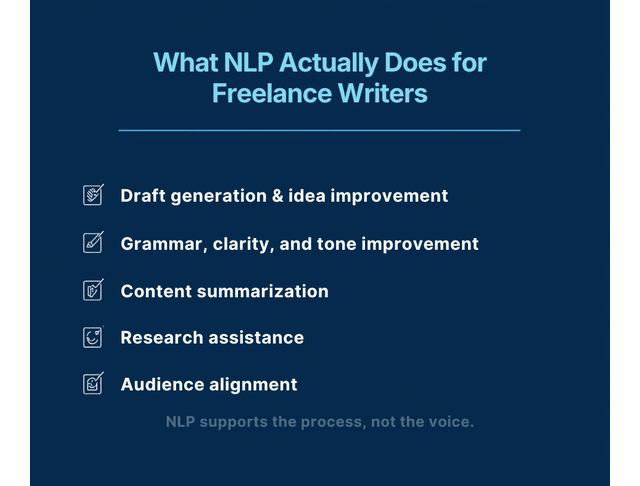
Grammar and style enhancement tools powered by NLP are crucial for maintaining high standards of language accuracy and coherence. Tools like Grammarly and Hemingway offer real-time feedback on various aspects of writing, including grammar, punctuation, and style. This immediate feedback loop helps writers produce polished and professional content suitable for their intended audience. Grammarly, for instance, not only corrects grammatical errors but also provides suggestions for improving the text’s overall readability and engagement level, catering to different writing styles and needs. Similarly, Hemingway focuses on readability, helping writers simplify complex sentences and eliminate unnecessary words.
For research and information retrieval, NLP tools are invaluable. They can quickly filter through extensive text to extract relevant information, saving writers considerable time and effort. Summarization algorithms, integral to many NLP tools, distill lengthy articles and documents into their core points. This allows writers to efficiently gather insights and incorporate them into their work without getting bogged down by information overload. For example, tools like IBM’s Watson can analyze large datasets to identify trends and critical information. This can then inform and enrich the writer’s content, making their research process more efficient and productive.
In summary, NLP tools substantially benefit freelance writers by automating routine tasks, enhancing writing quality, and streamlining research processes. These advancements enable writers to focus on what they do best—creating compelling and engaging content. As NLP technology continues to evolve, its impact on the writing profession will likely grow even more profound, offering new opportunities for efficiency and creativity.
A Writer-First Way to Use NLP Without Losing Your Voice
If you want NLP to help you without flattening your style, use it in controlled passes:
- Pass 1: Research compression (facts and notes only)
Use NLP to summarize sources, extract key points, and create a short notes doc. Do not ask it to “decide the angle” yet. - Pass 2: Structure (outline and section goals)
Turn your notes into an outline with clear section promises. You choose what stays and what gets cut. - Pass 3: Draft (fast, messy, editable)
Generate a draft that matches your outline. Treat it like a rough assistant, not a finished writer. - Pass 4: Human polish (voice, accuracy, audience fit)
You refine tone, confirm claims, add examples, and make it feel like it came from one mind.
This is where freelancers win: you use NLP for speed, and you keep the parts clients pay for: judgment, structure, and voice.
Advanced NLP Tools for Freelancers
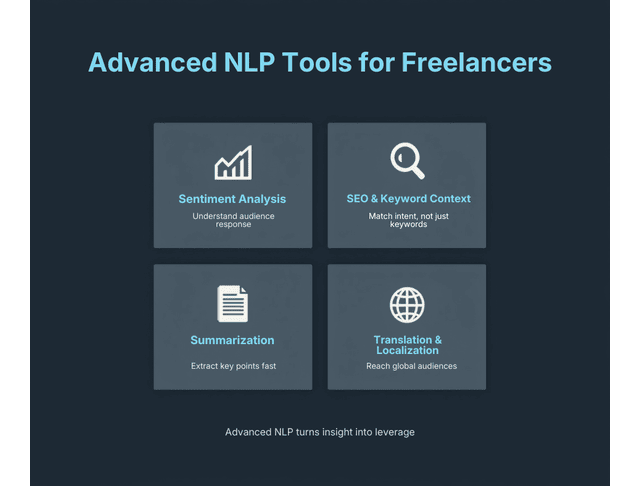
Sentiment analysis is a robust mechanism for comprehending audience engagement. By analyzing the sentiment behind reader comments or social media interactions, writers can tailor their content to better resonate with their audience, increasing engagement and impact. Sentiment analysis classifies text as positive, negative, or neutral, allowing writers to gauge the overall emotional tone of readers’ responses. For instance, if a significant portion of comments on a blog post are negative, a writer can identify common criticisms and adjust future content to address readers’ concerns. This proactive approach improves audience satisfaction and fosters a more loyal readership.
NLP also plays a crucial role in keyword optimization and SEO. Writers can enhance their content’s search engine ranking and attract more traffic by using tools that analyze search trends and keyword relevance. Keyword optimization tools leverage NLP to understand the context and intent behind search queries, enabling writers to incorporate relevant keywords into their content naturally. By leveraging these tools, writers can improve their visibility on search engines like Google, which prioritizes content that best matches user intent. This, in turn, enhances the discoverability of the writer’s work, attracting a larger and more engaged audience. If you want to see how this looks in a full content workflow, our Artificial Intelligence for Writers guide breaks down practical examples you can adapt.
Language translation and localization powered by NLP enable freelancers to create multilingual content, broadening their reach to global audiences. These tools ensure that translations are accurate and culturally appropriate, enhancing the writer’s ability to connect with diverse readerships. NLP-based translation tools like Google Translate and DeepL use advanced algorithms to interpret and convert text from one language to another while maintaining the original meaning and tone. Localization goes further by adapting content to fit cultural nuances and regional preferences, making it more relatable to local audiences. This capability is invaluable for freelance writers looking to expand their readership beyond their native language, allowing them to engage effectively with a global audience.
Challenges and Future of NLP in AI Freelance Writing
Natural Language Processing (NLP) faces several significant challenges despite its advancements. One of the primary issues is the inherent ambiguity of human language. Words and phrases can have numerous definitions depending on context. They make it difficult for NLP models to interpret and generate text accurately. For instance, the word “bank” can mean a monetary institution or the side of a river, and determining the correct meaning requires sophisticated context understanding.
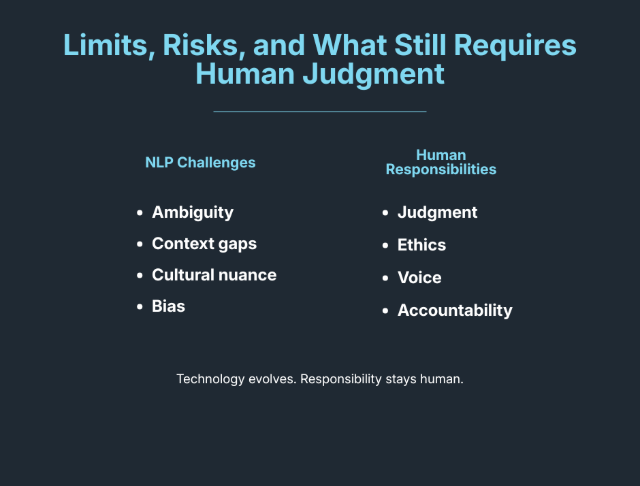
Understanding context is another major challenge. NLP models must understand the broader context in which a word or phrase appears to accurately interpret its meaning. This involves understanding individual words and their relationships within a sentence and across paragraphs. Accurately interpreting the tone and intent of the text is crucial for sentiment analysis, which relies heavily on contextual understanding.
Cultural nuances further complicate NLP. Different cultures have unique expressions, idioms, and references that can be difficult for NLP models to interpret correctly. This is particularly challenging in applications like machine translation and localization, where accuracy and cultural sensitivity are crucial.
Ethical considerations when using AI for writing are also paramount. The need is to balance the efficiencies of automation with the preservation of the writer’s unique voice and creativity. Moreover, addressing bias and fairness in NLP models is critical to ensure that the generated content does not perpetuate stereotypes or unfair biases. Ethical AI usage involves continuous monitoring and model improvement to maintain high standards of fairness and transparency.
The future of NLP in AI freelance writing is promising. Emerging trends such as transfer learning, which enables models to leverage knowledge from one task to another, and multimodal NLP, which integrates text with visual and auditory inputs, are poised to revolutionize the field. These advancements will enable real-time language processing and more dynamic, interactive applications, significantly enhancing NLP’s capabilities and applications in writing. As these technologies continue to develop, they will offer new opportunities for writers to harness AI’s power, making their work more efficient and impactful.
Final Thoughts
NLP transforms AI freelance writing by enhancing productivity, accuracy, and engagement. By embracing NLP tools, freelance writers can elevate their content creation process, making it more efficient and impactful. The practical advantage is not that NLP “writes for you,” but that it removes friction from research, drafting, editing, and repurposing so you can focus on strategy and voice.
If you want to put NLP to work in a practical, writer-first way without losing your voice or overcomplicating your process, check out my books on Amazon. They break NLP and AI writing into clear workflows you can apply immediately.
Frequently Asked Questions About AI Freelance Writing
AI freelance writing uses AI tools to help with research, drafting, and editing, while the freelancer controls strategy and voice. NLP powers these tools, enabling them to understand text, summarize sources, and generate usable drafts.
It can get close to simple, pattern-heavy content but struggles with nuance, story, and lived experience. Humans still need to shape the angle, check facts, and maintain brand voice.
It’s more likely to remove low-fee, repetitive work than eliminate writers. Freelancers are shifting toward editors, strategists, and “AI operators” who design and run workflows.
Get client consent for AI use, avoid pasting sensitive data into open tools, and always review and edit outputs. Make sure the final draft reflects your own thinking, not just raw AI text.
Start by using AI for outlining, summarizing, and generating ideas on low-risk tasks. As you get comfortable, plug it into repeatable steps—research, draft cleanup, and SEO tweaks—while you stay in charge of decisions and final polish.

Florence De Borja is a freelance writer, content strategist, and author with 14+ years of writing experience and a 15-year background in IT and software development. She creates clear, practical content on AI, SaaS, business, digital marketing, real estate, and wellness, with a focus on helping freelancers use AI to work calmer and scale smarter. On her blog, AI Freelancer, she shares systems, workflows, and AI-powered strategies for building a sustainable solo business.