
You’re doing everything you can as a freelance writer—delivering client work, posting on LinkedIn when you remember, pitching ideas you hope will land—and it still feels like guesswork. Some posts take off; others disappear. Pitches go unread. Instead of feeling smart and strategic, you feel like you’re throwing content at the wall and hoping something sticks. This is where AI market research changes the game. Instead of relying on intuition alone, you can use simple AI tools to see what your audience cares about, what competitors are publishing, and which topics are more likely to perform before you ever start drafting.
This guide takes you through the basics, shows you how to use AI to uncover stronger content ideas, and gives you a simple workflow you can return to.
Everything I’ve shared here—and more—is in my book, available on Amazon. Click the link if you’re ready to take the next step.
AI Market Research Basics for Writers
Right now, “market research” might sound like something big marketing teams do with huge budgets and dashboards. As a solo writer, you probably don’t have that luxury—you have tabs, deadlines, and a brain that’s already full. The goal here isn’t to turn you into an analyst. It’s to show you how to use AI as a lightweight research assistant so you can make smarter decisions without turning your life into a data project.
What AI Tools Actually Do in Market Research
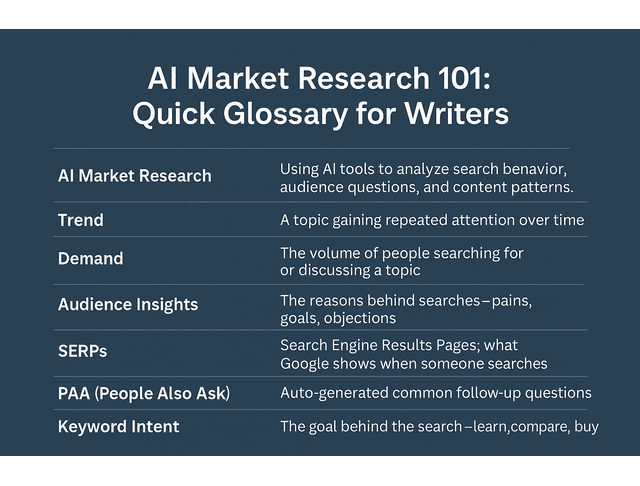
At a basic level, AI tools help you scan large amounts of data—search results, social posts, reviews, forums—and spot patterns in topics, questions, and keywords. They can then summarize what people are asking or saying about a subject, so you see the big picture instead of drowning in open tabs.
In marketing teams, AI is already used to analyze data, understand language, and recommend content ideas or channels. For you as a freelancer, that translates into faster topic research, better audience insights, and clearer content strategy without hiring a full research agency. Recent survey data from Orbit Media show that AI adoption among content marketers jumped from 65% to 95% in just two years, meaning almost everyone creating content is now using AI in some way.
Key Terms: Trends, Demand, Audience Insights
In AI market research, a few core ideas keep coming up. Trends are the topics, questions, or themes that show up again and again and grow in visibility over time—for instance, you might notice “AI SEO tools for small businesses” popping up repeatedly in search results and social feeds. Demand describes how much interest a topic attracts, which you can gauge from keyword volume, search patterns, and how often people bring it up. Audience insights are what tell you who’s interested and for what reason—the frustrations, objections, goals, and outcomes that sit underneath all that activity.
To make this concrete, imagine you write for B2B SaaS brands. You start with a broad topic like “email marketing for SaaS.” A quick AI-assisted scan might show repeated phrases such as “SaaS onboarding email sequence,” “product-led growth emails,” and “SaaS renewal reminder templates.” That tells you there’s strong demand for practical, lifecycle-based email content—not just another generic “5 tips for better newsletters” post.
Why You Shouldn’t Fear AI Market Research
AI isn’t here to replace your judgment or your voice. It exists to reduce the time you spend guessing what to write, manually skimming 30 tabs, and trying to “feel” which idea is best. Think of it as a research assistant that’s fast, objective, and tireless. You’re still the strategist and storyteller. AI gives you better raw material and clearer direction.
Using AI Market Research To Find Profitable Ideas
If you’ve ever poured your heart into a piece that went nowhere while a quick “filler” post unexpectedly did well, you’ve felt the cost of guessing. That gap between effort and results is often a research problem, not a writing problem. AI market research lets you reduce that guesswork. Data-driven marketing like this isn’t just a nice idea; one analysis found that businesses using it can achieve a five- to eightfold return on investment and a 20% boost in customer engagement metrics.
AI Market Research for Topic and Angle Discovery
Start with a broad idea, such as “email marketing for SaaS” or “burnout for freelancers.” Instead of jumping straight into a draft, ask a chat-based AI tool to help you explore the topic from different angles. You can prompt it with something like:
“List 15 blog post ideas for [niche] that reflect the common questions, objections, and goals of this audience. Prioritize topics that would appeal to [ideal client type], aiming for [outcome].”
That kind of prompt gives you a fast snapshot of promising angles. After that, you can use keyword or SERP tools to dig deeper into related phrases, long-tail queries, and “People Also Ask” questions, and to spot subtopics your competitors are already covering—or ignoring.
When you plug a phrase like “burnout for freelancers” into your research process, you’ll often uncover related searches such as “freelance burnout symptoms,” “how to set boundaries with clients,” or “using AI to prevent burnout.” Now you’re not staring at one fuzzy topic—you’ve got the outline of a small content series you can pitch or build out. You’re not chasing a perfect answer at this stage; you’re just collecting clues about what people actually care about.
Use SERPs, People Also Ask, and Forums To Validate Ideas
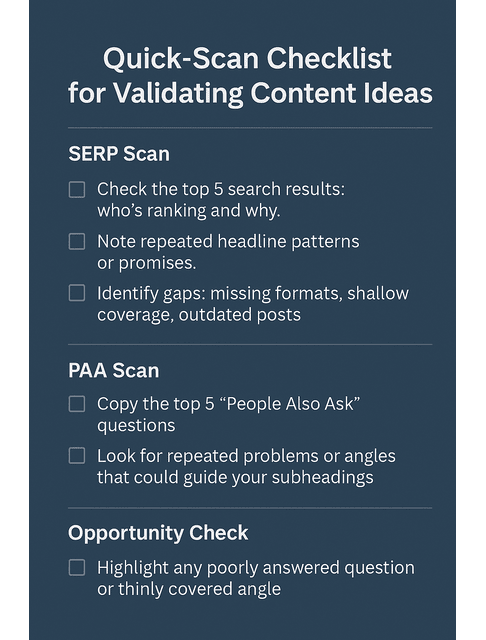
Before you commit to a piece, it helps to validate it quickly. A fast look at the search results shows you who is already ranking—agencies, SaaS brands, solo creators—and what headline patterns dominate the page: “how to,” “step-by-step,” “X examples,” and so on. The “People Also Ask” boxes reveal the follow-up questions real users are typing, which often make great subheadings, FAQ entries, or social posts. Meanwhile, forums and communities such as Reddit, Facebook groups, and indie platforms offer raw, unpolished complaints and “I’m stuck” posts that reveal the emotional side of the problem.
If you see the same questions and frustrations repeating across these spaces, and the existing answers are thin, inconsistent, or overly generic, you’ve probably found an opportunity to create something better.
Turn Data Into Simple, Pitch-Ready Ideas
Once you have some signal, you can turn it into concrete offers. For a client, you might say, “I noticed many founders are asking, ‘How can AI help me find content ideas?’ I’d love to write a data-backed guide that answers that specifically for your product.” For your own brand, you can group the most common questions into a small series: a main blog post, a LinkedIn carousel summarizing key points, and a follow-up email that goes deeper on one angle.
Your value isn’t just “I can write.” It becomes “I can write content aligned with real search intent and audience behavior.” If you want help turning that into outreach, you can also ask AI:
“Based on these five topic ideas and these audience pain points, write three short pitch angles I can send to a B2B SaaS client who wants more qualified leads.”
Know Your Audience With AI Market Research and Predictive Tools
You can write the most polished article in the world and still miss the mark if it’s aimed at the wrong problem. The magic happens when your content reads as if you’ve been inside your reader’s head. That’s where AI-powered audience insights and predictive tools start to earn their keep.
“Predictive” means a tool is looking at patterns over time and using them to forecast what might matter more in the near future. You don’t need to understand the underlying math. You’re borrowing the insight so you can move a little earlier on rising topics, rather than always reacting late.
Find Real Audience Problems in Search and Social Data
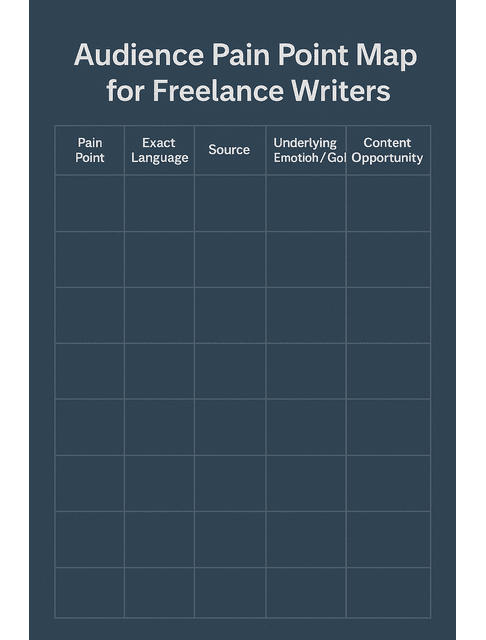
AI helps you see the why behind the searches. You might run a few high-intent keywords—say, “AI content workflow for freelancers”—through an AI assistant and ask:
“Here are some keywords: [list]. Summarize the main pain points, fears, and goals behind these searches in 5 bullet points.”
You can pair that with social listening tools or AI-generated summaries of comment threads to capture recurring complaints and questions. Very quickly, you’ll start seeing patterns like: “I don’t have time to learn every tool,” “I don’t know which ideas will actually bring leads,” and “I’m scared AI will make my writing sound generic.” Those patterns become hooks, angles, and objection-handling sections in your content.
Map AI Market Research Insights To the Buyer Journey
The next step is to place what you’re seeing along a simple buyer journey. At the awareness stage, people ask broad questions such as “What is AI market research?” or “How can AI help with content ideas?” In the consideration stage, they compare approaches and tools: “best AI market research tools,” “AI vs traditional research.” By the decision stage, they’re looking for concrete playbooks: “how to use AI tools for market research,” “step-by-step AI content workflow.”
You can map a single topic across this journey. For example, an awareness post might be “What Is AI Market Research for Freelance Writers?” A consideration piece could be “AI Market Research vs Traditional Keyword Research: What Solo Writers Actually Need.” A decision-level asset might be “Step-By-Step AI Market Research Workflow for Your Freelance Writing Business.” Together, these pieces educate, compare options, and drive action with clear calls to action, rather than existing as disconnected one-offs.
Skip Jargon and Keep AI-Assisted Content Human
Your clients don’t need a lecture about machine learning. They need clear, confident guidance. That might mean swapping a phrase like “synthetic personas” for something more grounded, such as “test ideas with simulated audiences before you run a full survey.” It also means translating algorithmic insights into straightforward recommendations—“do more of this, less of that”—rather than abstract dashboards. The more human and grounded your explanations are, the more valuable your AI research appears.
Simple AI Market Research Workflow for Your Writing Business
If your current process is “open 12 tabs, panic, then start writing whatever feels right,” you’re not alone. The fix isn’t more tools; it’s a predictable workflow you can run in under an hour. Once you have that, AI supports your business instead of overwhelming it.
Step-By-Step Workflow for Every Client Project
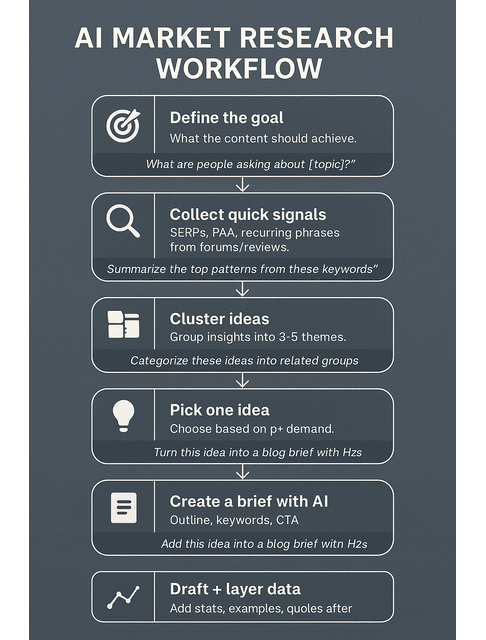
Here’s a lightweight process you can reuse:
- Define the goal. Clarify what you want the content to achieve—book more demos, grow your newsletter list, or strengthen your thought leadership.
- Collect quick signals (30–45 minutes). Use AI to pull a small, consistent set of data points: the top five search results and their headline patterns, the top five People Also Ask questions for your main keyword, and a handful of recurring phrases or complaints from reviews, forums, or social threads.
- Cluster ideas into three to five themes. Group what you’re seeing into themes like “founder stories,” “how-to tutorials,” “data and trends,” or “tool comparisons.”
- Pick one idea to test first. Start with a topic that clearly aligns with the audience’s pain points and shows strong search interest, rather than trying to cover everything at once.
- Create a content brief with AI help. Ask AI to “Turn this idea into a blog brief with H2s, key questions, and a suggested CTA.” Your brief can be very simple: a working title, a short description of the target reader and main pain point, a primary keyword and a few related phrases, a handful of subheadings based on real questions, and a desired next step such as reading another post, downloading a lead magnet, or booking a call.
- Draft, then layer in data. Write your draft, then use AI to suggest stats, examples, and quotes you can fact-check and weave in.
By running this workflow, every piece you write is tied to a specific goal and backed by real market signals, not just a hunch.
Choose One Main AI Tool for Market Analysis
You don’t need a full enterprise stack to do this. Start with one primary tool. For many writers, that’s a chat-based assistant that handles ideation and synthesis, or a simple AI-enabled SEO or keyword tool that surfaces search data and related questions. Use that tool consistently until it feels natural in your content planning. If you eventually need more depth, you can add a second tool for deeper keyword research or competitive analysis. Still, you don’t need it on day one.
Track Results and Refine Your AI Research Habits
You can keep tracking simply. For each piece, note the topic, angle, main keyword, and format—blog post, LinkedIn post, email, and so on. Over a month, watch basic metrics such as page views, time on page, saves, clicks, or replies. Then feed that back into your assistant with a prompt like, “Here’s traffic and engagement for my last 10 posts. Summarize patterns and suggest topics to double down on.”
If you see that your “how-to” posts, each focused on solving one clear problem, regularly beat your broader opinion pieces, lean into that pattern. Plan more how-to content and use AI market research to uncover related issues you can cover next. A PwC-supported survey, summarized by Harvard Business School, reports that highly data-driven organizations are three times more likely to see major improvements in decision-making than those that rely less on data. Even a light version of that approach can make your freelance writing business feel more intentional and less reactive.
Over time, AI market research shifts from a one-off experiment to a part of your writing operating system.
Final Thoughts: Let AI Market Research Carry More of the Load
You don’t need to become a full-time analyst to benefit from AI market research. You need a simple, repeatable way to see what your audience already cares about, choose topics with real demand, and pitch ideas that help clients hit their goals.
Start with one workflow, one tool, and one piece of content. Use AI to cut down guesswork, not your creativity. Your voice, judgment, and experience stay at the center—AI helps you aim them at the right problems.
FAQs on AI Market Research for Freelance Writers
AI scans large datasets—such as search queries, surveys, reviews, and social posts—and identifies patterns and trends. It helps you see what people are asking, how they feel about certain topics, and which gaps you can fill with useful content.
ChatGPT can’t replace full-scale research, but it’s a strong desk-research assistant. It can summarize search results, cluster questions, suggest angles, and simulate audience reactions. You still need to verify key details and decide which insights matter most for your client or project.
Use AI to uncover the questions and pain points your ideal clients’ audiences care about. Then pitch ideas that address those specific issues, framing them as data-backed solutions. This shows clients you understand both the content and the outcomes, not just the words on a page.
Free tools are usually enough to start. A chat assistant plus basic SERP checks and “People Also Ask” questions already give you better direction than guessing. Paid tools are helpful when you need deeper, more precise data, but they’re not required to make smarter content decisions.
Most freelancers do well with a focused AI research session at the start of each month or campaign, then quick check-ins when planning weekly content. That rhythm keeps your ideas aligned with current audience interests without turning research into another job.

Florence De Borja is a freelance writer, content strategist, and author with 14+ years of writing experience and a 15-year background in IT and software development. She creates clear, practical content on AI, SaaS, business, digital marketing, real estate, and wellness, with a focus on helping freelancers use AI to work calmer and scale smarter. On her blog, AI Freelancer, she shares systems, workflows, and AI-powered strategies for building a sustainable solo business.