
You finally ship the draft—then the client drops the follow-up: “Can we make this work for Singapore and Germany, too?” Same deadline. Same budget. Somehow more expectations. If that sounds familiar, content localization is the skill that lets you expand across markets without rewriting everything from scratch—and without accidentally stepping on cultural landmines that cost trust.
Localization isn’t extra work for perfectionists. It’s an efficiency play for writers who are already maxed out and need a repeatable system. In this guide, you’ll get a clear definition, a practical workflow, and a simple QA loop you can run under deadline pressure.
Everything I’ve shared here—and more—is in my book, available on Amazon. Click the link if you’re ready to take the next step.
Content Localization Basics For Cultural Fit
Most writers get tripped up here because the words “translation” and “localization” get used like they mean the same thing. They don’t.
Content localization Vs Translation Vs Transcreation

- Translation is language conversion.
- Localization is language plus cultural context (tone, conventions, trust markers, formats).
- Transcreation is “new copy, same intent”—often used for headlines, taglines, and high-stakes ads.
If you’re writing client-facing content, the difference matters because a “correct” translation can still feel off, untrustworthy, or even risky in-market. And the stakes aren’t small: CSA Research found that 76% of online shoppers prefer to buy products with information in their native language, and 40% will never buy from websites in other languages.
A fast decision rule:
- Translate when the goal is understanding (help docs, low-risk info, internal content).
- Localize when the goal is action (sales pages, email sequences, onboarding, CTAs).
- Transcreate when the goal is to evoke an emotional response (headlines, campaigns, brand lines).
Cultural Context Checks: Tone, Humor, Symbols, And Taboos
Beginners don’t need a degree in cultural studies. They need a lightweight scan they can run in minutes.
Use this cultural fit check before you touch the wording:
- Tone level: Is this market more formal, more direct, or more relational?
- Humor: Does the joke survive outside your culture—or does it become confusing?
- Imagery & symbols: Any gestures, icons, animals, colors, or holidays that carry different meanings?
- References: Sports, TV, slang, and “everyone knows…” assumptions that won’t land.
- Taboos: Topics that shift fast from “bold” to “bad judgment.”
Simple rewrite rule for busy writers: strip culture-bound phrasing (idioms, slang, pop-culture references) before you tune tone. Only add local flavor if you have validation (client guidance, in-market reviewer, or consistent brand history in that region).
What To Localize First: Headlines, CTAs, Pricing, And Proof
When you’re overloaded, don’t localize everything. Localize what moves outcomes.
Within one asset, prioritize:
- Headline (clarity + promise)
- CTA (what you want them to do, and how directly you say it)
- Offer terms (pricing, guarantees, timelines)
- Proof (testimonials, credentials, numbers, trust badges)
- Supporting copy (nice-to-have)
Also, fix the mechanics that instantly signal “this wasn’t made for me”: currency, units, date formats, decimal separators, and even spelling variants (US vs UK). If the formatting screams “foreign,” the reader’s trust drops before your argument even starts.
Hook to remember: A localized CTA with the wrong currency is still a broken CTA.
A Workflow That Makes Content Localization Repeatable
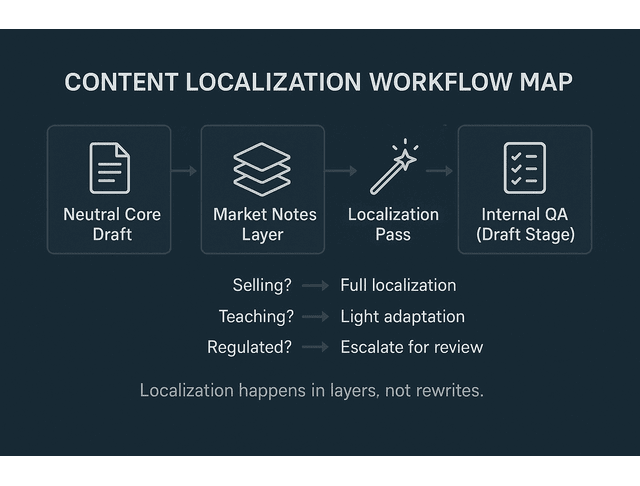
Once you know what to localize first, the next step is making localization predictable—so it doesn’t turn into endless edits.
Neutral Core Draft → Market Notes Layer → QA Pass
Think in layers, not rewrites:
Layer 1: Neutral Core Draft
Write the cleanest, most globally understandable version of the message. No slang. No culture-specific jokes. Clear nouns. Concrete promises.
Layer 2: Market Notes Layer
Add a short note set that tells you how this market reads. Keep it simple:
Market Notes Mini-Template
- Audience snapshot
- Tone level
- Trust cues
- “Do not use” list
- Preferred terms (glossary)
- CTA style
Sample Market Notes (Filled Example: Singapore, B2B SaaS Landing Page)
- Audience snapshot: Ops managers at mid-market companies; busy; practical; wants “prove it” clarity
- Tone level: Professional, direct, low-hype
- Trust cues: Client logos, quantified outcomes, short case proof, security/compliance mentions (when true)
- “Do not use” list: Heavy slang, aggressive urgency (“act now”), culture-specific jokes, sweeping guarantees
- Preferred terms (glossary): “demo” (not “free consult”), “pricing” (not “cost breakdown”), keep product name in English
- CTA style: Clear and transactional (“Book A Demo”), avoid overly casual (“Let’s chat!”)
Layer 3: QA Pass (Internal)
This QA pass happens during your localization workflow. It’s about catching meaning drift, claims changes, wrong formats, and mismatched examples before anything is “final.”
A realistic solo time box: 15 minutes market notes, 30 minutes localization pass, 10 minutes internal QA. That’s how you keep this skill profitable instead of draining.
Mini Before/After Example (Neutral Core → Localized)
Neutral Core Headline: “Reduce Reporting Time Without Adding Headcount.”
Localized (Singapore) Headline: “Cut Reporting Time Without Expanding Your Team.”
Neutral Core CTA: “Get A Free Consultation.”
Localized (Singapore) CTA: “Book A Demo.”
Why it changed: “Headcount” can be perfectly understandable, but “team” often reads cleaner and less HR-coded. “Free consultation” can sound salesy or vague; “Book a demo” is clearer and matches common B2B SaaS expectations.
When You Should Localize (Selling), Adapt Lightly (Teaching), Or Escalate (Regulated)
This is where most writers waste hours. Use a decision fork:
- Selling (Localize)
- Teaching (Adapt Lightly)
- Regulated (Escalate)
Selling (Localize): If the content asks for action—book a call, buy, subscribe, request pricing—localize the persuasion layer: benefits framing, urgency language, risk reversal, and proof style.
Teaching (Adapt Lightly): If the content is educational, keep the neutral core and swap only what’s likely to feel “foreign”: examples, references, phrasing cadence, a few trust cues.
Regulated (Escalate): If it touches finance, health, legal, safety, or strong outcomes/guarantees, treat localization as risk management. Escalation doesn’t mean “panic.” It means client review on claims, local review when stakes are high, and disclaimers adapted to local expectations (not copy-pasted).
AI-Assisted Draft Support for Content Localization Without Losing Voice
AI helps most when you use it like a production assistant—structured inputs, tight constraints. Use these prompts specifically at Layer 1 (Neutral Core) and Layer 2 (Market Notes Application).
Use two prompt modes.
First, neutralize: remove idioms and culture-bound phrasing while preserving meaning, preserving claims, and preserving brand terms. Then localize: apply market notes (tone, trust cues, CTA style) without intensifying promises.
Paste-Ready Prompt A (Neutralize First)
“Rewrite the copy below into a neutral, globally clear version. Remove idioms, slang, and culture-specific references. Keep the meaning identical. Do not add new claims, numbers, or guarantees. Preserve these exact terms: [PASTE GLOSSARY TERMS / DO-NOT-TRANSLATE LIST]. Copy: [PASTE TEXT].”
Paste-Ready Prompt B (Localize Using Market Notes)
“Localize the neutral copy below for [MARKET] using these market notes: [PASTE MARKET NOTES]. Keep meaning and claims identical. Do not intensify promises. Keep these exact terms unchanged: [PASTE GLOSSARY]. Output should match this brand voice sample: [PASTE 3–5 SENTENCES]. Copy: [PASTE TEXT].”
Voice lock mechanics: paste a short “voice sample” paragraph (something you or the client likes), add a Do/Don’t list (e.g., “Do: calm, direct, specific. Don’t: hype, slang, aggressive urgency.”), and add a mini glossary (product names, “do not translate” terms). This is how you get speed without producing generic copy.
Avoid Costly Mistakes in Content Localization

Most localization problems don’t come from “bad grammar.” They come from three predictable places: meaning drift, mismatched trust cues, and risky claims.
Common Localization Pitfalls: Slang, Idioms, And False Friends
Three common ways meaning breaks: idioms (confusing or awkward literal phrasing), slang (instantly dates the copy or makes it feel “trying too hard”), and false friends (words that look similar across languages/regions but shift meaning).
Beginner spot-check: scan headlines, CTAs, and promises for anything that can’t be read literally. If it can’t be literal, rewrite it into plain language first—then localize tone.
Trust Signals by Market: Credibility Markers, Formality, and Social Proof
Different markets don’t just “translate” trust. They signal it differently.
Common trust levers include certifications and standards, client logos and recognizable brands, measurable case proof, testimonials (where tone/formality varies), and media mentions. Tone calibration matters: in markets that expect formality, “friendly casual” can read as not serious; in markets that expect warmth, ultra-formal can read as cold or overly salesy. Proof localization matters too—sometimes swapping an example into a locally familiar context does more than rewriting a paragraph.
Mini Before/After Example (Proof Line, Neutral Core → Localized)
Neutral Core Proof: “Trusted By 200+ Teams Worldwide.”
Localized (More Formal Market) Proof: “Trusted By Over 200 Teams Across Multiple Regions.”
Neutral Core Proof: “See Why Teams Love Us.”
Localized (More Formal Market) Proof: “Read Customer Results And Implementation Outcomes.”
Why it changed: the first version leans promotional; the localized version keeps the claim but sounds more measured. The second shifts from “enthusiasm” to “evidence,” which can land better in markets that expect a more formal, proof-forward tone.
Local Compliance + Sensitivity: Finance, Health, Legal, And Claims
This is where writers get burned.
Risk management rules are simple: avoid absolutes (“guaranteed,” “always,” “no risk”) unless the client can legally support it, define conditions (“results vary,” “based on X,” “subject to eligibility”), and match local expectations for how claims are stated.
Safe rewrite pattern (quick and reliable): replace absolutes with conditions.
Example: “You will save 10 hours a week” → “Teams often save up to 10 hours a week, depending on workflow and adoption.”
Escalate when the copy implies medical/financial outcomes, includes strong guarantees, or the brand is entering a new region where reputational risk is high. Localization is not just “more accurate words.” It’s safer messaging.
Measure Impact and Scale Content Localization
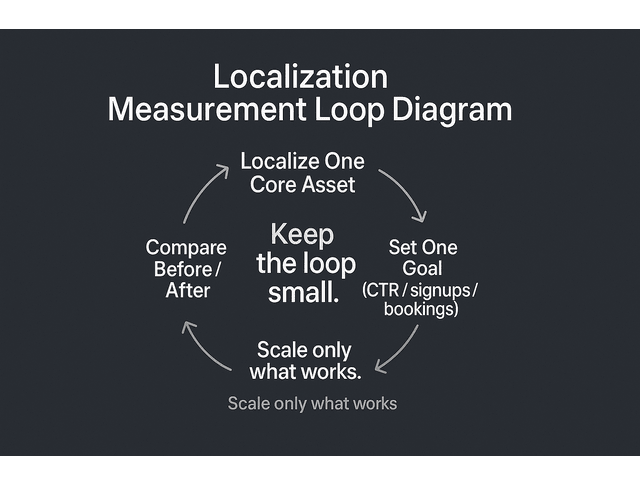
If you don’t measure, localization becomes a vibe. You want a loop you can run quickly—then improve over time.
Quick QA Checklist: Names, Numbers, Units, Dates, and Brand Terms
This is your final five minutes before publish—a last pass after the workflow QA above, right before the content goes live:
- Proper nouns (names, places, product features, brands)
- Numbers (prices, stats, dates)
- Units & formats (currency, metric/imperial, decimal separators)
- Links (right destination, right language)
- CTA targets (the page they land on matches the promise)
Mechanical mistakes are the easiest ones to prevent—and the fastest ones to create friction.
Lightweight Localization Stack: Glossaries, Style Guides, and Review Loops
You don’t need an enterprise stack to work like a pro. For solo writers, a minimal system wins.
Starter kit:
- Glossary doc
- Market notes doc
- QA checklist
Build your glossary fast: list the top 20 recurring terms in the project, add the approved equivalent per market (or mark as “keep in English”), then lock it and reuse it. Your review loop can be as lean as client sign-off on claims plus a native reviewer for high-stakes pieces, or an internal second pass for consistency.
Repurposing System for Faster Outputs With Content Localization
Scaling isn’t about doing “more localization.” It’s about turning one localized core asset into multiple outputs.
Across-assets strategy: localize one core asset (landing page section, key email, main offer page), then repurpose into 3–5 derivatives (LinkedIn post, short email, FAQ snippet, ad variations).
Now add a beginner-friendly measurement loop:
- 1 goal (CTR/signups/booked calls)
- 2 diagnostics (e.g., scroll depth, CTA clicks)
- Before/after comparison per market
Sample Measurement Set (Use This if You Don’t Want to Decide Yet)
- Goal: Email signups (or demo bookings)
- Diagnostics: CTA clicks + scroll depth to the form section
- Time frame: 14 days per market, then compare against the previous 14 days (or against the non-localized baseline)
Why bother? Because localization can materially change outcomes. A widely cited Appia test reported localized mobile ad creatives achieving 42% higher click-through rates and 22% higher conversion rates than the English versions in Germany, France, and Spain.
For a business-case anchor, Forrester’s Total Economic Impact hub for DeepL reports 345% ROI (commissioned study), which is a useful reminder that localization isn’t just “nice to have” when you operationalize it.
You don’t need perfect attribution. You need directionally clear wins you can repeat.
Final Thoughts
Content localization is not a bigger workload—it’s a smarter workflow. You start with a neutral core, layer market notes, localize what matters (headlines, CTAs, proof), and use a two-step QA habit: one pass during the workflow, one final five-minute check before publishing. The payoff is simple: fewer misunderstandings, stronger trust signals in-market, and a clearer path to measurable lifts when you scale what works.
If you want more step-by-step frameworks like this—plus ready-to-use templates and AI prompts you can drop into your workflow—visit my Amazon Author page and choose the book that fits what you’re building next.
Frequently Asked Questions About Content Localization
A website localization strategy is your plan for adapting language, tone, formats (currency/dates/units), and cultural cues so the site feels native to each target market—not merely translated.
Start with your revenue-driving pages. Write a neutral core draft, apply market notes for tone and trust cues, then run final QA on numbers, formats, links, and CTAs.
It can, because culturally appropriate language and market-fit phrasing can improve relevance and engagement. It works best when paired with international SEO basics like market-specific keyword research, clear language targeting (often via hreflang), and language-appropriate pages that aren’t just auto-translated.
It depends on volume, number of languages, and review depth. A practical approach is to localize the pages that drive conversions first, then expand after you validate demand.
Translation converts language while preserving meaning; localization also adapts cultural context and non-text elements—like formats, examples, and trust signals—so the content feels designed for the market.

Florence De Borja is a freelance writer, content strategist, and author with 14+ years of writing experience and a 15-year background in IT and software development. She creates clear, practical content on AI, SaaS, business, digital marketing, real estate, and wellness, with a focus on helping freelancers use AI to work calmer and scale smarter. On her blog, AI Freelancer, she shares systems, workflows, and AI-powered strategies for building a sustainable solo business.