
If you’ve ever opened your feed “for five minutes,” looked up, and realized you’ve just lost half an hour, this is why you feel behind. AI news is constant, repetitive, and often packaged as urgent. You don’t need more tabs. You need the best AI news sources that filter the noise and give you a clear signal you can use for decisions, content, and client work.
One reason newsletters still work for busy people: They’re a “push” instead of a “pull.” HubSpot reports that as of 2025, the average email open rate across industries is 42.35%, suggesting that curated inbox content can still win attention when it earns trust.
Best AI News Sources for People Who Don’t Have Time to Chase AI
AI news isn’t failing you because it’s “too much.” It’s failing you because it shows up unfiltered, mixed with hype, and wrapped in urgency you didn’t ask for. When you’re already at capacity, the wrong sources don’t keep you informed; they keep you distracted. The goal here is simple: pick a small set of sources that gives you a signal you can actually use.
Everything I’ve shared here—and more—is in my book, available on Amazon. Click the link if you’re ready to take the next step.
The Real Problem Isn’t Information. It’s Filtering.
Most people don’t have a “staying informed” problem. They have a filtering problem.
Why Your Brain Hates the Feed
A 2025 study introducing the Information Overload and Information Appreciation Scale found that appreciation for abundance was about twice as common as overload across news, entertainment, and personal communication (N = 2,049). That’s the point: Unmanaged information is the problem, not volume.
What This Post Will Help You Do
Here’s the simplest approach: Select a few sources with real editorial judgment, then put them on a schedule that protects your attention—so continuous learning doesn’t turn into constant scrolling.
How to Choose the Best AI News Sources for Business and Content
If you follow “AI news” in general, you’ll spend your week reading updates that don’t change your work, your strategy, or your writing. The fix isn’t another tab; it’s choosing sources based on what you need them to do: support decisions, fuel thought leadership, or speed up research. Once you pick by use case, the noise drops fast.
Choose the Best AI News Sources by Use Case, Not Popularity
Following “AI news” broadly is how you end up with a feed full of tool launches you’ll never use. Choose sources based on what you need the information for.
What You Need: Credible Context You Can Reuse
You want strong editorial framing and context you can cite without sounding like you’re repeating headlines. This is where established editorial outlets consistently outperform “daily roundup” accounts.
What You Need: Signal With Outputs Attached
You want updates that translate into action: what’s changing, what it affects, and what to do next. You also prefer sources that shorten research time and hand you clean inputs (original links, summaries, implications).
To sanity-check any source before you subscribe, look for these quality signals:
- Consistent cadence (weekly beats daily for most busy professionals)
- Links to primary sources (papers, official blogs, docs)
- Clear separation between reporting vs opinion
- Editorial judgment (real selection, not automated link dumping)
A Curated Shortlist You Can Actually Use (Pick 3)
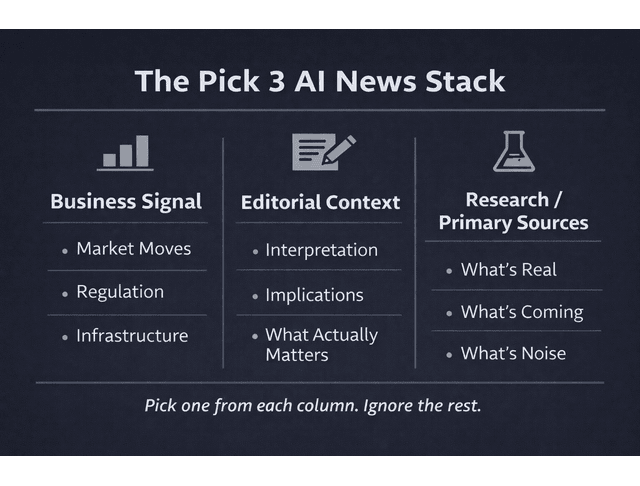
A long subscription list won’t help. A small mix will—one that covers business signal, credible editorial context, and research reality. Use this simple rule so you don’t overthink it: pick 1 business outlet, 1 editorial digest, and 1 research or primary-source channel. If you want a default starter stack: Reuters + The Algorithm + The Batch.
With those signals in mind, here’s a shortlist that consistently delivers high signals.
- Reuters — Artificial Intelligence hub (Business signal, minimal fluff.)
Use it once or twice a week to spot what could affect budgets, tools, regulations, or customer expectations. - Financial Times — Artificial Intelligence hub (Business + strategy context.)
Use it when you want the “so what” behind AI moves in the economy and enterprise—and when you need a strong source to cite in public content. - Financial Times — The AI Shift (Work and productivity implications.)
Use it when you want grounded angles about how AI changes roles, teams, and productivity—without getting stuck in tool chatter. - MIT Technology Review — The Algorithm (Editorial judgment, weekly cadence.)
Use it as an “anchor source” for clear framing and responsible coverage. - DeepLearning.AI — The Batch (Research + industry, readable.)
Use it as a weekly scan for credible inputs and links to primary sources without having to read papers all day. - Import AI (Jack Clark) (Research digest with interpretation.)
Use it when you want depth and nuance without getting lost. - Official Google AI news and updates (Product updates straight from the source.)
Use it when you’re making platform and tool decisions and want the information from the origin. - Google Research Blog (Research direction, not marketing.)
Skim monthly—or when you’re building a deeper piece and want to understand where the field is heading. - MIT News — Artificial Intelligence topic page (Credible institutional reporting.)
Use it when you want university-grade explainers and research coverage that’s easier to cite than a random thread.
Using the Best AI News Sources Inside a Weekly Workflow
A list of links won’t save you time. A system will. The difference between “I try to keep up” and “I stay current” is having a repeatable way to scan, capture, and convert AI updates into output, one client note, one post, one decision, without disappearing into a feed.
Why Most “Top Sources” Posts Don’t Help
Most posts hand you links and move on. That’s not the hard part. The hard part is staying informed without adding another task to your week.
The 15-Minute Scan (Once or Twice a Week)
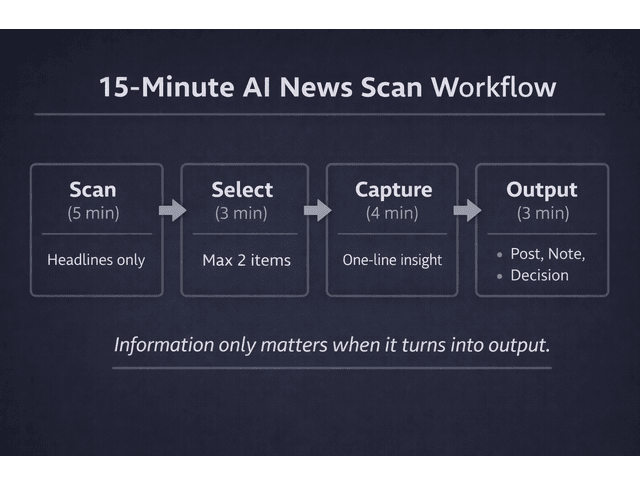
Here’s a workflow that works because it’s small enough to keep:
- Pick two “signal” sources (one business-facing, one research/editorial).
- Skim headlines only, then open at most two items that affect your work right now.
- Capture one line per item: what changed, who it affects, and what people will misunderstand.
- Turn that into one output: a client insight, a post angle, or a decision note.
Turn News Into Thought Leadership Without Rewriting Headlines
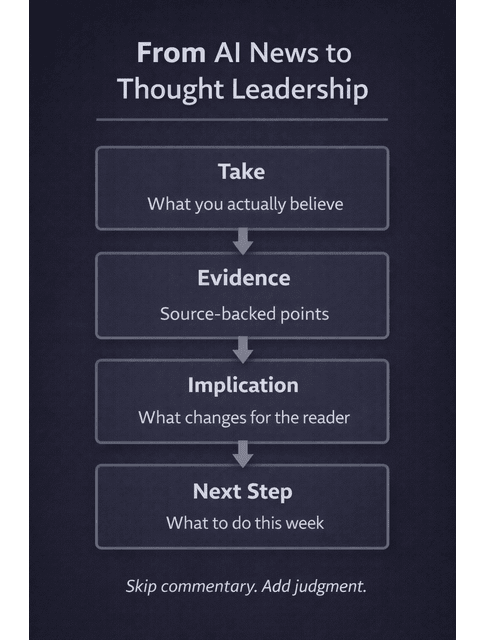
When you need to turn AI news into content fast, without rewriting headlines, use this structure:
- Take: one sentence you actually believe
- Evidence: 1–2 bullets from the source
- Implication: What does this change mean for your audience?
- Next step: what you’d do this week
This is how you publish credible content that feels like leadership, not commentary.
And the “stay current” pressure is only getting heavier. Microsoft’s 2024 Work Trend Index reported that 75% of global knowledge workers are using AI at work, which makes filtering and workflow even more important, because the signal-to-noise problem won’t slow down.
This is the exact routine I use when I’m busy and still need clean inputs for posts, decisions, or client work—small scan, one capture, one output.
A Worked Example (So You Can See the System)
Here’s what “scan → capture → output” looks like in practice.
A Reuters piece (business-facing signal) reported that AI demand is driving data-center dealmaking to record highs, based on a report Reuters cited.
A one-line capture might be: “Infrastructure is the bottleneck story again—expect rising costs and vendor pressure; plan budgets and timelines accordingly.”
Another capture might be: “The next wave of AI advantage won’t come from prompts; it’ll come from who can afford compute and deploy reliably.”
Another capture might be: “Angle: ‘AI isn’t free; here’s what the infrastructure shift means for timelines, pricing, and expectations.’”
That’s enough to write a clean LinkedIn post or a client note without spiraling into ten more tabs.
Avoiding Burnout While Staying Informed With the Best AI News Sources
Staying informed shouldn’t feel like another job. The smartest move is to shrink your inputs to a few trusted sources, put them on a schedule, and ignore everything that doesn’t change your next quarter.
Stop Confusing “Current” With “Constant”
The trap is thinking “staying current” means “tracking everything.” It doesn’t. It means building a small, repeatable input stack.
A Source Stack That’s Actually Sustainable
For most people, you can stay ahead with a short setup like this:
- 2 newsletters (one business-facing, one research/editorial)
- 1 primary-source channel (official product/research updates you trust)
- 1 business news source (for market moves and context)
Know What to Ignore (So You Can Keep Shipping)
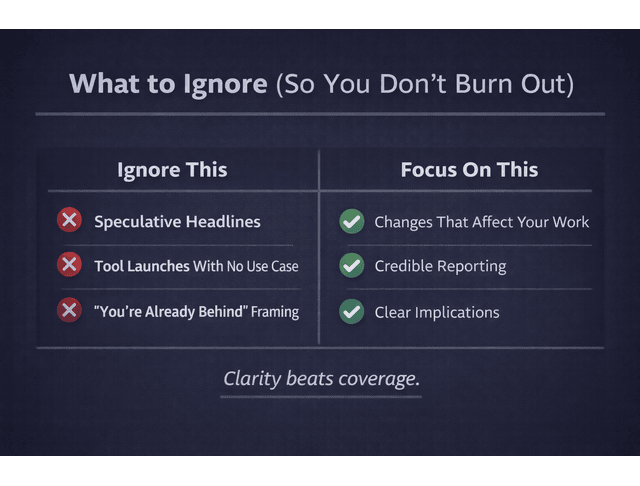
If your source stack makes you anxious, it’s not keeping you informed; it’s draining your capacity. A good stack should make you feel clearer after 10–15 minutes, not more behind.
You’ll also stay calmer if you learn what to ignore. If an item doesn’t change your work this quarter, is mostly speculative (“could,” “might,” “soon”), or is a tool launch with no clear use case, let it pass. Your audience doesn’t reward you for being early. They reward you for being clear.
Final Thoughts
The point of following the best AI news sources isn’t to become an AI commentator. It’s to protect your time while staying credible and making better calls, whether you’re publishing thought leadership, running a business, or delivering client work on tight deadlines.
Pick a small source stack. Put it on a schedule. Turn what you read into output.
If you want a calmer way to stay current and turn what you read into output, check out my books on my Amazon Author Page. You’ll find practical workflows, prompts, and systems you can plug into your week, so you spend less time chasing updates and more time shipping. (Disclosure: this links to my books.)
Frequently Asked Questions About the Best AI News Source
This comes up constantly because people want one “default” pick. The practical answer is to choose by use case: editorial clarity, business implications, or research-to-reality summaries.
The best source depends on your interests, and that’s why the strongest setup is usually a small mix: a business-facing outlet plus a research/editorial digest.
Reduce inputs and add a small output habit. Two sources, one scan session, one captured insight, and one published note weekly. That’s how “keeping up” turns into something you can actually maintain.
Look for newsletters that explain impact and application, not just model releases. If you can’t turn what you read into a decision, a post, or a useful note, it’s not for you.
This question shows up frequently in newsletter roundups and FAQ-style lists. The most reliable test is the same for any daily digest: does it link to originals, separate news from takes, and consistently produce usable insights for your work?

Florence De Borja is a freelance writer, content strategist, and author with 14+ years of writing experience and a 15-year background in IT and software development. She creates clear, practical content on AI, SaaS, business, digital marketing, real estate, and wellness, with a focus on helping freelancers use AI to work calmer and scale smarter. On her blog, AI Freelancer, she shares systems, workflows, and AI-powered strategies for building a sustainable solo business.