
If you’re building a career around AI—but you’re not a developer—you can get stuck in a frustrating middle zone: you’re close enough to see how fast things are moving, but not connected enough to benefit from the rooms where decisions and opportunities are made. AI networking events can change that quickly, without you having to pretend you’re technical.
One data point makes the stakes clear: LinkedIn reported that nearly 80% of professionals consider networking important to career success, and 70% of people in 2016 were hired at a company where they had a connection.
This guide is written for non-technical pros who still want to “belong” in AI—writers, consultants, coaches, strategists, operators, marketers, and founders—without pretending to be something they’re not. Here’s how to pick the right events and use industry forums to turn first conversations into real relationships.
Everything I’ve shared here—and more—is in my book, available on Amazon. Click the link if you’re ready to take the next step.
AI Networking Events for Non-Technical Professionals
You’re not “behind” because you can’t talk model architecture. You’re behind because the people who trade opportunities—referrals, collaborations, inside invites—aren’t in your inbox. They’re in rooms. If you’re a consultant, coach, writer, or operator working around AI, your leverage comes from being the person who makes AI usable, understandable, and actionable. AI networking events aren’t about pretending to be technical—they’re about getting close to the people who need what you already do well.
- AI networking events are leverage, not a social activity: use them to earn collaborations, referrals, clients, and authority.
- Your edge isn’t code—it’s translation (messaging, enablement, positioning, adoption support).
Your Edge Isn’t Code—It’s Translation
AI teams and AI-adjacent businesses still need clear messaging, customer education, positioning, documentation, and enablement, content that doesn’t sound like a robot wrote it, process design, and operational clarity. That’s not “nice to have.” That’s revenue and adoption.
A quick clarity shift that helps in almost any room: lead with the same outcome-based line you’ll use later—“I help [role] achieve [result] without [risk].”
What “Counts” as AI Networking (It’s Not Just Big Conferences)
When you think about where networking actually happens, it helps to see it in three buckets. There are large AI conferences that offer broad exposure and big-room credibility (but also higher noise). There are industry conferences with AI tracks that tend to be tighter in relevance and often easier for non-technical professionals to meet buyers. Then there are local meetups and community events, where the relationship density is usually the highest because you see the same people repeatedly.
To make this immediately usable, here’s a simple “event discovery stack” (so you’re not stuck guessing where to look):
- Meetup (topic pages + local groups): start broad, then narrow by city and interest.
https://www.meetup.com/topics/ai/ - Eventbrite (local + online AI events): helpful for scanning what’s happening this month and what formats exist.
https://www.eventbrite.com/d/online/ai/ - IEEE conference calendars / IEEE AI events: good for higher-signal, research/industry crossover rooms where credibility is built fast.
https://cis.ieee.org/conferences/conference-calendar
https://www.ieeesmc.org/cai-2026/ - Flagship conference sites (for “where serious AI people gather”): even if you don’t attend, these help you map the ecosystem and the adjacent workshops.
https://neurips.cc/
Use this stack in 10 minutes: scan Meetup/Eventbrite for two plausible events, then shortlist them and score them with the rubric in Section 2.
How to Talk About What You Do (Without Apologizing)
An outcome-based frame keeps you from sounding either vague or overly technical. One simple approach is: “I help [role] use AI to achieve [outcome] without [risk].” For example: “I help consultants turn AI tools into consistent weekly thought leadership without losing their voice,” or “I help founders explain their AI product so customers actually understand it—and buy.”
If you want one more line that makes you stick, add a concrete deliverable.
“I help [role] achieve [outcome]—usually through [deliverable], delivered in [timeframe].”
Choosing the Right AI Networking Events for Authority Building
Not all events are networking events—some are expensive spectator sports. You sit, you listen, you collect a tote bag, and you go home with the same problem you started with: no new relationships that move your work forward. Choosing the right event is the first act of authority. The right room gives you decision-makers, structured conversations, and context you can turn into credibility. The wrong room gives you noise and LinkedIn photos.
- Choose events for “room ROI”: audience quality + structured networking + practical content + side events.
- Non-technical professionals often win in “adjacent rooms” (AI in marketing/ops/CS/founders) where buyers show up.
Use a “Room ROI” Filter Before You Register
Use this scorecard. Score each event 0–2 on each line:
- Audience fit (are your people there?)
- Buyer/decision-maker density
- Structured networking (roundtables, office hours, working sessions)
- Practicality (real deployments, real constraints, real lessons)
- Side events (dinners, meetups, after-hours)
Quick rule: 8–10 = attend, 6–7 = attend only if local/cheap, ≤5 = skip.

Prefer “Adjacent” Rooms if You Sell Services
If you’re a writer, consultant, or coach, you’ll often do better in rooms where AI shows up as a tool inside a function. AI in marketing, sales, customer success, operations, productivity, HR, L&D, SMB communities, and founder circles tend to contain people actively buying help. You’re not fighting to prove you’re technical—you’re demonstrating you understand outcomes and adoption.
The simplest way to pick the best adjacent room is to ask: “Where would someone already be budgeted to solve this problem?” Those rooms are where your services convert without you forcing it.
Why In-Person Still Wins for Relationship-Building
If you feel guilty spending time (and money) on events, anchor it to reality: Bizzabo’s 2025 benchmarking report found that 78% of organizers consider in-person events their organization’s most impactful marketing channel (and 80% say these events are critical to success).
Translation: the people you want to meet are still showing up—because it works.
How to Prepare Before Attending AI Networking Events
Walking into an AI conference “to network” is like opening a blank doc and hoping a great draft appears. The people who leave with real traction don’t wing it—they arrive with a clear angle, a short list of who they want to meet, and questions that make others feel understood. Preparation isn’t extra work; it’s how you protect your time.
- Prep is the difference-maker: build a short “who to meet” list (10 people) instead of wandering.
- Bring 3 strong conversation starters that invite stories and reveal real needs.
- Have a one-line, outcome-based offer so people can place you and refer you later.

Build a 10-Minute “Who to Meet” List
Do this the day before. Pick a handful of speakers you genuinely want to learn from, a handful of attendees or companies you want to connect with, and a few community leaders (organizers, moderators, volunteers). Your goal isn’t to meet everyone. It’s to meet the right few people who can change what happens next.
Make it more specific by labeling each target with one reason:
- “Potential collaborator”
- “Potential referrer”
- “Buyer / decision-maker”
- “Someone I want to learn from”
That single tag prevents random wandering.
Prepare 3 “Non-Cringe” Conversation Starters
Bring questions that invite stories and surface real needs: “What are you building—and what part is harder than expected?” “Where are you seeing AI adoption actually stick inside companies?” “What’s one thing you wish non-technical teams understood about your work?” Questions like these work because they don’t require you to demonstrate technical knowledge, and they naturally lead to the problems you can help solve.
Use the next set as diagnostic questions once the conversation is already moving:
- “What does success look like for you in the next 90 days?”
- “Where does the work get stuck—people, process, or proof?”
- “What’s the hardest part to communicate internally?”
- “What are customers misunderstanding most?”
- “If you could wave a wand and fix one workflow, what would it be?”
Create a One-Line Offer (So People Can Place You)
You want a sentence people can repeat later. Something like: “I help [type of business] turn AI capabilities into clear content, onboarding, and client-facing messaging.” The point is not to “sell.” The point is to be easy to remember and easy to refer to.
A small upgrade: add your “proof cue” (without bragging).
“I do this through [deliverable], and it’s designed to reduce [pain].”
Turning AI Networking Events Into Long-Term Opportunities
Most networking dies in your notes app. You meet someone smart, you promise to follow up, and then client work takes over—so the connection fades into “nice chat.” The difference between a pleasant conversation and a real opportunity is what happens in the next 72 hours.
A good follow-up is proof you listened, a useful next step, and a quiet signal that you’re the kind of professional people want in their circle.
- Follow up within 72 hours with specifics + a useful next step (not a pitch).
- Turn one event into 3 weeks of content to reinforce authority and stay top-of-mind.
- Create tiny collaborations (Q&A, recap post, shared checklist) to make relationships real quickly.
The 72-Hour Follow-up That Doesn’t Feel Salesy
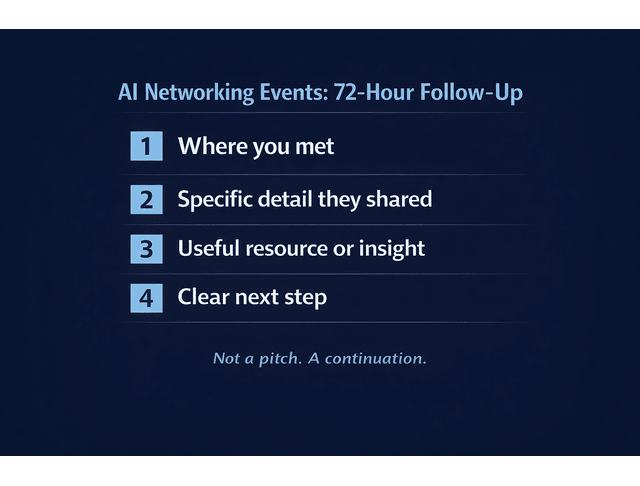
A clean follow-up has four parts: remind them where you met, mention one specific detail they shared, share one useful resource if it fits, and offer one clear next step. For example: “Loved your point about internal adoption being the real bottleneck. If you’re open, I’d love to trade notes on how you’re packaging that message for non-technical teams—15 minutes next week?”
Two permission lines that keep it low-pressure:
- “Would it be useful if I sent you a quick one-page outline?”
- “Want me to share a template I use for this?”
Turn 1 Event Into 3 Weeks of Content (Authority on Autopilot)
Post one insight you learned, one myth the event challenged, and one “here’s how I’d apply this” takeaway for a founder, consultant, or operator. If you’re an Authority Builder, this is how you stay top-of-mind without spamming your network—your content becomes the second touchpoint that makes the relationship stick.
A simple cadence that doesn’t overwhelm you:
- Day 1: “What I noticed.”
- Day 4: “What people are getting wrong.”
- Day 8: “A practical framework you can steal.”
Make the Relationship Real With a Tiny Collaboration
Low-lift collaborations make you memorable fast. Invite someone to a short LinkedIn Q&A. Offer to summarize their talk into a clean post they can share. Propose a small joint resource—something like an “AI adoption checklist for non-technical teams.” These aren’t big commitments; they’re small bridges that turn “nice meeting you” into “we should do something together.”
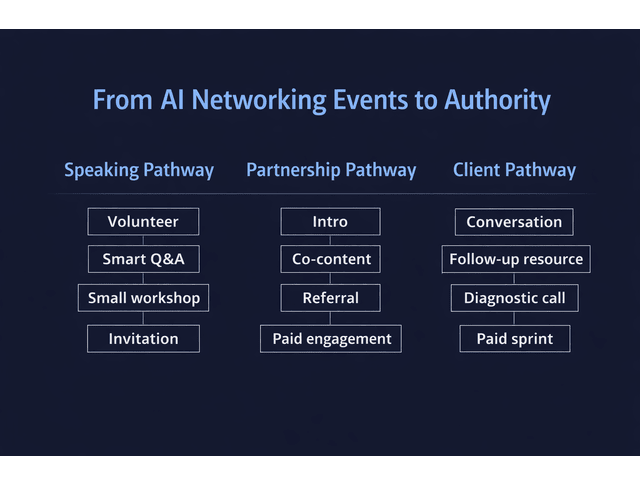
If you’re aiming for authority, here are three “pathways” that often start at events:
- Speaking pathway: volunteer → ask a smart question in Q&A → propose a small workshop → get invited
- Partnership pathway: intro → co-content → referral → paid engagement
- Client pathway: conversation → follow-up resource → short diagnostic call → paid sprint
Final Thoughts
If you’ve been trying to build credibility in AI from behind a screen, you’re not doing it wrong—you’re just missing the relationship layer that makes opportunities move faster.
AI networking events work when you stop treating them like a social task and start treating them like a business system: pick the right rooms, show up prepared, and follow up like a professional.
One more useful signal: MarketingProfs reported that 54% of B2B event attendees planned to attend more in-person events in 2025 than in 2024.
If you want more practical, writer-friendly systems for building authority (without burning out), check my Amazon Author page.
Frequently Asked Questions About AI Networking Events
Yes—if your work touches adoption, communication, positioning, enablement, or implementation. Your goal is relationships, not technical validation.
Search Meetup for “Artificial Intelligence” groups, local tech community calendars, university event listings, and LinkedIn Events.
Pick 2–3 sessions with Q&A, attend 1 structured networking block, and plan 5 targeted conversations instead of chasing volume.
Use a simple outcome-based line: “I help [role] use AI to achieve [result] without [risk].” Then ask them what they’re building.
Within 72 hours, while the conversation is still fresh and before the “nice to meet you” memory fades.
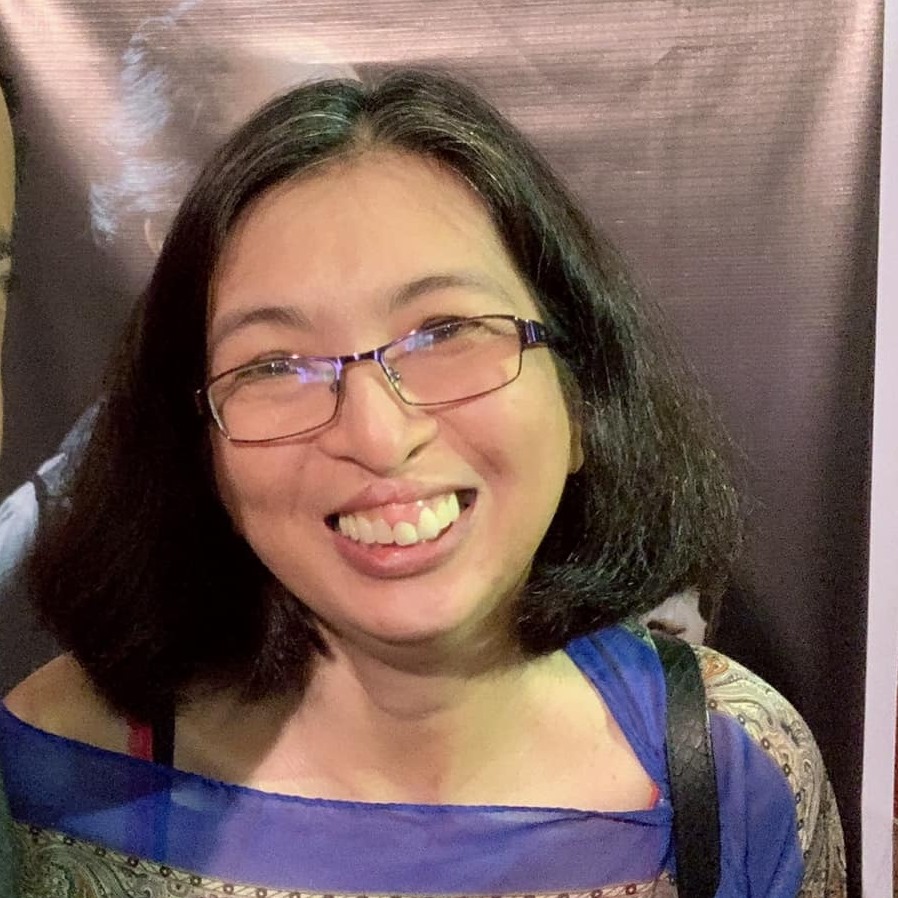
Florence De Borja is a freelance writer, content strategist, and author with 14+ years of writing experience and a 15-year background in IT and software development. She creates clear, practical content on AI, SaaS, business, digital marketing, real estate, and wellness, with a focus on helping freelancers use AI to work calmer and scale smarter. On her blog, AI Freelancer, she shares systems, workflows, and AI-powered strategies for building a sustainable solo business.