
AI events are loud. Your calendar fills, your brain overloads, and you end up with a phone full of new contacts you’ll never message because you can’t remember why you met them. That’s exactly why AI conference networking tips need to be a system, not “be confident and put yourself out there.” If you’re trying to build authority, generate deal flow, or turn visibility into paid work, the goal is simple: leave with clear next steps you can execute in under an hour.
Everything I’ve shared here—and more—is in my book, available on Amazon. Click the link if you’re ready to take the next step.
Why AI Conference Networking Tips Matter for Solo Operators

Most people don’t fail at networking because they’re awkward. They fail because they treat networking like a social activity instead of a pipeline activity.
Here’s the reality: A huge portion of opportunities never show up in public listings. Many positions are never advertised (the “hidden job market”); you often only hear about them through people in the field or inside the company.
AI conferences amplify this dynamic because:
- Decision-makers show up in person (founders, heads of product, partners, operators)
- “Weak ties” form faster (a single conversation can become a bridge)
- The room is already filtered for shared interests (AI adoption, tooling, strategy, implementation)
What actually matters is whether a conversation produces permission, a topic, and a channel for follow-up. That is the unit of success.
Before the Event: AI Conference Networking Tips for Strategic Prep
If you arrive without a target list and a conversation plan, you’ll spend the event reacting instead of choosing. Prep fixes that.
Time-box your prep to 45–60 minutes, and walk in with three outputs:
- Targets
- Your angle
- Your follow-up plan
If you have a full hour, build your target list from three places:
- The agenda (track owners, panelists, workshop leaders)
- The sponsor list (often closer to budget and implementation)
- The speaker list (strong for authority and collaboration angles)
When you do not have an attendee list:
- Pick 5–10 people you know will be there (speakers, sponsors, organizers)
- Define the type of introduction you want to receive
- Choose sessions where that type of person is likely to sit
If you only have 15 minutes, do the minimum:
- Choose three Tier 1 targets
- Write one positioning line
- Write two questions you’ll ask everyone
AI Networking Tips for Choosing the Right People to Meet
Build a 3-tier target list so you don’t “network randomly”:
- Tier 1 (Must meet): 5 people max
- Tier 2 (Nice to meet): 10 people max
- Tier 3 (Skip): everyone else, even if they’re interesting
Fast filters:
- Can they buy, partner, refer, or amplify?
- Are they close to your lane (AI + your industry)?
- Would you feel comfortable following up within 48 hours with a clear ask?
When you’re unsure, choose proximity to ownership. People responsible for rollout and decisions usually create more follow-through than people who collect ideas.
Prep Smarter With AI Conference Networking Tips That Save Time
Write a positioning line that is not a pitch. One sentence is enough:
- Who you help
- What outcome you drive
- What you’re focused on right now
Then prep three openers:
- Curiosity: “What are you building or shipping this quarter?”
- Implementation: “Where is adoption breaking down right now?”
- Collaboration: “If there’s overlap, what would be worth doing next?”
Career guidance from sites like Indeed consistently emphasizes researching the event and setting goals before you arrive, not improvising in the room.
Now you’re walking in with targets and questions. Next is execution.
During the Event: AI Conference Networking Tips That Prevent Wasted Conversations

Most conversations die because they never move from “interesting” to “actionable.” Your job is to cross that line quickly and politely.
Use this simple protocol:
First Minute: Confirm relevance
Ask what they’re focused on now, not their title.
Third Minute: Locate overlap
Listen for constraints: time, headcount, budget, workflow friction, or go-to-market pressure.
Sixth Minute: Secure a next step or exit
If there’s overlap, get permission to follow up with one specific item and confirm the channel. If there isn’t, exit cleanly.
This works because conferences are a weak-tie factory. A large-scale experiment using data from 20 million LinkedIn profiles shows that weak ties can be more effective for job mobility than strong ties.
You don’t need depth in the room. You need clarity.
Use implementation-focused questions to keep conversations grounded:
- “What’s the biggest blocker right now: behavior, workflow, or data?”
- “Where does the process break most often?”
- “What would success look like in 30 days?”
- “Who owns the decision for this?”
- “What’s the constraint: speed, accuracy, cost, or compliance?”
Two signals to disengage:
- The conversation stays at “cool models” with no owner or use case
- No one can name a concrete next step
Using Networking Tips to Capture Context in Real Time
Your notes are the bridge between a good conversation and a follow-up that lands.
Capture only five fields and stop:
- Who: name, role, company
- Now: what they care about
- Overlap: where you might help or collaborate
- Next step: what was agreed
- Anchor detail: one human detail (optional)
Statistical analysis in the same research found the effect of weak ties is nonlinear, with “moderately weak ties” often most beneficial.
Once those notes are captured, follow-up becomes a simple sorting and sending task.
After the Event: AI Conference Networking Tips for Follow-Up That Converts
Follow-up is where conference ROI is won or lost.
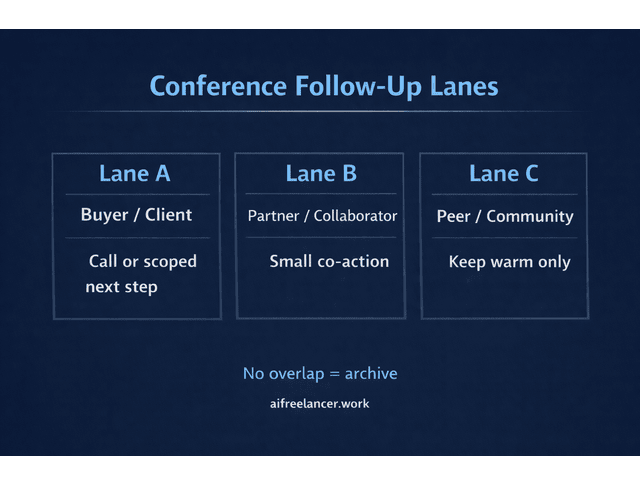
Sort contacts into lanes:
A: Buyer/client
One concrete next step: call, intro, or scope check.
B: Partner/collaborator
One small co-created action: shared notes, a short co-post, a quick brainstorm.
C: Peer/community
Keep warm with a lightweight share or connection.
A common recommendation is to follow up within 24–48 hours while the interaction is still fresh.
Use a simple structure, so you don’t overthink it.
A
- Reference the constraint discussed
- Share one relevant idea or resource
- Propose a short next step
B
- Reference their insight
- Suggest a small collaborative angle
- Propose a brief call
C
- Reference the conversation
- Share something useful
- No ask required
If there’s no overlap and no next step, archive the contact. That’s not rude. It’s how you protect attention.
How to Turn AI Conference Conversations Into Authority, ROI, and Time Protection
Use the same system, but choose your emphasis:
- Authority: capture publishable insights and examples you can reference publicly
- ROI: prioritize Tier 1 targets and Lane A follow-ups; track booked calls, intros, and qualified leads
- Time protection: keep the workflow lean and only follow up when there’s overlap and a next step
A simple scorecard is enough:
- Tier 1 conversations completed
- Next steps secured
- Follow-ups sent within 48 hours
- Calls or intros booked
Final Thoughts
The best AI conference networking tips aren’t about being more outgoing. They’re about running a repeatable system: target → talk → capture → follow up. Do that consistently, and conferences stop being exhausting and start producing outcomes.
If you want more workflow-first systems like this—templates, checklists, and practical guides you can apply without adding chaos—visit my Amazon Author page to explore my books on AI-powered workflows and authority-building writing systems.
Frequently Asked Questions About AI Conference Networking Tips
Use a simple structure: confirm relevance, find overlap, then secure permission to follow up with a specific topic. Structure reduces awkwardness because you always know what’s next.
Ask questions that reveal focus and constraints, like what someone is working on now, what’s blocking execution, and what would count as success in the next 30 days.
Within 24–48 hours is commonly recommended so your message lands while the context is fresh.
Reference the specific discussion, share one relevant idea or resource, and propose a small next step. Keep it tied to what you already discussed.
Prep a short target list, show up with two strong questions, capture context fast, and run follow-ups by lane. That’s how conversations turn into outcomes instead of a dead contact list.

Florence De Borja is a freelance writer, content strategist, and author with 14+ years of writing experience and a 15-year background in IT and software development. She creates clear, practical content on AI, SaaS, business, digital marketing, real estate, and wellness, with a focus on helping freelancers use AI to work calmer and scale smarter. On her blog, AI Freelancer, she shares systems, workflows, and AI-powered strategies for building a sustainable solo business.