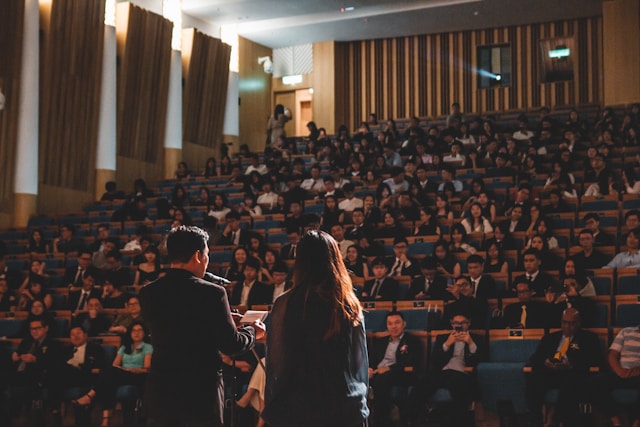
You don’t need another conference badge. You need a return. Because the frustrating part isn’t paying for the ticket; it’s spending two full days listening, taking notes, and coming home with nothing you can use. Nothing moved forward: no deals, no drafted content, no partnerships started. Just a dusty notebook and a “we should stay in touch” thread that dies quietly. These AI conference tips are built for two people: The consultant trying to build authority and the founder trying to turn events into pipeline, partnerships, and content fast.
Everything I’ve shared here—and more—is in my book, available on Amazon. Click the link if you’re ready to take the next step.
Before the Event: AI Conference Tips for Strategic Positioning
Most people show up to AI conferences with a hopeful plan: attend a few sessions, talk to a few people, “see what happens.” That’s how you end up with a full schedule and nothing to show for it. If you’re a founder or consultant, you need a different approach: one that starts with outcomes, not attendance, so every session and conversation is chosen with purpose.
Define Outcomes Beyond Attendance

Most people plan a conference like a buffet: “I’ll see what looks good.” That’s how you leave with scattered ideas and zero usable output.
Instead, decide your outcome first:
- Authority outcome: You want to be remembered as “the person who gets it.”
- Content outcome: You want enough material for a month of posts.
- Pipeline outcome: You want conversations that lead to next steps.
- IP outcome: you want patterns you can turn into a framework or guide.
Pick one primary outcome and one secondary outcome, then set a measurable target (example: “Leave with 5 content-ready insights and 3 follow-up calls booked.”). If you’re wondering whether this level of intention matters, LinkedIn reported that almost 80% of professionals consider professional networking important to career success.
Use AI Conference Tips to Pre-Plan Visibility, Not Schedules
A full calendar can still be a waste of time if you’re invisible.
Your job is to identify one “anchor session” per day where you’ll create a visible moment (questions, introductions, workshop participation). Think of visibility as being remembered by the right people, not being loud. That’s how you become memorable without being on stage.
Two simple filters when choosing sessions:
- “Will this help me create a point of view I can publish?”
- “Will this room contain the people I need to be remembered by?”
This shift, from consuming to being seen, matters because attention is the real currency at conferences.
Once you’re filtering sessions this way, you also need a skip list.
What to skip (so you don’t waste the day):
- Skip sessions you can get as a recap later, unless the speaker is someone you need to meet.
- Skip back-to-back sessions with no breaks; breaks are where the conversations happen.
- Skip collecting contacts without a next step. If there’s no next step, it’s just a name in your phone.
Research Attendees and Speakers With AI-Assisted Prep
Keep it small and tactical.
- Build a hit list of 10 people max (speakers, moderators, founders, program leads, potential partners).
- Write two positioning lines you can repeat all week: what you do, who you do it for, and what result you create.
Example: “I help consultants turn expertise into structured content and a clear point of view, so their content builds demand, not just engagement.”
Example: “I’m focused on using AI to reduce content and ops bottlenecks, so marketing output increases without adding headcount.”
If you want the prep to take 20 minutes instead of two hours, use AI to compress your research: paste the conference agenda and speaker list into your AI assistant and ask it to (1) flag sessions aligned to your outcome, (2) summarize each speaker’s current focus, and (3) suggest two smart questions per anchor session.
Output from this phase: Positioning lines, session filter, attendee hit list
Now you’re not browsing; you’re executing.
During the Event: AI Conference Tips That Build Authority in Real Time
This is where most people disappear. They sit quietly, take polite notes, and leave the room unchanged and unremembered. The goal isn’t to talk to everyone. It’s to create a few high-signal moments that make the right people remember you, trust your thinking, and want to continue the conversation after the event.
Ask Questions That Signal Expertise, Not Curiosity

A good question doesn’t sound smart; it reveals decision-making.
Prepare 2–3 questions that connect implementation, outcomes, and trade-offs. The goal is to surface what most people are too vague to ask.
Use questions like:
- “What’s the most common failure point when teams implement this, and what would you do differently in week one?”
- “If you had to choose between accuracy, speed, and cost for this workflow, which trade-off usually wins in the real world?”
The right question does more than get you an answer. It makes you memorable, opens the door to a post-session conversation, and gives you a quote-worthy insight you can turn into content.
Here’s what this looks like in real life: imagine you’re in a workshop where everyone is excited about automating support or content operations. Most attendees ask, “What tools do you recommend?” You ask, “Where does this usually break in production: handoffs, data quality, or review?” The speaker answers with a specific failure point and a practical workaround. After the session, you can walk up and say, “That failure point is exactly what I’m seeing too; can I send you a quick write-up of the checklist we use?” That’s not networking. That’s authority.
AI Conference Tips for High-Leverage Conversations
Stop trying to “network.” Start trying to earn the next steps.
Use a simple conversation arc:
- Context: “What brought you here? What are you building?”
- Insight: “Here’s what I’m seeing in the market…”
- Next step: “Want me to send a resource/intro/example?”
Aim for fewer conversations with stronger follow-through. That aligns with what conferences are actually for: relationships that move something forward.
Capture Insights in a Format Built for Reuse
Most notes are useless because they’re written like a diary.
Capture insights like assets:
- Problem
- Insight
- Implication
- Content angle (post title, carousel idea, newsletter hook)
Also: collect examples, not just concepts. Examples make your post-event content credible and specific.
This matters because follow-up is where conferences win or die. Bizzabo reported that 92% of attendees say they’ve followed up with someone they met through a networking tool, but for 34% nothing ever came of it, a massive drop-off that usually comes down to weak activation after the event.
If you want your capture to stay clean, use AI to keep your raw material usable: record a quick voice memo after each anchor session (“3 bullets: What mattered, why it matters, what to do next”), then have your AI assistant transcribe it into your note template. You’ll capture sharper language than you will from tired typing.
Output from this phase: Reusable insights, priority contacts tagged, content-ready notes
Now you’ve captured raw material that can become assets.
After the Event: AI Conference Tips for Turning Notes Into Assets
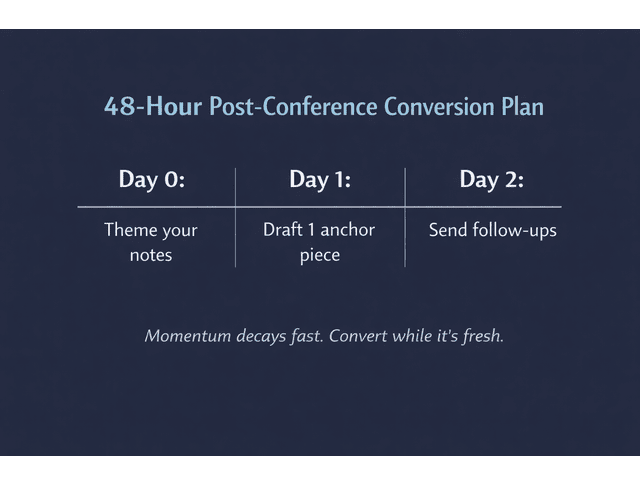
The conference doesn’t pay off during the keynote. It pays off in the 48 hours after you get home, when you either turn those ideas into content, follow-ups, and opportunities… or you let them fade into another forgotten notebook. If you want ROI, you need a post-event system that converts raw notes into assets while the momentum is still alive.
Turn Sessions Into Posts, Frameworks, and Outlines
Do it in this order:
- Start with themes (group notes by repeated problems and patterns)
- Draft one long-form piece (this becomes your anchor article)
- Schedule short-form assets (5–10 posts pulled from the same themes)
This is how an event turns into a content engine instead of a memory.
To speed this up, use AI to convert notes into structure: Paste your “Problem / Insight / Implication” bullets and ask your AI assistant to:
- Group them into 3–5 themes
- Propose a headline for each theme
- Draft a one-paragraph takeaway you can polish.
Follow Up Using AI Conference Tips That Save Time
Send follow-ups within 24–48 hours while your conversation is still fresh (and your name still rings a bell). LinkedIn’s follow-up guidance explicitly recommends reaching out in that 24–48 hour window with a personalized note that references the conversation.
A simple follow-up format:
- 1 line: where you met
- 1 line: what you discussed
- 1 line: the promised resource or idea
- 1 line: a specific next step (15-min call/intro/doc share)
If you’re a founder, your next step might be: “Want to compare notes on vendors?”
If you’re an authority builder: “Want the outline template I mentioned?”
If you want to do this fast without sounding robotic, use AI only as a drafting assistant: feed your AI assistant your notes (“we met at X, discussed Y, I promised Z”), then edit the message to match your tone and add one human detail they’ll recognize.
Package Insights Into Long-Term IP
This is where you win.
Look for repeated themes, like the same objection showing up in multiple sessions, the same workflow breakdown everyone complains about, or the same “we tried this, and it failed” story. Then outline a reusable asset you can refine over time: a framework, a diagnostic checklist, a short guide, or even a chapter for a future book.
Output from this phase: Published content, follow-ups sent, IP outline started
Now the value compounds beyond the event.
Why AI Conference Tips Matter More for Founders and Consultants
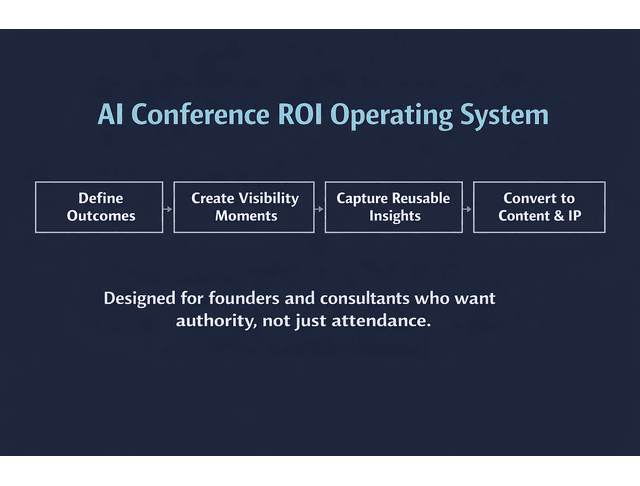
When you’re a founder or consultant, conferences aren’t “professional development.” They’re an investment. Every hour you spend in a room is an hour you’re not building, selling, shipping, or serving clients. That’s why you can’t afford to attend like everyone else; you need a repeatable operating system that turns events into authority, content, and compounding visibility.
Events are expensive; attention makes them profitable
Conferences cost money, time, travel energy, and opportunity cost. The difference between “worth it” and “waste” is whether you turn attention into outputs.
Bizzabo’s benchmarking report notes that proving event ROI continues to be a focus, with 70% of organizers reporting difficulties in 2024.
If the people running the events struggle to quantify ROI, attendees need a system even more.
Authority Compounds Faster Than Networking Volume
A few visible moments outperform dozens of surface-level chats.
When you show up with a clear point of view, ask sharp questions, and follow through quickly, people remember you as someone with signal, not noise.
Systems Beat Motivation Every Time
The best conference outcome is not a great weekend. It’s a repeatable workflow:
- Plan with outcomes
- Execute with visibility moments
- Capture notes as assets
- Follow up fast
- Package patterns into IP
Output from this phase: Decision rules and a reusable operating system for future events
Final Thoughts
The biggest mistake people make at AI events is treating the conference like school: show up, take notes, go home.
A better approach is to treat it like an authority and asset-building sprint. When you use AI conference tips to plan outcomes, create visible moments, capture insights in reusable formats, and follow up quickly, your event stops being “interesting” and starts being profitable.
Want a plug-and-play playbook you can reuse for every event? Visit my Amazon Author Page to browse my books and practical frameworks on AI-powered workflows, content systems, and authority building.
Frequently Asked Questions About AI Conference Tips
AI conferences typically cover themes like machine learning, natural language processing, computer vision, robotics, and AI ethics, often alongside real-world use cases.
Registration is typically handled on the official conference website, where you select a ticket tier and complete the payment process. Many event pages also list deadlines and “important dates” for submissions or registration windows.
You’ll get more out of a conference when you define outcomes in advance, prioritize a few high-leverage conversations, and treat your follow-up and content conversion as part of the event, not an afterthought.
Focus on a short list of priority people, ask better questions, and offer value (a resource, an intro, or a quick insight) instead of collecting contacts.
Sort notes into themes, draft one anchor piece while the insights are fresh, and follow up quickly with a personalized message that references your conversation and proposes a clear next step.
Florence De Borja is a freelance writer, content strategist, and author with 14+ years of writing experience and a 15-year background in IT and software development. She creates clear, practical content on AI, SaaS, business, digital marketing, real estate, and wellness, with a focus on helping freelancers use AI to work calmer and scale smarter. On her blog, AI Freelancer, she shares systems, workflows, and AI-powered strategies for building a sustainable solo business.