
You didn’t start a business to stay up until 2 a.m. fixing headlines and rewriting bland blog posts. But if you’re a founder without a content team, that’s exactly what happens: launches slip, emails don’t go out, and your best ideas stay stuck in your head instead of working for you. The problem isn’t that you’re lazy or “bad at marketing.” The problem is that you’re trying to run content on willpower instead of a system. That’s exactly where an AI content strategy comes in: not as a magic writer, but as a structured way to plan, prioritize, and ship content with far less effort.
Below, we’ll walk through how to use AI to build a simple, focused content engine that supports your business instead of draining you.
Everything I’ve shared here—and more—is in my book, available on Amazon. Click the link if you’re ready to take the next step.
Why AI Content Strategy Matters for Time-Strapped Founders
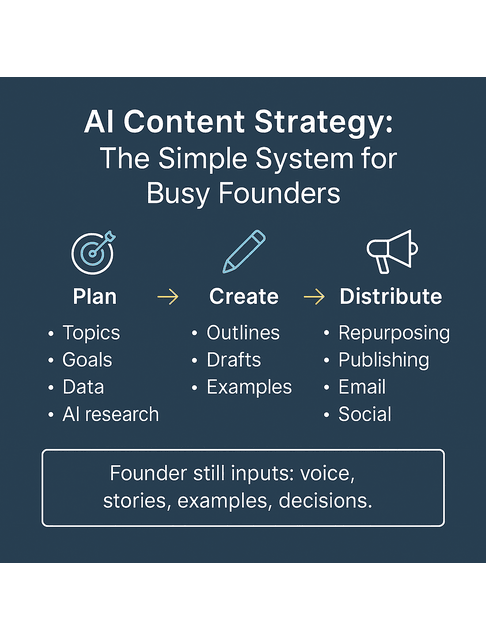
You’re not short on ideas—you’re short on hours. Every time you choose between fixing a landing page and jumping on a sales call, content loses. A clear AI content strategy stops content from being “extra work”. It turns it into a system that quietly runs in the background while you focus on running the business.
AI Content Strategy Basics for Non-Marketer Founders
Let’s keep this simple.
An AI content strategy is a plan for how you’ll use AI tools to plan, create, and distribute content that supports your business goals. Think of it as the “operating system” for your content:
- What to talk about (topics tied to your offers and audience)
- Where to show up (blog, email, LinkedIn, landing pages)
- How AI helps (research, outlines, drafts, repurposing)
Instead of asking AI for random blog posts, you use it to build a deliberate, repeatable system: from keyword research and content planning to drafting and optimization.
You still decide the direction and voice. AI removes the heavy lifting.
From Random Posts to a Clear Content System
Most founders publish like this:
- A blog post when there’s time
- A LinkedIn update when inspiration hits
- An email only when launching something
That pattern creates random activity, not a strategy.
With AI, you can move to a simple system:
- Choose one core business goal (e.g., book more demos, sell a course, grow your email list).
- List 3–5 topics that directly support that goal (e.g., “how our solution solves X,” “mistakes people make without X”).
- Ask an AI tool to turn those topics into a content calendar with article ideas, email angles, and social posts aligned to each subject.
Now every piece of content has a job: move people closer to your offer. That’s basic AI content marketing, but structured for a busy founder.
A simple example: if your goal is “book more demos,” your topics might be “problems we solve,” “how the product works,” and “case studies.” AI can then turn those into specific titles, email subject lines, and social hooks so you’re not starting from scratch.
How AI Tools Turn Customer Data into Insightful Topics
You don’t need to guess what to write about. You already have data:
- Sales call notes
- Support chats and tickets
- Common objections in DMs
- Questions from webinars or demos
You can feed these into AI and ask:
- “Summarize the top 10 questions prospects ask before buying.”
- “Group these questions into 3–5 themes and suggest blog topics and email ideas.”
Now your content plan comes directly from real customer language, which improves relevance, search intent alignment, and conversions. AI helps cluster and structure this input so you aren’t starting from a blank page every time.
When prospects keep asking things like “How long does implementation take?” or “Will my team need training?”, you can feed those questions into AI and get topics such as “Your First 30 Days of Implementation” or “How to Get Your Team Onboard in One Week,” which turn real concerns into clear, practical angles for your content.
This shift is already happening in the market: one analysis of Semrush data found that 67% of small businesses now use AI for content marketing or SEO, showing that even lean teams are relying on AI to turn customer data into consistent content.
Map Your Offers to an AI Content Strategy That Actually Sells
It’s tempting to let AI pump out endless “tips and tricks” that don’t actually change anything. The real impact comes when each piece of content points to a clear offer and a clear buyer. When you line up your offers with your AI content strategy, you’re no longer educating anyone and everyone—you’re steadily warming up the people who are most likely to work with you.
Define One Core Offer and One Primary Audience
Trying to talk to everyone at once is the quickest path to burnout.
Start by choosing:
- One core offer (e.g., done-for-you service, SaaS product, program)
- One primary audience (e.g., early-stage founders, HR leaders, SaaS marketers)
Then tell AI:
“You are my content strategist. My core offer is [X]. My main audience is [Y]. List 10 content topics that move people from ‘never heard of me’ to ‘ready to buy.’”
This keeps your AI content strategy grounded in positioning and sales, not just traffic.
If you’re new to this, think in stages: “never heard of me,” “curious,” “comparing options,” and “ready to decide.” Ask AI to suggest topics for each stage so your content naturally walks people forward instead of leaving them stuck.
Turn Sales Conversations into an AI Content Strategy Engine
Every time you answer a question on a call, that’s content.
You can:
- Take a call transcript or your notes.
- Paste sections into AI.
- Ask: “Turn these objections and explanations into a content roadmap: blog posts, landing page sections, FAQ content, and email topics.”
Now your content plan mirrors how you actually sell, instead of generic “top tips” posts. This aligns content with bottom-of-funnel intent and supports your sales enablement efforts.
For example, if prospects often say, “You’re more expensive than competitors,” and you explain your process and support, AI can help you turn that explanation into a blog called “Why We Cost More (and How That Protects Your Results),” a pricing page section, and a follow-up email after demos. One real conversation fuels multiple useful assets.
Use AI to Build a Simple, High-Intent Topic Map
Instead of chasing dozens of keywords, focus on themes.
Ask AI to:
- Group keywords into 3–5 core themes (e.g., “problem education,” “solution comparison,” “implementation how-tos”).
- Suggest pillar pages and supporting articles for each theme.
- Map each theme to a stage of your customer journey.
You end up with a topic map like:
- Theme 1: The Problem & Stakes
- Theme 2: Why Your Approach Is Different
- Theme 3: How to Implement (With or Without You)
AI can help you build this map faster by clustering keywords, competitor gaps, and “People Also Ask”- style questions into a single view.
A simple example might look like this:
- Theme 1: “Billing mistakes for small businesses”.
- Posts: “5 Common Billing Mistakes,” “How Billing Errors Hurt Cash Flow”
- Theme 2: “How your solution fixes those mistakes.”
- Posts: “How Our Tool Flags Errors Automatically,” “Why Our Clients Close Invoices Faster”
- Theme 3: “Getting started and next steps.”
- Posts: “What Your First 30 Days Look Like,” “Checklist: Getting Ready to Switch Tools”
Seeing it laid out this way makes it clear which topics to write first and how they connect.
Build a Lean Marketing Engine with AI Content Strategy
You don’t need a full marketing department to stay visible—you need a small engine you can run consistently. With the right AI workflows, you can turn one focused piece of content into emails, posts, and talking points across your channels. The goal isn’t to produce more content; it’s to build a lean machine that keeps working even when product or client work fills your schedule.
Design a Weekly Content Rhythm You Can Actually Keep
A simple rhythm can look like this:
- 1 long-form asset per week (blog, podcast, video)
- 3–5 social posts repurposed from that asset
- 1 email summarizing the key insight and inviting replies or actions
Ask AI to:
- Turn each blog into LinkedIn posts, X threads, or short video scripts.
- Extract quotes and hooks to reuse across platforms.
- Draft your weekly email based on the main piece.
This is how you use an AI content strategy to increase output without increasing hours.
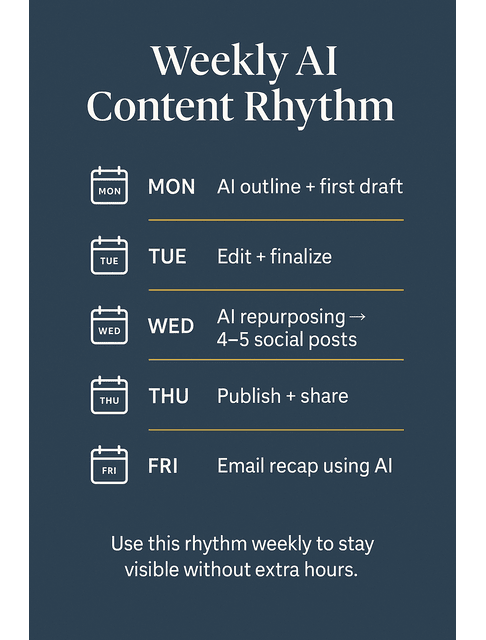
A simple sample week might look like this:
- Monday: Ask AI for an outline, then a first draft of your main blog post.
- Tuesday: Edit the draft, add examples, and finalize it.
- Wednesday: Ask AI to turn the blog into 4–5 social posts. Schedule them.
- Thursday: Publish the blog post on your site and manually share one key post.
- Friday: Ask AI to write a short email summarizing the blog; you edit and send it to your list.
This gives you a clear, repeatable pattern instead of a vague “post more often” instruction.
Marketers who are already doing this are seeing measurable gains: one 2025 roundup of AI marketing statistics reported that 93% of marketers using AI say it helps them create content faster, and 81% say it boosts brand awareness and sales.
Automate Briefs, Drafts, and Repurposing with AI
- Briefs: “Create a content brief for a 1,500-word blog targeting founders searching for [keyword]. Include outline, key points, and CTA.”
- Drafts: “Using this brief, generate a first draft in a calm, expert tone for busy founders. Keep paragraphs short and avoid hype.”
- Repurposing: “Turn this blog into four LinkedIn posts, three email angles, and five short tips for social captions.”
You then spend your time editing for accuracy, voice, and examples—not staring at a blank page. This is where AI writing tools shine: giving you structured, editable drafts instead of raw ideas.
If you’re starting, you can even ask AI to label which parts of the draft need your input (“Add a client example here,” “Add your own story here”) so you know exactly where to personalize.
Keep Your Voice While Scaling with AI Content Strategy
The fear: “If I use AI, everything will sound generic.”
To avoid that, create a simple voice guide that AI can follow:
- How do you greet people
- Words you avoid
- Phrases you use often
- Your level of formality
You can paste a few of your best emails, posts, or articles into the prompt and say:
“Analyze my tone and summarize it. Then write in this style in the future.”
Over time, you refine this guide so that your AI content strategy respects your brand voice rather than flattening it.
A basic voice summary might sound like: “Friendly but direct, avoids jargon, uses simple examples from small businesses, and speaks in short, clear sentences.” You can also give before-and-after examples, like:
- Raw AI: “Our solution revolutionizes your operations.”
- Your version: “Our tool makes your day-to-day work lighter and easier to manage.”
Feeding these into AI helps it learn how you actually talk, so you don’t feel like you’re handing over your voice to a robot.
This focus on voice is also where founders can differentiate themselves, even as AI becomes mainstream. Recent benchmarking from CoSchedule found that 85% of marketers now use AI tools for content creation, which means the advantage no longer comes from using AI alone, but from pairing it with a distinct point of view and a clear brand voice.
Avoid Common Pitfalls When Implementing AI Content Strategy
AI can save you a lot of time—or waste it—depending on how you use it. Many founders jump in, generate a few posts, and write the whole thing off as “too generic.” The problem isn’t the tools; it’s a few simple mistakes in the strategy’s setup. Avoiding these traps is what turns AI from a toy into real operational support.
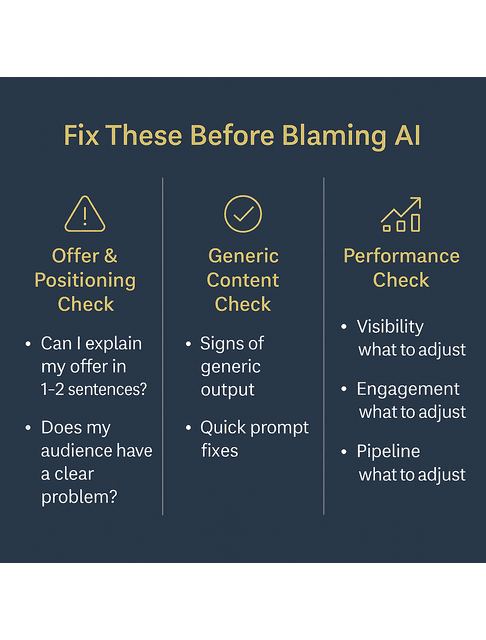
What AI Can’t Fix: Weak Offers and Fuzzy Positioning
AI can’t rescue:
- An unclear offer
- A vague target audience
- Messaging that doesn’t match what your market cares about
If your conversions are low, AI might help you test messaging faster—but you still need to make hard decisions about who you serve and what problem you solve. Content can’t compensate for a misaligned offer.
A simple test: if you can’t explain what you sell and who it’s for in one or two sentences, fix that first before scaling content.
Red Flags: Content That Sounds Generic or Off-Brand
Watch for:
- Overly broad posts that could apply to any industry
- Content that avoids specifics about your process, your clients, or your product
- Repetitive phrasing and buzzwords
When you see this, don’t give up on AI. Adjust your prompts:
- Add real client stories or examples.
- Provide your own bullets and let AI smooth the flow.
- Tell it: “Avoid generic advice. Use concrete examples relevant to [your niche].”
AI is a multiplying force. If you feed it vague inputs, you’ll get vague outputs.
A quick fix: always add one line to the prompt that says “Include at least one specific example from [my industry], not just general advice.”
Simple Metrics to Track If Your AI System Is Working
You don’t need a complex dashboard. Start with:
- Visibility: Are key pages being seen? (Impressions, search queries, AI overview citations.)
- Engagement: Are people replying to emails, saving posts, clicking through?
- Pipeline impact: Do more calls, demos, or inquiries mention your content?
If content doesn’t move any of these, adjust your strategy—not just the individual post. Ask AI to audit what you’ve already published and suggest improvements to titles, CTAs, and structure.
To make this even simpler, use a small checklist:
- If visibility is low → revisit topics and keywords.
- If engagement is low → add more stories, examples, and clearer CTAs.
- If pipeline impact is low → create more content that answers sales questions and objections directly.
This gives you a clear way to react without needing advanced analytics skills.
Final Thoughts
As a founder, you don’t need another thing screaming for your attention. You need a lighter way to stay visible.
A thoughtful AI content strategy gives you that:
- It replaces chaotic, last-minute writing with a simple weekly rhythm.
- It turns customer conversations into structured content, not extra work.
- It lets AI handle the heavy lifting while you focus on decisions, stories, and offers.
You’re not trying to become a full-time content creator. You’re building a business. Let AI handle the repetitive parts of planning, drafting, and repurposing so your best ideas actually reach the people you want to help.
If you’d like support turning this into a weekly habit, grab my free Founder’s AI Content Rhythm Checklist. It gives you step-by-step guidance to plan one core piece of content, spin it out across your channels, and plug AI into each step—without extending your work hours.
If you’re ready to go deeper into building AI-powered systems for your business, explore my books on AI, content, and burnout.
Frequently Asked Questions About AI Content Strategy
An AI content strategy is a plan for using AI tools to research topics, outline ideas, draft content, and repurpose assets so they support clear business goals. Instead of publishing on impulse, you follow a simple system that keeps your brand visible without eating up your week.
Start by clarifying your main offer and primary audience, then collect the questions they ask most often. Feed those into an AI tool to generate topic ideas and a basic content calendar, and commit to a realistic rhythm—one core piece plus repurposed posts—using AI for briefs, drafts, and edits so you can stick to it.
AI can analyze keywords, surface relevant topics, draft blog posts and emails, rewrite copy in your voice, and break long-form content into short social updates. It speeds up the workflow so you spend your time on decisions, stories, and examples instead of starting from a blank page.
AI-generated content can help SEO when it’s guided by a clear strategy and reviewed by a human. AI is useful for matching search intent and filling content gaps. However, you still need to add real insights and experience for search engines to see it as genuinely helpful.
Yes. AI can handle drafting, organizing, and repurposing, but humans are still better at nuance, voice, accuracy, and storytelling. For most founders, the best setup is for AI to produce the first draft and a human to tighten, fact-check, and shape it so it feels like a real extension of the brand.

Florence De Borja is a freelance writer, content strategist, and author with 14+ years of writing experience and a 15-year background in IT and software development. She creates clear, practical content on AI, SaaS, business, digital marketing, real estate, and wellness, with a focus on helping freelancers use AI to work calmer and scale smarter. On her blog, AI Freelancer, she shares systems, workflows, and AI-powered strategies for building a sustainable solo business.