
If you’ve ever opened a “must-read AI report,” skimmed three pages, then quietly closed the tab because you’re already behind on deadlines, you’re not lazy; you’re overloaded. AI market research is supposed to make you faster and sharper, but without a simple way to filter, verify, and extract signal, it turns into another pile of tabs you’ll “get to later.”
This guide is for busy professionals who need research to pay off fast, whether you’re producing client work under constant deadlines or building authority content that needs credible sources. The goal is practical: turn industry reports and journals into usable insights you can apply to writing and strategy.
Everything I’ve shared here—and more—is in my book, available on Amazon. Click the link if you’re ready to take the next step.
AI Market Research as a Signal Filter, Not More Noise

If your research process feels like a graveyard of open tabs, the problem isn’t effort; it’s triage. AI doesn’t help when it turns into “one more thing to read.” It helps when it becomes a signal filter that tells you what to ignore, what to trust, and what’s worth turning into words. This is the shift that saves you: research as a decision step, not a reading project.
Why Overloaded Writers Struggle With Research Overload
Most research “takes too long” for one reason: you’re trying to read like an analyst while living like a freelancer. You’re juggling client delivery, edits, admin, and marketing, so research has to compete with everything else.
McKinsey Global Institute estimates that “interaction workers” spend 19% of their time trying to track down information. That’s nearly a full workday every week that can disappear into “just checking a few sources.”
Your job isn’t to read everything. Your job is to make decisions: what’s reliable enough to cite, what’s useful enough to shape an angle, and what’s important enough to change what you write.
AI Market Research for Faster Insight Extraction
Here’s the mindset shift: AI is not your “answer machine.” It’s your triage assistant. Use it to reduce reading time with structured summaries and extraction, create consistency by asking the same questions of every source, and protect your framing and tone by letting you decide the message while AI helps organize evidence.
A simple signal filter that works across most topics is:
- What changed?
- Why now?
- So what?
If a report or paper doesn’t help you answer at least one of those, it’s probably noise for your current goal.
Nielsen Norman Group summarized case studies showing generative AI can improve task performance by about 66% on average. Those gains don’t come from “reading more.” They come from tighter inputs, clearer extraction, and faster synthesis.
Reports vs. Blogs vs. News: What Actually Builds Credibility and Why
Blogs and news are great for awareness, but they’re often optimized for speed and clicks. Industry reports and peer-reviewed research move more slowly, and that’s why they help: they’re more likely to define scope, disclose assumptions, and show comparative baselines. When you’re writing for clients or building authority, those features aren’t academic; they reduce rework.
Once you know what counts as credible, reports are usually the fastest place to get usable baselines.
How AI Market Research Works With Industry Reports
Industry reports can either waste your afternoon or pay for your week. The difference is whether you treat them as something to “get through” or something to mine for usable claims, definitions, and evidence. When you extract the right parts, let AI structure them into briefs and angles. You stop sounding like everyone else and start writing with the calm confidence that comes from real baselines.
Where to Find High-Quality Industry Reports and How They Differ by Source
Not all reports are created equal, and you don’t need a massive list of sources, just a way to recognize what kind of document you’re holding.
Consulting reports are usually strong on executive framing and implications. Industry associations and standards bodies tend to be better for stable definitions and sector norms. Public-sector and multilateral reports are useful when you need policy, workforce, or adoption constraints. Vendor reports can be valuable for product and category context, but you’ll want to watch for marketing bias and selective examples.
In practice, you’ll save time by choosing reports that clearly state (1) scope, (2) method, and (3) what the data actually represents before you invest effort in extracting insights.
Turning Reports Into AI Market Research Inputs for Prompts and Briefs
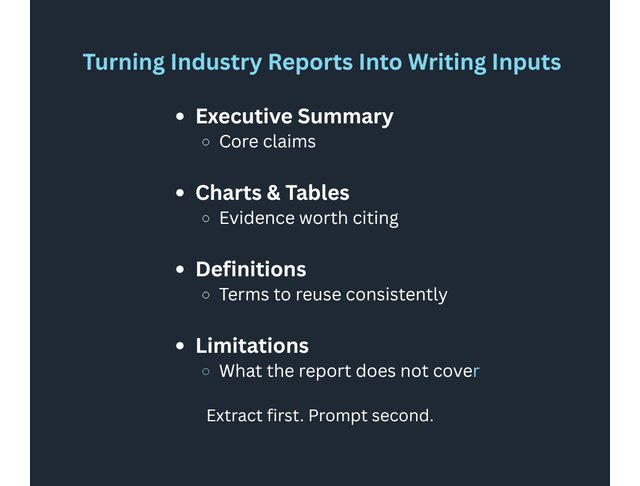
“Inputs” means you’re not feeding an entire PDF and hoping for magic. You’re extracting only what matters:
- the executive summary (claims)
- 1–3 charts/tables (evidence)
- definitions (terms you’ll reuse)
- limitations (what the report doesn’t cover)
Then run a consistent extraction pass. Ask AI to list the top claims and the evidence supporting each claim, pull out definitions and metrics suitable for client-facing writing, and flag assumptions that could change the conclusion. When your inputs are clean, your outputs stop sounding generic—and you spend less time “fixing the draft later.”
Executive Summaries: What to Trust, What to Verify, and What to Ignore
Executive summaries are useful, but they’re also where persuasion lives. A clean way to read them is:
- Trust: definitions, scope, and what’s directly measured
- Verify: big numeric claims, causal statements, “X leads to Y.”
- Ignore (for now): vendor-heavy sections that don’t affect your angle
If you want a strong baseline for “AI is operational now,” Stanford’s AI Index reports that 78% of organizations reported using AI in 2024, up from 55% the year before. That’s the kind of anchoring stat that stops your piece from feeling like trend-chatter.
A Worked Example (Industry Report → Client-Ready Writing)
Let’s say you’re writing a client blog about “why AI adoption feels sudden.”
- You pull one chart or highlighted finding from a credible index/report (your evidence).
- You run one extraction pass to turn it into “usable language.”
- You write one paragraph that separates fact from interpretation.
A simple extraction prompt that keeps you honest:
“Turn this finding into: (a) one sentence I can cite, (b) the key definition(s) involved, (c) one caveat/limitation, (d) one practical implication for a reader.”
Then your draft paragraph becomes straightforward:
- Cited fact: “Business AI use rose to 78% of organizations in 2024, up from 55% the year before.”
- Your interpretation: “That kind of jump suggests the conversation has shifted from experimentation to operational use.”
- Caveat: “This is survey-reported usage, so the intensity and maturity of use vary.”
- Implication: “If your competitors are already testing AI in workflows, the strategic question is where it reduces cycle time without degrading quality.”
That is “market research” as a writing asset: one anchor, one caveat, one implication—done.
Using AI Market Research to Read Journals Without Burnout
Journals intimidate smart people because they’re built for precision, not speed. But they’re also where you go when you want to separate measured reality from loud opinions. The trick isn’t reading more; it’s reading strategically: the three sections that matter, the one limitation you can’t ignore, and a simple AI-assisted note system that keeps you accurate without dragging you into the weeds.
Academic Journals for Practitioners: What Sections Matter and What Do Not
You don’t need to read journal articles like you’re writing a thesis. You need the parts that answer, Is this relevant and trustworthy for what I’m writing?
Most of the time, these are the only sections you need:
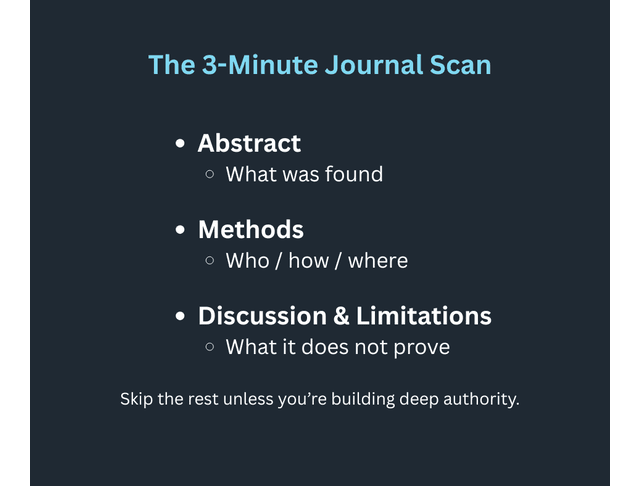
- Abstract
- Methods
- Discussion/limitations
The literature review and long statistical appendices can usually wait unless you’re building a deep, research-first authority piece.
AI Market Research in Peer-Reviewed Sources
Journals are where you go when you want to challenge hype, confirm what’s measurable versus assumed, and borrow precise definitions. They’re especially useful when reports disagree, when claims are high-stakes, or when you need language that holds up under scrutiny.
AI helps here by turning dense structure into usable notes: extract the sample, method, key finding, and the biggest limitation; translate technical terms into plain English; and surface practical implications without overstating what the paper proves.
The 3-Minute Paper Scan: Abstract, Methods, Discussion
If you only have three minutes, scan in this order: abstract first to get the claim, methods next to understand what was actually studied, and discussion/limitations last to see what the findings do not prove. Then use AI as a structured note-taker to keep your summary accurate.
Start with the abstract, and copy the one or two lines you might actually cite before you do anything else.
A Worked Example (Paper Scan → Safe Citation)
When you run the 3-minute scan, your notes should fit on one screen. A clean output template looks like this:
Claim (1 sentence): What the study found (no hype words).
Method (1 sentence): Who/what, where, when, how.
Limitations (1 sentence): What it doesn’t prove.
Use in writing (1 sentence): The narrow point you can safely make.
Do not say: The overreach you’re tempted to write.
Applying AI Market Research to Writing and Authority
Research is only valuable when it shows up in your output. Otherwise, it’s just procrastination with better branding. The real payoff of AI market research is that it turns credible sources into deliverables: outlines that write themselves, briefs that clients instantly trust, and authoritative content that doesn’t sound like recycled internet advice. This section shows how to place research where it belongs—upstream—so the draft becomes easier, not heavier.
Here’s the exact sequence that keeps research from expanding.
From Insights to Outlines: A Repeatable Content Pipeline
This is the workflow that keeps you consistent:
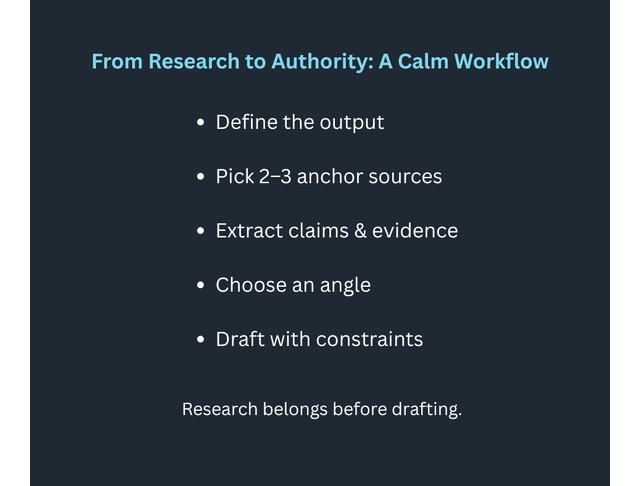
- Define the output
- Pick 2–3 anchor sources
- Extract claims and evidence
- Choose an angle
- Draft with constraints
That pipeline is what turns research into delivery, without becoming a full-time researcher.
The 6-Point Credibility Checklist (Fast Enough to Use Daily)
Use this on any report, index, or study before you cite it:
- Scope: What is included and excluded?
- Definitions: What does the source mean by “AI,” “adoption,” or the key term?
- Method: How was the data gathered (survey, logs, interviews, experiments)?
- Sample: Who/what was studied (size, geography, sector)?
- Timing: When was it collected, and is it still relevant?
- Incentives: Who funded it, and what might they want you to believe?
Thought Leadership and Client Deliverables: Where Research Creates Leverage
This is where research starts paying you back. When you consistently ground your work in credible sources, you spend less time justifying your claims and more time shipping writing that sounds confident.
Stanford’s AI Index is a strong example of a widely cited baseline source for adoption and investment context. If you want to support “productivity upside” without making inflated promises, Nielsen Norman Group’s summaries of observed performance gains are also useful—especially when you frame them as “potential improvements under specific conditions,” not universal guarantees.
AI Market Research Placement in Your Workflow: Before Drafting, Not After
This matters more than people think. Research is most useful when it happens before you commit to an angle, because it stops you from writing yourself into a corner.
A simple rule: research first to choose the angle, draft second to express it, edit last to tighten voice and clarity. That sequencing is what turns research from a time sink into a protective layer.
Final Thoughts
AI market research becomes genuinely useful when you treat it as a workflow for signal extraction, not a reading assignment. Use reports for baseline clarity and executive-ready framing. Use journals for precision, limits, and credibility. Then convert what you find into outlines, briefs, and content that ships.
If you want more workflow-first, freelancer-friendly systems like this—writing templates, research shortcuts, and calm AI routines you can actually stick with—visit my Amazon Author page.
Frequently Asked Questions About AI Market Research
AI market research uses AI to collect, analyze, and synthesize information about customers, competitors, and markets so you can generate insights faster than manual-only approaches.
AI is commonly used to summarize long documents, extract themes across sources, analyze text for patterns, and turn findings into structured briefs and drafts, while humans verify claims and decide what the insights mean.
A reliable mix is: an index-style source for baselines (adoption/investment), a strong industry report for framing, and a peer-reviewed paper when you need methods and limitations. Stanford’s AI Index is a widely cited baseline source.
AI is commonly used to summarize long documents, extract themes across sources, analyze text for patterns, and turn findings into structured briefs and drafts, while humans verify claims and decide what the insights mean.
Define the content goal, select 2–3 anchor sources, extract claims/evidence with a consistent template, choose an angle (what changed/why now/so what), then draft and edit with a clear line between sourced facts and your interpretation.

Florence De Borja is a freelance writer, content strategist, and author with 14+ years of writing experience and a 15-year background in IT and software development. She creates clear, practical content on AI, SaaS, business, digital marketing, real estate, and wellness, with a focus on helping freelancers use AI to work calmer and scale smarter. On her blog, AI Freelancer, she shares systems, workflows, and AI-powered strategies for building a sustainable solo business.