
You’re smart, experienced, and already doing the work… but the ideas are starting to feel heavy. Client assignments blur together, your own marketing keeps slipping, and every time you sit down to plan content, you end up scrolling instead of deciding. You know there are high-demand topics out there for your niche, but digging them up feels like it’s its own full-time job. That’s exactly where AI topic research comes in.
Used well, it doesn’t replace your judgment. It gives you faster, clearer signals about what your audience actually cares about, so you can choose topics that earn attention without burning yourself out. That matters because research from BrightEdge (via Semji) shows that around 53% of all website traffic still comes from organic search (people finding you through unpaid Google results). If your topics match what people are searching for, you’re not shouting into the void; you’re meeting demand.
This guide is written for you if you’re:
- A mid-career freelance writer juggling too many deadlines
- A consultant or coach is trying to build authoritative content
- A creative pro who needs content but hates writing
- A self-publisher who wants books that people actually search for
Let’s turn topic selection from guesswork into a calm, repeatable system.
Everything I’ve shared here—and more—is in my book, available on Amazon. Click the link if you’re ready to take the next step.
How AI Topic Research Supports Busy Experts
You’re not short on skill; you’re short on bandwidth. The problem isn’t “Can I write this?” It’s, “Do I have the mental space to figure out what’s worth writing in the first place?” This is where AI helps you front-load clarity, so every idea you touch has a real chance of paying off.
Map Your Niche Audience Clearly
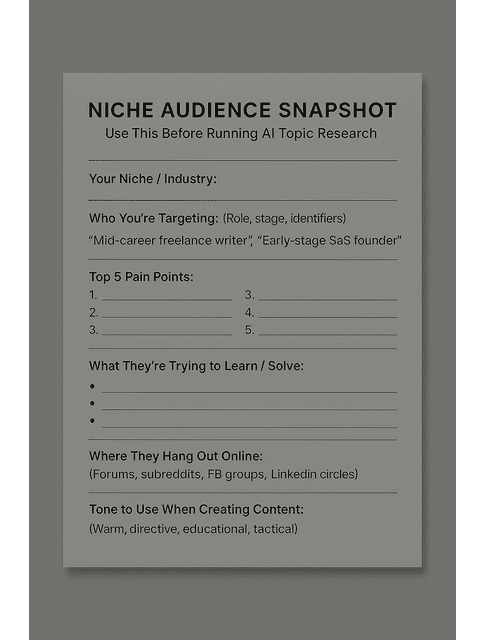
Before you open any tool, you need a handle on who you’re speaking to and what they’re trying to solve.
- For overloaded freelancers, that might be “small B2B SaaS founders who need educational blogs.”
- For consultants, it could be “mid-size business owners stuck between DIY and hiring a full agency.”
- For DIY authors, maybe it’s “new freelancers who want step-by-step systems.”
AI tools (even general assistants like ChatGPT) can accelerate this mapping by:
- Summarizing existing audience research, survey responses, or buyer personas into a clear, one-page profile
- Extracting recurring pain points and questions from testimonials, call notes, or even YouTube comments
- Turning those pain points into seed topics and keyword ideas you can explore further.
You bring the context; AI helps you see patterns faster.
Turn Data-Backed Topics Into Faster Drafts
Once you have a set of promising topics, the goal is not just “more ideas.” It’s faster, better drafts.
For writers and consultants, this looks like:
- Using topic research outputs (related searches, People Also Ask data, subtopics) to build an outline that matches search intent (the real reason someone is typing that query into Google)
- Turning that outline into a detailed brief: target reader, angle, example stories, and calls to action
- Letting AI suggest section-level talking points or example structures while you keep the voice and nuance
For self-publishers, the same logic scales up: you can cluster related topics into book sections or even a full series rather than single posts.
Use Insights To Balance Client Work And Marketing
One of the biggest pains for all four profiles is this: client work wins, your own content loses.
AI helps you protect your market research time by:
- Creating a prioritized topic list based on relevance + demand (search volume, question frequency, and competitiveness)
- Tagging topics by format: quick LinkedIn post, carousel, newsletter, deep-dive article, or book chapter
- Scheduling 1–2 high-impact topics per week so you always know what to create when you sit down.
Instead of debating what to post, you execute the next item in a topic queue that’s already grounded in audience demand.
Using AI Topic Research To Find High-Demand Ideas
Staring at a blank calendar is brutal when you already feel behind. Instead of trying to “be creative on command,” you can let AI sift through the noise—search data, questions, comments—and surface the themes that keep coming up for your audience.
AI Topic Research For Niche Authority Builders
If you’re a consultant, coach, or expert, your content has to do more than “get views.” It needs to signal authority.
AI-powered topic research tools and workflows can help you:
- See which questions your ideal clients ask around your core topic (e.g., “pricing strategy for consultants,” “onboarding systems for creatives”)
- Group those questions into content pillars (your core themes you return to again and again) that reflect your IP: frameworks, methods, or signature systems
- Spot gaps where no one is giving a clear, practical answer—those become your standout pieces
When you consistently publish around those question clusters, people start to associate you with that niche problem.
Mine SERPs, PAA, And Forums For Real Questions
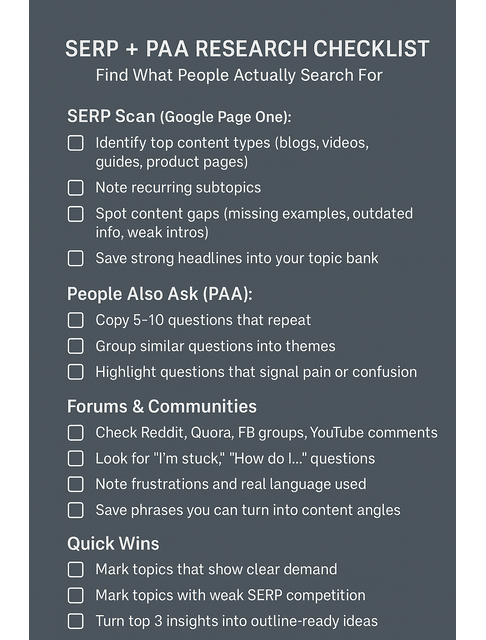
Whether you’re a freelancer, creative, or self-publisher, your strongest ideas usually come from real language your audience uses.
You can combine:
- Search results (SERPs) to see what already ranks
- People Also Ask boxes to surface real questions around your topic.
- Forums and communities (Reddit, Facebook groups, industry Slack, YouTube comments) to find unsolved pain points.
AI can then:
- Group similar questions into themes (e.g., “pricing stress,” “client boundaries,” “marketing consistency”)
- Suggest angle variations: how-to guides, myths, mistakes, templates, or case-study style posts.
- Turn each cluster into a mini-series so that a single research pass becomes several weeks of content.
This is especially powerful for the Multi-Hat Creator who has loads of raw ideas but not enough structure.
Validate Ideas With Simple Keyword Metrics
You don’t need a full SEO suite to double-check ideas.
For most solo professionals, a lightweight validation process is enough:
- Check search volume: are people actually typing variations of this into Google?
- Look at keyword difficulty or competition (how hard it is to rank on page one for that term): choose topics where you can realistically compete.
- Scan the top results: can you create something clearer, more specific, or more useful?
Semrush’s research on search intent found that content aligned with intent is about 2.5x more likely to drive qualified traffic (people who are actually a good fit for your offer) compared with content that targets a keyword loosely. That’s exactly what you’re doing when you use AI topic research well: matching your ideas with the real reasons people are searching in the first place.
The goal isn’t perfection. It’s stacking enough evidence to say, “This idea is worth my limited time.”
Turn AI Topic Research Into Client-Ready Workflows
Good ideas are only half the battle; the other half is not reinventing your process every week. When you plug AI topic research into a simple workflow, you stop “winging it” and start moving through a clear path from idea to outline to draft. This is one of the reasons Semrush reports that around 68% of marketers who use AI in their content strategy see higher ROI (more results from the same amount of effort or spend)—they’re not just generating content faster, they’re using systems that make each piece more intentional.
Build A Simple Idea-to-Outline System
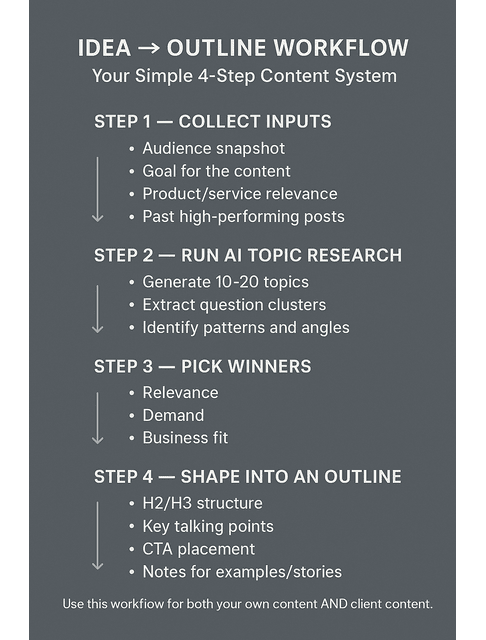
If you’re the Overloaded Producer, that’s where a simple, repeatable workflow comes in.
A simple workflow might look like this:
- Collect inputs: audience profiles, client goals, product info, and past content that performed well.
- Run AI-assisted topic research: generate topic clusters, related keywords, and question lists.
- Promote winners to outlines: for each selected topic, create an outline with H2s/H3s, key points, and examples.
- Draft quickly: use AI as a drafting assistant for sections you’re stuck on, while you control tone and final structure
Once you’ve built this once, you can reuse it for each new client or book project.
Turn Briefs Into AI Topic Research–Driven Outlines
Client briefs often arrive vague:
“We want more thought leadership on [broad topic].”
Instead of guessing, you can:
- Feed the brief into an AI tool along with the target audience details
- Ask it to propose topic clusters, questions, and subtopics based on search behavior and competitor content.
- Turn those into a series of proposed outlines you send back to the client for approval.
For consultants and coaches selling strategy and copy, this instantly raises your value. You’re no longer just a writer; you’re the partner who turns fuzzy goals into a data-backed content roadmap.
Keep A Shared Topic Bank For Retainer Clients
For retainer clients—and for your own brand—you want a living topic bank rather than one-off brainstorms.
You can maintain a simple spreadsheet or Notion database with:
- Topic title or working angle
- Target keyword/search intent
- Format (blog, email, script, carousel, chapter)
- Status (idea, outlined, drafted, published)
- Performance notes once it goes live
AI supports this by:
- Periodically refreshing your topic bank with new ideas based on updated SERPs or competitor content.
- Suggesting adjacent topics whenever a post performs well
- Identifying which ideas are strong enough to expand into a lead magnet or book
This is golden for your own brand and for retainer clients (ongoing clients who pay you every month) who expect a steady stream of strategic content.
Scale Your Brand With AI Topic Research Across Formats
Once you trust your topics, you can stop chasing trends and use them across your blog, socials, videos, and even your book roadmap. You’ve already done the hard part—finding and validating good ideas. This is where AI-supported topic research scales: one strong concept feeding all those channels.
Repurpose Winning Topics Into Scripts And Captions
You don’t need new ideas for every format. You need new angles on proven concepts.
Take one high-performing or high-potential topic and:
- Turn the main promise into a short, punchy Reels/TikTok script
- Slice the key takeaways into 5–7 social captions.
- Build a simple case study showing how a client or reader applied the idea
- Turn questions from comments into follow-up posts or FAQ-style content
AI can help here by turning a blog outline into social post variations, hook options, and short-form video scripts, while keeping the voice consistent.
For the Multi-Hat Creator, this turns one good idea into a week of content without adding more mental load.
Plan Your Next Book Series With AI Topic Research
If you’re a self-publisher or consultant with book ambitions, think of AI topic research as your scout.
You can:
- Cluster related questions and search terms into book-level themes or “volumes.”
- Map those clusters into a logical progression of chapters (beginner → intermediate → advanced)
- Validate demand by checking search volume and competitor books in your niche.
Instead of starting from a blank page, you’re building books that sit directly on top of proven topics people already search for.
Link Your Topic Roadmap To A Publishing Cadence
Finally, tie everything together with a realistic publishing rhythm:
- Freelance writer or consultant: 1–2 authority posts per month + weekly short-form posts
- Creative pro: 1 in-depth case study or project breakdown per month + repurposed clips and captions
- Self-publisher: ongoing short-form content that tests book ideas and gathers reader questions you can fold into future editions
AI can keep your roadmap up to date by periodically suggesting fresh topics based on shifts in search behavior or new tools in your space. At the same time, you decide which ones fit your brand and capacity.
Final Thoughts
You don’t need more pressure to “create more content.” You need to make clear, confident decisions about what to create and why it deserves your time.
That’s what AI topic research gives mid-career freelancers, authority-building consultants, multi-hat creatives, and DIY authors. It shows you where demand already exists, so every outline, script, post, or chapter has a better chance of landing—without you disappearing into research rabbit holes for hours. And when you build AI into your content strategy, you don’t just work faster; you actually increase the return you get from the effort you put in.
If you’re brand new, start small:
- Pick one audience you care about.
- Spend 20–30 minutes using AI to collect questions and topic ideas around one core theme.
- Choose one idea that clearly fits your services or book.
- Turn it into a simple outline and draft, nothing fancy—just shipped.
Use AI to surface patterns. Use your expertise to choose what matters. Together, that’s how you build a body of work your audience actually wants, at a pace your brain can sustain.
Want to skip the guesswork? Get my free AI Topic Research Workflow and start choosing high-demand content ideas in under 30 minutes.
If you want a practical guide to AI topic research without the rabbit holes, explore my books on Amazon. They show you how to find high-intent ideas, turn them into outlines fast, and build a sustainable content system for your services and books. Visit my Amazon Author page to pick the guide that fits your current stage.
Frequently Asked Questions About Using AI Topic Research
Most creators start by feeding AI tools a seed keyword, niche, or audience description. The tool then suggests related topics, common questions, and keyword variations based on search data and competitor content. You refine the list by relevance, difficulty, and business fit, then promote the best ideas into outlines or briefs.
AI can scan SERPs, People Also Ask data, forums, and social content to find patterns in what people ask and share. From there, it suggests ideas that align with real search intent, not just random brainstorming. You can then prioritize ideas with high search volume and gaps in existing content.
AI works best with traditional SEO tools, not instead of them. AI helps you quickly explore topics, questions, and clusters. At the same time, dedicated keyword tools give you hard numbers like search volume, difficulty, and SERP snapshots. Combining both makes your research faster and more reliable.
You can ask AI to expand a broad keyword into more specific angles, long-tail phrases, and question-based topics. Then, plug those into keyword or topic research tools to check volume and difficulty. Look for long-tail queries with clear intent, modest search volume, and weak or outdated content on page one—that’s where niche opportunities live.
There’s no single “best,” but useful options include AI-assisted topic and keyword platforms, People Also Ask and question-based tools, and general AI chat tools (like ChatGPT) for clustering and ideation. For example, you might pair a tool like Semrush or Ahrefs for metrics with AnswerThePublic or AlsoAsked for questions, and then use ChatGPT to cluster and shape those ideas into outlines. The right mix depends on your budget, your niche, and how deep you want to go into SEO.

Florence De Borja is a freelance writer, content strategist, and author with 14+ years of writing experience and a 15-year background in IT and software development. She creates clear, practical content on AI, SaaS, business, digital marketing, real estate, and wellness, with a focus on helping freelancers use AI to work calmer and scale smarter. On her blog, AI Freelancer, she shares systems, workflows, and AI-powered strategies for building a sustainable solo business.