
If you are juggling deadlines, revisions, and marketing your own services, the real bottleneck is not talent. It is friction. An AI writing workflow for freelancers exists to remove that friction so you stop rewriting drafts at midnight and start delivering work with control.
Used correctly, AI does improve productivity. Nielsen Norman Group reviewed three workplace studies and found that generative AI increased throughput by an average of 66% on realistic tasks.
Those gains show up when AI operates inside a defined process. Without stage boundaries, tools overlap, decisions multiply, and output quality becomes inconsistent.
Everything I’ve shared here—and more—is in my book, available on Amazon. Click the link if you’re ready to take the next step.
The Hidden Cost of Working Without a Defined Workflow
Most freelancers think they need better prompts. What they actually need is a sequence that reduces decisions before the first paragraph is written. When you work without a defined workflow, time fragments across tabs and tools. You move from research to drafting to editing and back again because the process does not prevent rework.
Voice shifts from section to section. Drafts require rewriting instead of refinement. Cognitive load rises, and client turnaround slows because revision loops stack up.
The issue is not AI. It is the absence of stage boundaries.
Tool Hopping vs. Structured Process
Tool hopping feels productive. You generate an outline, expand a section, rewrite the intro, test alternatives, and then tighten the conclusion. But without defined stages, drafting bleeds into editing and editing bleeds back into research. You are busy, yet you rarely finish.
A structured process enforces discipline.
Workflow Rule Set
- No drafting before outline approval
- One primary tool per stage
- One editing pass per outcome
- Review metrics weekly
This rule set forces the completion of one cognitive task before beginning another. It creates a boundary between thinking and refining, which is where most freelancers lose time.
Building a Writing Workflow From Research to Delivery
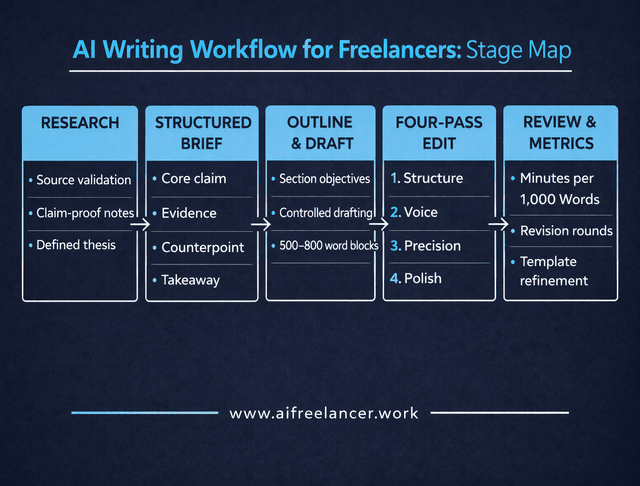
Once you separate stages, the workflow becomes easier to build. The strongest systems follow one principle: clean inputs produce clean drafts.
Research Acceleration Inside an AI Writing Workflow for Freelancers
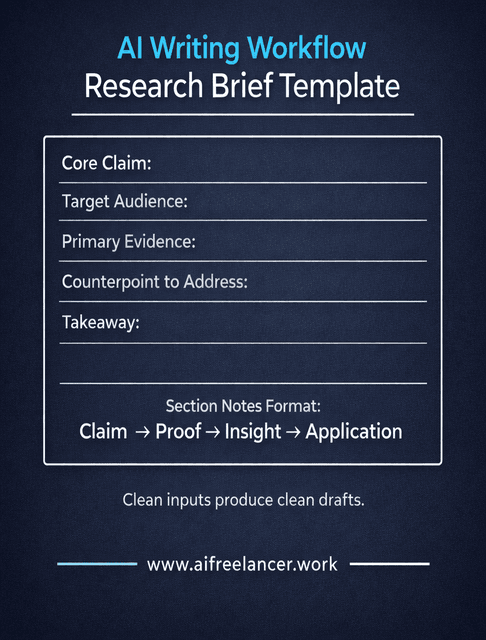
AI should accelerate structure, not replace judgment. Use it to cluster ideas, surface counterpoints, and summarize long materials. Then apply your own Source Validation Filter by checking authority, recency, and whether the data is primary or clearly referenced.
Create a research brief before drafting. Define your core argument. List supporting evidence. Note a counterpoint you will address. Clarify your angle. Extract notes in a consistent pattern, such as claim, proof, insight, and application.
Here is what a weak research brief looks like:
“Topic: AI for writers. Benefits include speed and efficiency. Mention tools. Include stats.”
That brief guarantees rewriting because it leaves the argument undefined.
Now compare it to a structured version:
- Core claim: A defined AI workflow reduces revision rounds for freelance bloggers.
- Audience: Mid-career freelancers overwhelmed by editing time.
- Evidence: 66% productivity increase (Nielsen Norman Group); 40% time reduction in MIT study.
- Counterpoint: AI can flatten voice if unbounded.
- Takeaway: Structure first, AI second.
The second brief narrows the field of possible drafts before you write a single paragraph. It clarifies what the draft must prove and what it must avoid.
In an MIT study on workplace writing tasks, ChatGPT reduced completion time by 40% and improved quality scores by 18% when used as an assistive tool.
Structure turns that assistance into leverage. The clearer your brief, the less you depend on rewriting later.
There is also a trade-off worth acknowledging. The first few times you enforce this level of structure, drafting may feel slower because you are front-loading decisions instead of improvising. After several projects, revision time drops. For most freelancers, that shift creates breathing room rather than extra effort.
Outline and Section Drafting Within an AI Workflow for Freelancers
Research clarity must carry forward into drafting. Otherwise, the benefits collapse.
Convert your research brief into a hierarchical outline. Define the objective of each section in one sentence before you generate anything. That sentence becomes your guardrail.
For example, instead of “Section 2: Benefits,” write:
Objective: Show how drafting in controlled sections reduces editing time for overloaded freelancers.
Draft in controlled sections of 500 to 800 words. Before generating, clarify who the section is for, what claim it must prove, what evidence it must include, and what tone it must maintain. These constraints prevent drift and reduce later corrections.
If a section misses its objective, rewrite the structure before polishing sentences. Most editing fatigue is structural, not stylistic. When freelancers say AI drafts feel bloated, the issue is usually an undefined objective.
There are moments when skipping AI entirely is the better decision. If a section requires nuanced personal experience, strong opinion, or strategic positioning for a high-value client, draft it yourself first. Then use AI to test clarity or tighten structure. The workflow is a guide, not a cage.
Your definition of done should include a clear argument, logical flow, no placeholders, and a transition that leads to the next section. Without these criteria, drafting never truly ends.
A Real Example of an AI Writing Workflow for Freelancers in Action
Consider a tight client deadline and a 1,500-word blog with a minimal brief.
You begin with research and produce a brief containing seven structured claim-and-proof notes tied to the target audience. Because the thesis is defined early, drafting feels directional rather than exploratory.
Next, you outline and draft three sections separately. The second section drifts into tools instead of workflow mechanics. Instead of editing sentences, you return to the objective and restructure the section around claim, proof, and takeaway.
During the precision pass, you notice repetition. “Improve productivity” appears several times without specificity. You tighten each instance into concrete outcomes, such as fewer revision rounds or shorter drafting time.
Finally, you confirm brief compliance, formatting clarity, link accuracy, and CTA alignment. The workflow catches problems early because each stage has criteria. This is where revision rounds drop, which matters most to the Overloaded Producer who wants fewer late-night edits.
Layered Editing in an AI Writing Workflow for Freelancers
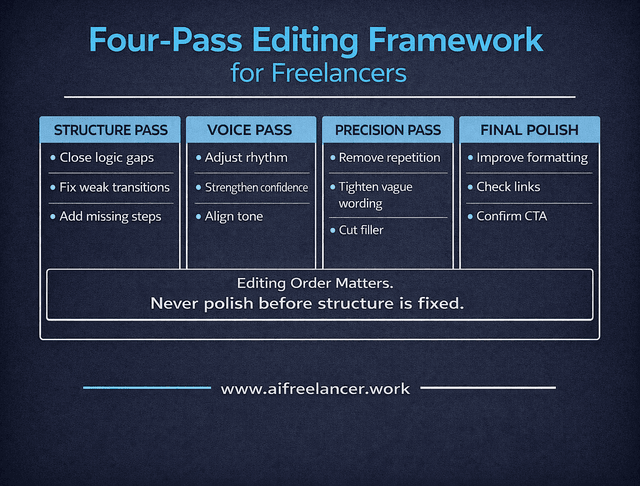
Editing without structure leads to endless tweaking. Editing in passes creates movement because each pass isolates a different type of problem.
Apply a Four-Pass Editing Framework:
- Structure Pass: close logic gaps, fix weak transitions, fill missing steps.
- Voice Pass: adjust rhythm, tone, and confidence in language.
- Precision Pass: remove repetition, tighten vague wording, cut filler.
- Final Polish: improve scannability, formatting, and CTA placement.
Here is a micro example.
Before structure pass:
“This workflow helps freelancers be better and more productive in their writing projects.”
After structure pass:
“This workflow reduces revision rounds by forcing section objectives before drafting.”
Before precision pass:
“It really helps improve overall productivity and efficiency.”
After precision pass:
“It shortens drafting time and reduces editing fatigue.”
Research on the “jagged frontier” of AI shows performance improves significantly when AI is used within tasks it handles well, but declines when users rely on it outside those boundaries.
Boundaries increase reliability because they define when AI assists and when human judgment leads.
Optimizing Your AI Writing Workflow for Freelancers Without Losing Voice
Once the mechanics are stable, the next concern is authority. Speed means nothing if your voice erodes over time.
AI Role Boundaries Inside an AI Writing Workflow for Freelancers
AI is effective for ideation, outline expansion, redundancy detection, and structural critique. It is risky for unverified factual claims, confident generalizations, and replacing lived experience.
If a section requires personal experience or nuanced judgment, write it yourself first. Then use AI to test clarity or tighten structure. This sequence preserves authority while still gaining efficiency.
Google’s guidance reflects this distinction. Using AI is not against policy when the content is helpful and created for people rather than search manipulation.
Protecting Authority in an AI Writing Workflow for Freelancers
Consistency protects credibility, especially when publishing frequently.
Use a voice calibration step. Paste 150 to 200 words of your strongest writing into your AI tool and extract structural and tonal rules. Convert those rules into a reusable style card that includes tone description, sentence-length preference, words to avoid, and signature phrasing.
Insert a one-line tone reminder into drafting prompts. Maintain non-negotiables: no filler transitions, no vague claims, and human override at strategic points. Over time, these guardrails maintain clarity and voice stability even as volume increases.
Scaling an AI Writing Workflow Into a Repeatable System
A workflow only counts if it survives busy weeks. Reliability under pressure is the true test.
Minimum Viable Stack for an AI Writing Workflow
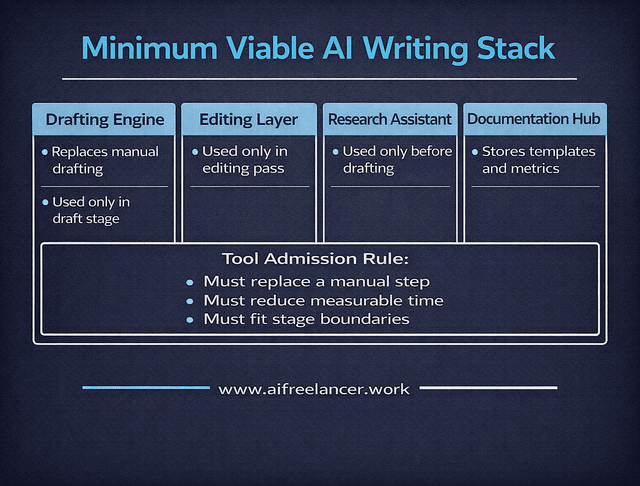
Keep the stack small, so the workflow stays repeatable under deadline pressure.
- One drafting engine
- One editing layer
- One research assistant
- One documentation hub
Each tool must replace a manual step, reduce measurable time, and fit into your defined sequence. Additional tools should only enter the stack if they simplify rather than complicate.
Measuring and Refining an AI Writing Workflow for Freelancers
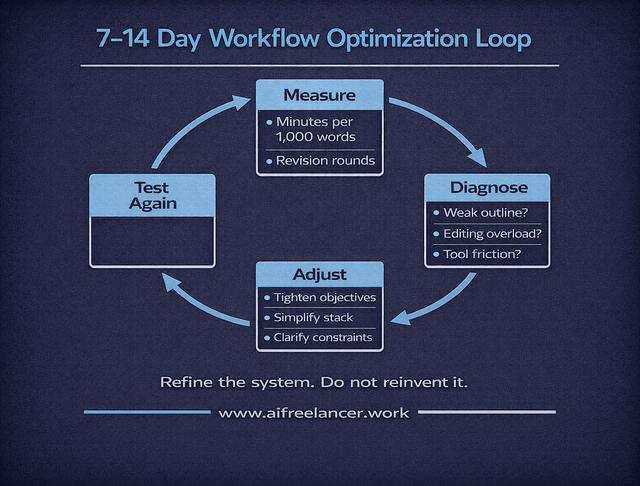
Track two metrics: minutes per 1,000 words and revision rounds per project. Review them weekly and run a 7 to 14-day optimization cycle.
When revision rounds go beyond two, strengthen the outline stage by defining sharper section objectives and specifying the evidence each section must include. Editing taking longer than drafting is usually a structural issue, so apply a clear claim–proof–takeaway format to every section. And when performance still doesn’t improve after two optimization cycles, reduce complexity by trimming down your tool stack.
Keep the workflow map visible:
Research → Structured brief
Outline and Drafting → Controlled section drafts
Editing → Polished article
Review → Adjust templates or constraints
When refinement becomes habitual, reinvention becomes unnecessary.
Final Thoughts
A scalable AI writing workflow for freelancers is not about producing more words. It is about reducing decision fatigue, protecting your voice, and turning content delivery into something you can repeat without burning out.
If you want deeper workflow frameworks, visual systems, and structured checklists you can apply immediately, visit my Amazon Author page and explore the resources built specifically for freelancers who want calm, scalable processes.
Frequently Asked Questions About AI Writing Workflow for Freelancers
No. Google does not penalize content simply because AI was used. What matters is whether the content is helpful, accurate, and created for people rather than search manipulation. If your AI-assisted article is original, fact-checked, and genuinely useful, it can rank like any human-written piece. Problems arise when AI is used to mass-produce thin or low-value content.
Google’s systems focus on evaluating quality signals, not policing tools. Even if detection technologies exist, detection alone is not a ranking factor. Content performs based on clarity, usefulness, depth, and trust signals. In practice, poorly edited AI content struggles because it lacks substance, not because it was generated by AI.
Start by defining a clear section objective before generating text. Apply structured constraints such as claim-proof-takeaway formatting. Use a voice calibration step to extract your tonal rules and reuse them in prompts. Then edit in passes—structure first, then voice, then precision. Generic output usually comes from vague prompts and skipped editing stages.
The best workflow separates research, outlining, drafting, editing, and review into distinct stages. Each stage should produce a defined output, such as a structured brief or a section draft with a clear objective. Keep your tool stack minimal, track revision rounds and drafting time, and refine the system regularly. A good workflow reduces rework and protects your voice.
Yes, when used within defined tasks. Research shows AI can reduce drafting time and improve output quality when it is used as an assistive tool rather than a replacement for judgment. The strongest results occur when freelancers use AI for structure and idea organization while retaining control over argument, voice, and final editing.

Florence De Borja is a freelance writer, content strategist, and author with 14+ years of writing experience and a 15-year background in IT and software development. She creates clear, practical content on AI, SaaS, business, digital marketing, real estate, and wellness, with a focus on helping freelancers use AI to work calmer and scale smarter. On her blog, AI Freelancer, she shares systems, workflows, and AI-powered strategies for building a sustainable solo business.