
You’re not “bad at research.” You’re overloaded. When you’re juggling client deadlines, edits, outreach, and admin, one more hour spent chasing answers in scattered threads can quietly wreck your day. That’s why best AI forums matter: the right communities help you solve problems faster, borrow proven workflows, and get feedback that actually improves your writing—without turning your week into endless scrolling.
McKinsey estimates that “interaction workers” spend 19% of their time just trying to track down information. That’s not a personal flaw. That’s a system problem.
By the end of this post, you’ll have a simple way to pick 2–3 high-signal communities, ask better questions, and turn good threads into reusable writing assets.
Everything I’ve shared here—and more—is in my book, available on Amazon. Click the link if you’re ready to take the next step.
Best AI Forums by Goal
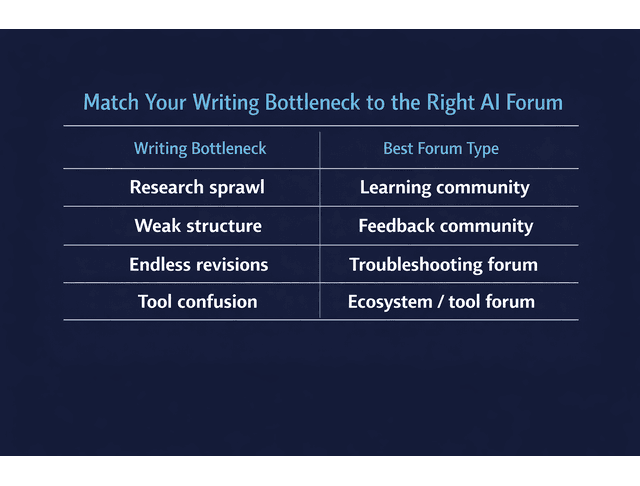
If you join forums without a goal, you’ll end up with tabs, not answers. Most writers don’t need “more AI content.” They need the right kind of community for the bottleneck they’re facing today—research sprawl, messy outlines, voice loss in edits, or tool confusion.
Best AI Forums for Workflow Wins
A forum is worth your time when it helps you ship something. For an Overloaded Producer, the highest-value wins usually fall into four buckets:
- Research compression: turn a messy topic into a clean brief fast
- Structure clarity: tighten an outline so drafting is straightforward
- Revision relief: reduce edit loops without flattening your voice
- Tool decisions: avoid experimenting with five tools when one is enough
Quick rule: if the community can’t help you produce a deliverable in one session, it’s not a “workflow win” space—it’s entertainment.
Learning vs Troubleshooting vs Feedback (AI Communities)
Use the right “type” of community for the job:
- Learning communities give you deeper threads and “why it works” context. Great when you’re building a repeatable system.
- Troubleshooting communities are for quick fixes: “Why is my output drifting?” “How do I structure this prompt?” Fast in, fast out.
- Feedback communities focus on critique and iteration. These are gold when your work is “almost there,” but you’re too close to it.
This single distinction reduces the most common failure mode: joining a dozen AI discussion forums that talk about work instead of helping you finish work.
Quick Fit-Check Signals
Do a 30-second skim test before you join or post:
- Moderation is visible (rules are enforced, spam isn’t everywhere)
- Threads are searchable (archives exist; answers aren’t trapped in chat)
- Reply quality is real (people ask clarifying questions; answers include reasoning)
If it fails the skim test, skip it.
Once you’re clear on what you need and which forum types fit that goal, the next step is choosing spaces that won’t waste your time.
How to Choose the Best AI Forums
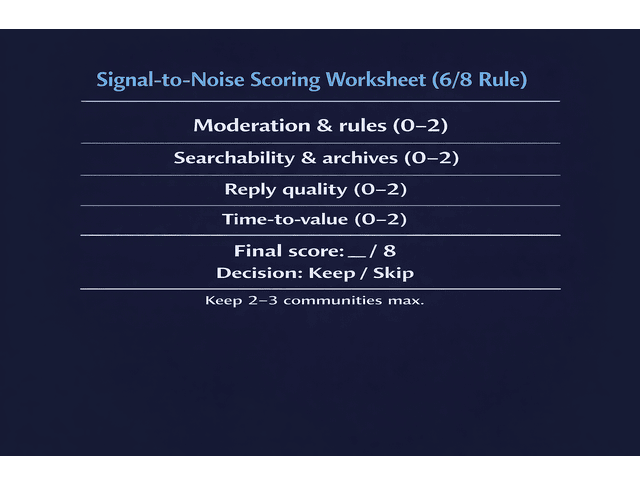
You don’t need more communities; you need fewer, better ones. Here’s a simple method to evaluate communities quickly—so you stop “trying them all” and start picking the ones that pay you back.
Signal-To-Noise Checklist (AI Communities)
Use this 5-minute evaluation before you commit:
A. Moderation & rules (0–2 points)
- 0 = vague rules, spammy promos
- 1 = rules exist but aren’t enforced
- 2 = rules are clear + enforced
B. Searchability & archives (0–2)
- 0 = answers vanish in chat
- 1 = searchable but messy
- 2 = searchable + organized
C. Reply quality (0–2)
- 0 = one-liners, hype, no follow-up
- 1 = occasional depth
- 2 = consistent context + examples
D. Time-to-value (0–2)
- 0 = takes hours to find anything useful
- 1 = occasional wins
- 2 = you can get a useful answer in one visit
Rule: If a forum scores 6/8 or higher, keep it. If it scores lower, don’t “give it more time.” That’s how burnout grows.
Default setup: Score communities before you post, then keep 2–3 active spaces max. Everything else is optional.
Best AI Forums by Skill Level
This isn’t about intelligence. It’s about norms.
- Beginner-friendly spaces tolerate applied questions and plain language. Good when your goal is writing output, not building models.
- Technical spaces assume jargon, code, and research context. They can be brilliant—but slow—if you’re trying to improve a client draft by tomorrow.
If the replies routinely include research shorthand and assume you’re implementing models, you’ll spend more time translating than writing.
Platform Tradeoffs Explained
Different platforms create different friction:
- Reddit AI communities: broad, active, but noise varies by subreddit and moderation style.
- Discord/Slack groups: fast and social, but easy to get pulled into real-time distraction.
- Traditional forums: slower replies, but high archive value—perfect for writers who want searchable answers.
The platform isn’t the point. The question is: Does it fit your working style under deadline pressure?
After you’ve chosen the right forums, the real leverage comes from how you use them—not how many you join.
Using the Best AI Forums Effectively
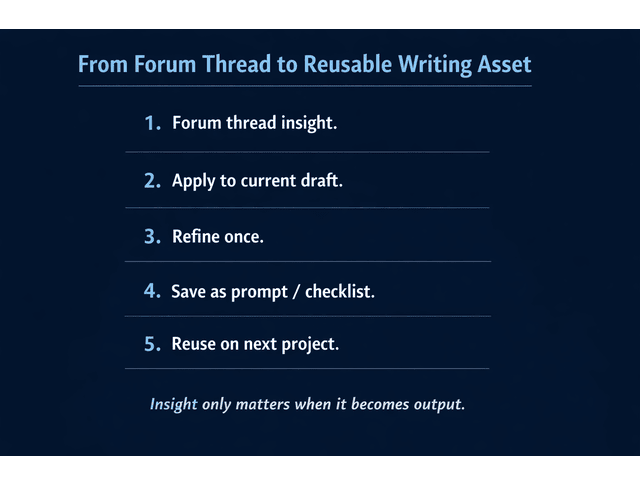
The win isn’t “being in the community.” The win is extracting value fast, then leaving. Being in the right communities is step one. Getting value without losing time is the real skill.
In the 2025 Stack Overflow Developer Survey, 84% of respondents say they’re using or planning to use AI tools in their development process, and 51% of professional developers report using AI tools daily.
Microsoft also reports that employees can be interrupted as often as every two minutes during core work hours for high-volume communicators. One reason real-time communities can quietly sabotage writing time is if you don’t time-box them.
Questions That Get Answers (Prompt Engineering)
High-signal communities respond best to posts that feel like real work, not vague curiosity. Use templates like these:
Template 1: Research compression
“I’m writing about [topic] for [audience]. Goal: [what the reader should do/understand]. Constraints: [tone, length, SEO angle]. Here are 5 bullets I have—what’s missing or misframed?”
Template 2: Outline critique
“Here’s my outline for [deliverable]. Where is the logic weak, redundant, or out of order? I want [outcome: clearer structure / fewer sections / stronger flow].”
Template 3: Voice-safe revision
“Here’s a paragraph. My voice is [plain/warm/authoritative]. I need it [shorter/clearer/less repetitive] without sounding generic. What would you change and why?”
These templates don’t just get replies; they get useful replies.
From Threads to Deliverables
Treat every good thread like a reusable asset.
One thread → one output workflow:
- Extract the best idea (one sentence)
- Test it in your draft immediately (don’t “save it for later”)
- Keep what works, delete the rest
- Save the final version as a reusable prompt or checklist
Mini example:
Before: “This section feels rambling.” → After: “Swap to Problem → Why it matters → 3-step fix → example.” Save that as Outline Prompt v1 and reuse it on the next client brief.
Best AI Forums Usage Routines
Keep this lightweight. You’re not building a second job.
Weekly routine (10–15 minutes):
- Open saved threads
- Tag anything useful:
- Research / Outlining / Editing / Voice / Client Comms
- Delete anything you won’t reuse within 30 days
Over time, this becomes a small, personal workflow library you can search and reuse—so you’re not solving the same problem twice.
With a clear usage routine in place, you can now start with a small, intentional shortlist—and protect your time as you go.
Best AI Forums Shortlist
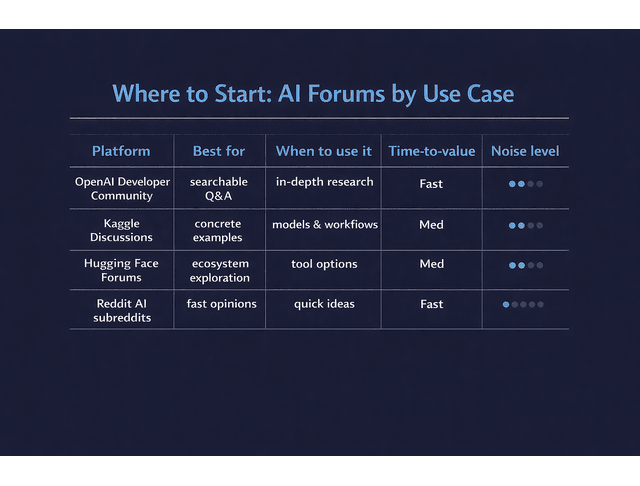
This is the “stop browsing, start choosing” section. You’re not looking for the most popular communities—you’re looking for the ones that reliably pay you back.
Top Picks in 60 Seconds
- Best overall (searchable + stable): OpenAI Developer Community
- https://forum.openai.com/
- Best for practical problem-solving culture: Kaggle Discussions
- https://www.kaggle.com/discussions
- Best for ecosystem context (models/tools/datasets): Hugging Face Forums
- https://discuss.huggingface.co/
- Best for broad Q&A volume (requires filtering): Reddit AI subreddits (r/MachineLearning, r/artificial)
- https://www.reddit.com/r/MachineLearning/
- https://www.reddit.com/r/artificial/
Choose-your-path (pick one place to start today):
- If your bottleneck is research sprawl, start with OpenAI Developer Community (search threads first; post only if needed).
- If your bottleneck is tool decisions, start with Hugging Face Forums (ecosystem context before you commit).
- If your bottleneck is “I need examples to learn from”, start with Kaggle Discussions (applied, example-driven mindset).
- If your bottleneck is “I want fast opinions”, use Reddit—but time-box it and verify anything you plan to reuse.
High-Signal General Hubs (AI Forums)
Use these as your foundation spaces.
OpenAI Developer Community
- Best for: model/tool discussion, practical Q&A, implementation context
- Not for: vague “what tool should I use” posts with no context
- Time-to-value: fast when your question is specific
Kaggle Discussions
- Best for: applied learning, concrete examples, problem-solving culture
- Not for: quick micro-edits on a paragraph
- Time-to-value: slower, but durable (great for archive mining)
Hugging Face Forums
- Best for: understanding tool and model options before you commit
- Not for: purely writing craft feedback
- Time-to-value: high when you’re choosing tools; less useful for line edits
Writer-Focused AI Communities
These are specialist add-ons when your problem is writing-specific: clarity, tone, voice, revision.
Use these when:
- You want voice-safe tightening (without “AI blandness”)
- You need outline critique and structural feedback
- You want prompt patterns that improve drafts and revisions
- You’re building a repeatable writing workflow, not debating AI philosophy
Where to look (categories):
- AI writing assistant communities (prompt sharing, workflows, “here’s what worked”)
- editing and revision critique spaces (clarity, tone, concision, readability)
- creator communities that discuss repurposing (blogs → posts → emails)
- writing subcommunities inside broader AI spaces (look for channels/threads labeled “writing,” “content,” “prompts”)
What to post there (one realistic example):
“I’m writing a client blog for [industry]. I need a stronger outline that reduces revision loops. Here’s my current outline—where does the logic break, and what would you cut?”
Safety and Sanity Rules
This is where most writers burn out: too many communities, too much chatter, too little output.
Do
- Anonymize examples
- Time-box visits (set a timer)
- Save only what you’ll reuse soon
Don’t
- Paste client docs or proprietary info
- Leave real-time notifications on by default
- Argue in low-mod spaces (it never pays you back)
Comparison Table
| Platform | Best for | Searchable? | Noise level | Time-to-value |
| Traditional forums | durable answers, archives | Yes | Low–Med | Med |
| broad Q&A volume | Yes | Med–High | Fast–Med | |
| Discord/Slack | quick back-and-forth | Limited | Med–High | Fast (but costly) |
| Curated directories | discovery | N/A | Low | Fast |
Final Thoughts
The best AI forums won’t make you magically faster. But they will remove friction—if you treat them like curated input and consistently convert useful threads into reusable prompts and checklists. Pick communities with a clear purpose, score them quickly, and keep only the ones that pay you back.
If you want deeper, structured systems for writing faster without losing your voice, visit my Amazon Author page.
Frequently Asked Questions About the Best AI Forums
The best AI forums depend on your goal. For writers, prioritize communities with strong moderation, searchable archives, and applied discussions. Start with one foundation hub for broad AI Q&A, then add a writer-focused community only if you need revision, voice, or prompt feedback.
Choose spaces that are moderated and searchable, then time-box your visits. If you can’t find useful threads within one focused session, the community is probably a distraction-heavy match for an Overloaded Producer.
They can be—if you treat them like a tool. Mute most channels, join for a specific purpose, ask your question, capture what you need, and leave. For long-term value, forums usually win.
Beginner-friendly forums welcome applied questions and explain reasoning without assuming code-level expertise—ideal for writers using AI for research, outlines, and editing.
Include context, constraints, and a concrete example. Then ask for one specific next step.

Florence De Borja is a freelance writer, content strategist, and author with 14+ years of writing experience and a 15-year background in IT and software development. She creates clear, practical content on AI, SaaS, business, digital marketing, real estate, and wellness, with a focus on helping freelancers use AI to work calmer and scale smarter. On her blog, AI Freelancer, she shares systems, workflows, and AI-powered strategies for building a sustainable solo business.