
If you’re searching for the best AI tools for writers, you’re probably not looking for shiny features. You’re looking for relief.
Endless research tabs can leave you mentally drained before you even begin writing. Rewriting the same paragraph five times chips away at your confidence and momentum. Watching other writers move faster while you’re still polishing drafts at midnight makes the gap feel even wider.
For mid-career freelancers and system-driven writers, the problem isn’t effort. It’s friction. The wrong tools create more steps. The right ones remove them.
This guide evaluates tools by workflow stage so you can build a calmer, faster, more predictable writing system.
Everything I’ve shared here—and more—is in my book, available on Amazon. Click the link if you’re ready to take the next step.
How to Evaluate the Best AI Tools for Writers
Before we talk tools, we need to define “best.”
A 2023 study reported by MIT News found that using an AI writing assistant — generative models in particular — reduced task time by about 40% while improving output quality compared to unaided writing. Researchers noted that AI paired with structured human direction produced the biggest gains.
When evaluating AI writing tools, use these criteria:
- Workflow stage fit (research, drafting, editing, repurposing)
- Output control and voice safety
- Performance consistency
- Risk factors like hallucinations and privacy
- Learning curve versus actual payoff
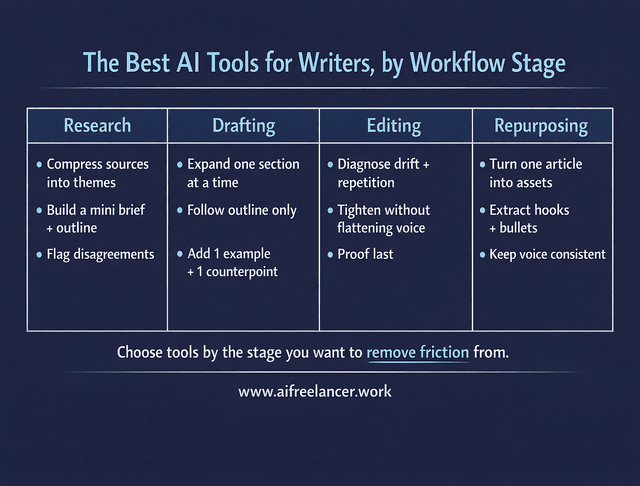
Start by identifying the stage that slows you down the most. When research feels overwhelming, focus on tools that compress information and cluster insights. If drafting is where momentum drops, use structured expansion to keep progress steady. When editing becomes exhausting, rely on tools that diagnose structure and logic first. And if your entire workflow feels chaotic, simplify your stack before introducing anything new.
Many writers feel the bottleneck first in research, but if your pain is editing or drafting, you can move to that section directly. We’ll start with research because it’s the most common slowdown.
Best AI Tools for Writers at the Research Stage
Research shouldn’t feel like drowning in 27 browser tabs.
For many freelancers, research becomes a second job: collecting sources, extracting points, organizing notes, and then trying to remember what mattered. According to Asana’s Anatomy of Work Index, professionals spend huge swaths of time on ancillary tasks rather than the core creative work itself.
The best research-stage tools turn scattered material into structure. After one focused session, you should have a clear brief that includes key claims, supporting evidence, and a draft outline you can refine.
A Simple Research Workflow You Can Run Today
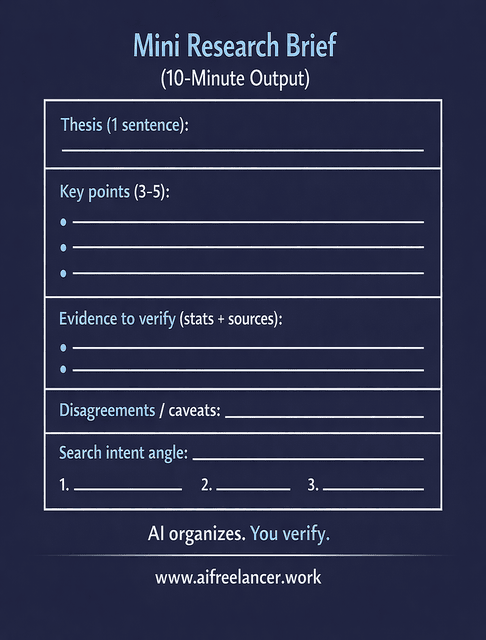
- Paste 5–10 URLs or excerpts into your AI research assistant.
- Ask it to extract the core thesis, supporting data points, and areas of disagreement.
- Prompt it to cluster insights into 3–5 themes aligned with search intent.
The result should be a mini research brief with headings, summarized evidence, and a structured outline. In practical terms, this turns unproductive tab-hopping into an organized direction in one sitting.
Verifying Facts and Citations Safely
AI compresses information efficiently. It does not validate authority.
Use AI to summarize and organize, then manually confirm statistics and claims against primary sources like Pew Research Center or McKinsey Global Institute reports. Never publish AI-generated citations without checking them yourself. Professional credibility still depends on human judgment.
Drafting Faster With the Best AI Tools for Writers
The first draft should feel mechanical, not emotional.
Blank-page friction is usually structural, not creative. When your outline is clear, drafting becomes execution.
The best drafting-stage tools help you expand a defined section while keeping structure intact. Instead of generating an entire article at once, work section by section and control scope.
A Controlled Drafting Sequence
- Paste your finalized heading and bullet outline.
- Prompt the tool to expand the section without adding new subtopics.
- Ask it to include one example and one counterpoint to strengthen clarity.
You should end up with a clean, structured section draft that follows your outline and resembles a solid first pass — not a complete article you have to dismantle.
For long-form content, lock the outline first. Draft one section at a time. Avoid full-document generation. These simple constraints prevent structural drift and reduce heavy rewrites later.
AI improves productivity most when paired with structured human direction, not when it replaces it.
Editing Smarter: Best AI Tools for Writers Who Hate Rewrites
Editing drains more energy than drafting when the structure is weak.
Surface-level grammar tools are helpful, but they don’t diagnose logic gaps or repetition. The strongest editing agents act like editors first: they show you where an argument drifts, where repetition lives, and which sections can be tightened without flattening your voice.
A Four-Pass Editing Model
- Pass 1: Structure — Confirm logical flow.
- Pass 2: Clarity — Strengthen weak claims.
- Pass 3: Tightening — Remove unnecessary wording.
- Pass 4: Proofread — Correct surface errors.
This model turns editing into a reliable system rather than a guessing game.
Protecting Your Voice During AI Edits
Anchor your tool to a sample of your writing style. Instruct it to preserve tone and rhythm. Keep a stop rule: if edits begin flattening your voice, complete the final pass manually. AI should tighten your writing, not sanitize it.
Best AI Tools for Writers and the Minimal Stack Model
More tools often mean more friction.
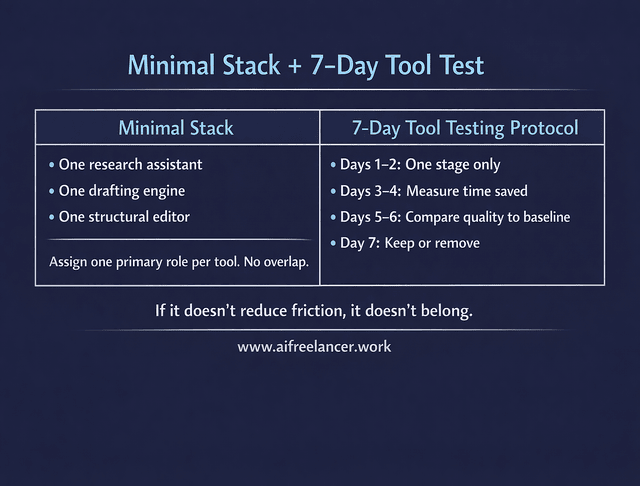
Writers who move fastest typically operate with a minimal stack:
- One research assistant
- One drafting engine
- One structural editor
Assign each tool a single primary role. Avoid overlap. Review your stack weekly and remove anything that does not reduce friction.
Track simple indicators such as time saved per draft and fewer revision rounds. If a tool does not clearly improve either, it likely does not belong in your system.
A 7-Day Tool Testing Protocol
- Days 1–2: Use the tool for one defined stage only.
- Days 3–4: Measure time saved compared to manual work.
- Days 5–6: Compare output quality to your baseline.
- Day 7: Decide whether to keep or remove it.
Structured testing prevents reactive tool adoption and keeps your workflow stable.
Emerging AI Applications Writers Should Watch
After you’ve simplified your core stack, you can explore what’s next.
Emerging AI applications can automate entire steps rather than individual tasks. AI agents are beginning to convert batches of sources into structured briefs, generate outlines from intent patterns, and repurpose long-form content into shorter assets, reducing context switching and compressing preparation time. A broad overview of AI writer tool categories illustrates how tools can do very different work — from idea generation to structural editing — depending on your goals.
Another development is argument auditing. Instead of correcting grammar, these tools analyze claim strength, surface counterarguments, and detect logic gaps. Structural editing improves readability. Argument auditing strengthens authority.
If you experiment here, apply these tools to one long-form piece and compare clarity before and after. Measure whether improvements feel sharper without losing your voice.
Final Thoughts
The best AI tools for writers are not defined by feature count. They are defined by how effectively they remove friction at a specific stage of your workflow.
If you’re an overloaded producer, the right stack returns hours to your week. If you’re a structure-seeker, it gives you a predictable system that reduces decision fatigue.
AI should function as infrastructure, not a distraction.
If you want a structured framework for building a calm, efficient AI writing workflow, explore my books and resources on my Amazon Author page.
Build systems. Reduce friction. Scale sustainably.
Frequently Asked Questions About the Best AI Tools for Writers
Every stage of the writing process demands a different kind of support. When handling research, prioritize AI that condenses multiple sources and turns scattered information into structured briefs. For drafting, select tools that expand your outline step by step without wandering off course. During editing, focus on solutions that analyze structure and logic rather than just correcting grammar. When it comes to repurposing, rely on AI that can reshape a blog post into emails or social content while preserving your central message. Ultimately, the right tool is the one that strengthens the exact stage where your progress slows.
AI improves quality by strengthening structure and clarity. It can help you build cleaner outlines, identify weak transitions, surface repetition, and suggest tighter phrasing. However, quality ultimately depends on human direction. Writers still need to shape the argument, verify facts, refine tone, and decide what to keep or cut. AI enhances the process, but it does not replace editorial judgment.
Many AI tools offer free tiers that are useful for basic drafting or grammar correction. These are often enough for testing workflows or light content. However, professional writers typically benefit from paid plans because they provide stronger models, greater consistency, longer context windows, and advanced features such as structural analysis and automation. If a paid tool consistently saves hours per week, it usually justifies its cost.
AI cannot replace freelance writers because it lacks strategic thinking, lived experience, and client-specific nuance. While AI can generate drafts quickly, it does not understand audience psychology, brand positioning, or business objectives as well as a professional writer does. Writers who use AI effectively become more efficient and competitive — not obsolete.
Professional writers use AI as an assistant, not an author. They rely on it to organize research, expand outlines, and flag structural issues. They manually verify all facts and statistics, avoid copying AI-generated citations, and always perform a final human edit. By setting clear guardrails and maintaining control over tone and argument, they protect originality while gaining speed.

Florence De Borja is a freelance writer, content strategist, and author with 14+ years of writing experience and a 15-year background in IT and software development. She creates clear, practical content on AI, SaaS, business, digital marketing, real estate, and wellness, with a focus on helping freelancers use AI to work calmer and scale smarter. On her blog, AI Freelancer, she shares systems, workflows, and AI-powered strategies for building a sustainable solo business.