
You’re juggling multiple clients, staring at half-finished drafts, and watching “urgent” briefs pile up. The last thing you have time for is guessing which topic might perform, or rewriting yet another blog that sinks without clicks, shares, or leads. That’s the silent tax on your time: content that feels okay but doesn’t move the needle. This is where data-driven content marketing stops being a buzzword and starts acting like a filter. Instead of trying to write more, you use data to decide what’s worth writing at all. That way, every piece has a clearer purpose, a defined audience, and a measurable outcome.
Let’s walk through how to use industry data to build a calmer, more effective content workflow.
Everything I’ve shared here—and more—is in my book, available on Amazon. Click the link if you’re ready to level up.
Why Data-Driven Content Marketing Matters for Freelance Writers
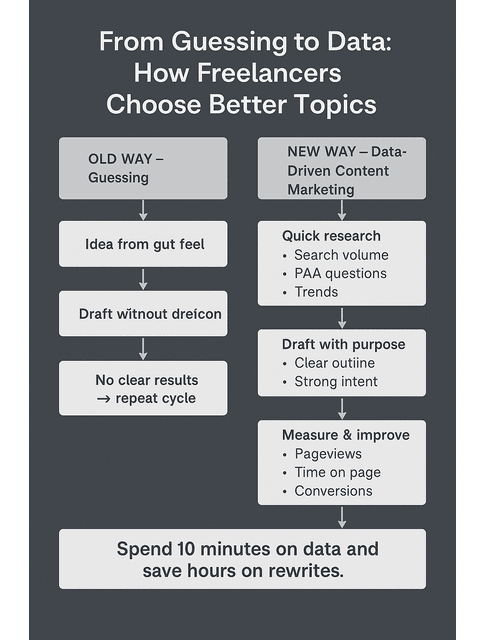
You’re not just competing with other writers—you’re competing with guesswork. Every time you choose a topic based on “what feels right,” you’re gambling your time. Data-driven content marketing turns that guess into a decision, so you spend your limited energy on pieces that are actually likely to perform.
Understanding Audience Intent Through Market Trends
As a mid-career freelance writer, your biggest asset isn’t just your writing skill—it’s how accurately you can anticipate what your client’s audience wants to read.
Industry data helps you do that by showing:
- What people are actually searching for (search volume, related queries, People Also Ask).
- How they phrase their questions (great for headlines and H2s).
- Which topics sustain interest vs. quick spikes (Google Trends, social listening)?
Instead of starting from a blank page, you’re starting from real behavior, which makes your outlines easier and your pitches more grounded.
How Market Signals Reveal High-Value Topics
Market signals—like rising search terms, popular formats, or competitor content that keeps getting backlinks—tell you where the attention is. These come from:
- AI market analysis tools
- SEO tools (search rankings, SERP features, keyword difficulty).
- Social metrics (saves, shares, comments on posts around a topic).
- Email and on-site data (click-through rates, time on page, scroll depth).
For you, that translates into a simple question: Which ideas are worth a full blog, and which are better as a tweet or a LinkedIn post?
Using Data-Driven Content Marketing to Validate Ideas Before Writing
Here’s the sanity-saving shift: you don’t commit to 2,000 words until the idea earns its place.
Before you pitch or draft:
- Check if people search for the topic (or a closely related one).
- Look at the SERP and see what already ranks.
- Ask: “Is there a gap I can fill—angle, depth, format, audience?”
Nearly 80% of marketers now use data analytics to shape their strategies and drive better results, which means moving away from gut feel puts you in line with how leading teams already work.
For example, if a client wants a post on “remote team productivity,” you might search for that phrase, scan the top results, and check the People Also Ask box. Suppose you see questions like “How do you measure remote productivity?” and “What are the best tools for managing remote teams?” In that case, you can build an outline that answers those questions directly instead of guessing what to cover.
That’s data-driven content marketing at its simplest: letting evidence—not vibes—decide whether an idea becomes a full piece.
Core Types of Industry Data for Data-Driven Content Marketing
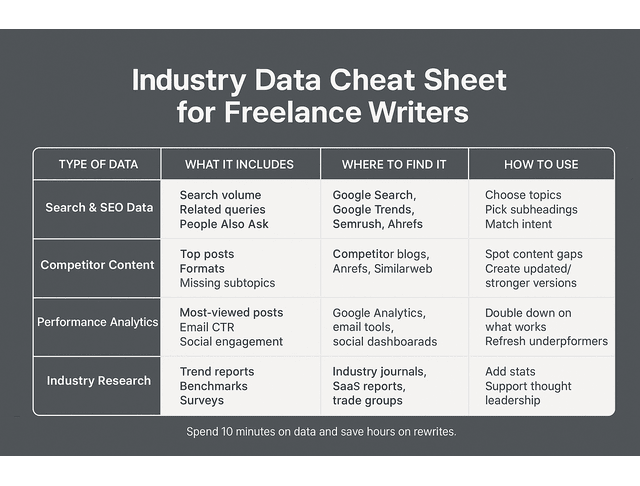
Industry data can feel abstract until you realize it’s just evidence of what real people care about. Search trends, competitor articles, engagement metrics—these aren’t just numbers, they’re clues. When you know which signals to watch, choosing topics and angles becomes less emotional and more predictable.
Competitive Content Audits for Gap Analysis
A quick competitor audit doesn’t need a complex framework. For each main competitor or similar brand:
- List their strongest content by traffic, backlinks, or shares.
- Note formats: guides, case studies, comparison posts, checklists.
- Spot gaps: outdated posts, missing subtopics, weak explanations.
Here’s a simple checklist you can literally copy into your notes and reuse for each competitor:
- Top 3–5 pages by traffic or links
- Main topics they cover repeatedly
- Content formats they rely on most
- Obvious gaps or outdated posts you could improve on
This “gap analysis” gives you ready-made opportunities: “definitive” explainers, updated guides, or niche angles your client can own.
Platform Analytics and Performance Signals
Even if you don’t have full analytics access, you can often see:
- Top posts on a client’s blog (most viewed / most shared).
- Email campaigns with the highest open or click-through rates.
- Social posts that outperform others (saves, comments, shares).
If you’re just getting started with data, ask your client for three simple things:
- A list of their top 5–10 blog posts by traffic
- The subject lines and topics of their best-performing emails
- Examples of social posts that got above-average engagement
These performance signals tell you what already resonates, so you can double down instead of starting over.
Industry Reports That Support Data-Driven Content Marketing Decisions
Industry reports, trend studies, and benchmark data help you:
- Back up claims with fresh stats (great for thought leadership).
- Spot “macro” themes (AI adoption, buyer trust, budget shifts).
- Align client content with what decision-makers are worried about this year.
If you don’t know where to start, try searching for phrases like “[industry] trends 2025,” “[niche] benchmark report,” or “[topic] industry statistics.” Save the most relevant reports in a single folder so you can quickly pull stats and charts into future drafts.
Use them to choose angles like “2025 benchmarks,” “what’s changing this year,” or “how top performers approach X,” reinforcing your data-driven content marketing strategy.
Using Data-Driven Content Marketing to Build a Strong Content Strategy
Collecting data is the easy part; turning it into a clear content plan is where most writers stall. The goal isn’t to drown in dashboards—it’s to translate insights into a handful of focused pillars, angles, and formats. Done right, your strategy becomes a map you can actually follow instead of a chaotic list of ideas.
Mapping Insights to Content Pillars With Topic Clustering
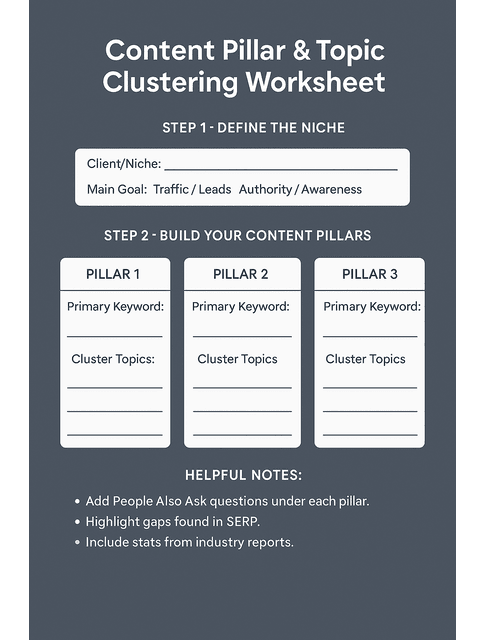
Once you’ve gathered data, cluster it into a few clear content pillars.
To make this more concrete, imagine you write for a SaaS time-tracking tool:
- Pillar A: Beginner education – “What Is Time Tracking?”, “Why Remote Teams Struggle With Time Management,” “How to Introduce Time Tracking Without Micromanaging.”
- Pillar B: Use cases and workflows – “Time-Tracking Workflows for Agencies,” “How to Use Time Data to Improve Estimates,” “Templates for Weekly Time Reviews.”
- Pillar C: Proof and results – “Case Study: How Time Tracking Increased Billable Hours by 20%,” “Benchmarking Your Team Against Industry Averages.”
Within each pillar, you can weave in LSI-style ideas like content analytics, audience insights, SEO content strategy, and conversion-focused content to diversify topics while staying on theme.
This makes your pitches clearer and your editorial calendar easier to manage.
Identifying Opportunity Keywords and Angles With SERP Analysis
When you look at the SERP for a target keyword:
- Note search intent (informational, comparison, transactional).
- Check what’s missing—e.g., examples, screenshots, templates, freelancer-specific advice.
- Look at People Also Ask questions to see what else readers want to know.
A simple three-question SERP scan you can use for any topic:
- What type of content dominates the first page (guides, listicles, comparison posts, tools)?
- Do the top results answer the main question clearly, or are there gaps in clarity, depth, or recency?
- What can you add—more beginner-friendly explanations, fresher data, specific examples, or a different audience angle (like “for freelancers” or “for small teams”)?
This is where you find “entry points” like:
- “[Topic] for small teams.”
- “[Topic] with limited budget.”
- “Beginner-friendly guide to [topic].”
These nuanced angles often have less competition but strong intent.
How Data-Driven Content Marketing Improves Your Content Calendar
A data-backed calendar isn’t just a list of blog titles; it’s a plan shaped by:
- Seasonal interest (e.g., Q1 planning, year-end reviews).
- High-intent keywords aligned with client offers.
- Supporting pieces designed to rank, nurture, or convert.
By building your calendar around proven topics and clear goals (traffic, leads, authority), data-driven content marketing helps you avoid random “idea of the week” posts. Once you have that kind of calendar, the next step is building a workflow that lets you move through research, drafting, and optimization without burning out.
Real-world examples show why this matters: one data-driven content update process increased organic traffic by 67% in four months. It brought in 23 new clients for a business that focused on optimizing existing posts based on analytics.
Building a Simple, Data-Driven Content Marketing Workflow for Writers
If every new brief feels like starting your process from scratch, you’re burning energy you don’t have. A simple, repeatable workflow built on data lets you move from research to outline to draft without overthinking every step. The result: faster projects, fewer rewrites, and a writing routine that feels sustainable instead of frantic.
Fast Research Workflows Using AI Tools
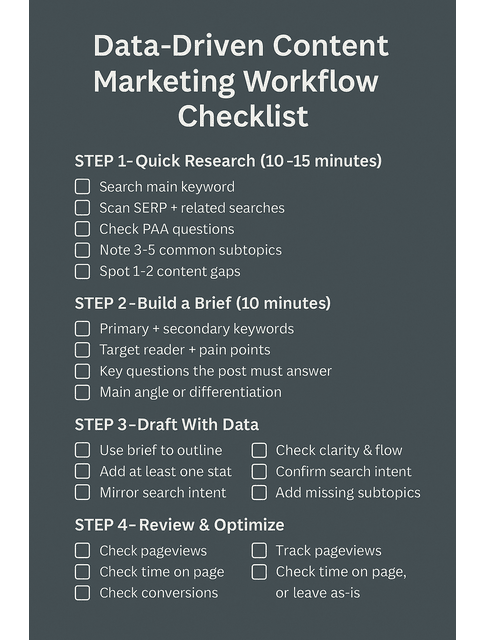
You don’t need to become a data analyst. You need a repeatable mini-process you can run before each piece:
- Search the main keyword → scan the SERP, PAA, and related searches.
- Use AI tools (like ChatGPT or SEO platforms) to summarize top-ranking pages, extract common subheadings, and list content gaps.
- Pull key stats from trusted reports to anchor your arguments.
A simple prompt you can reuse might be:
“Look at the top 5 ranking pages for “[keyword]” and summarize them. List the main subtopics each one covers, what they all share, and any important points they skip that you could turn into a unique angle.”
This keeps your research to 15–20 focused minutes instead of an afternoon of tab-hopping.
Creating Briefs From Industry Insights
Before drafting, build a one-page brief that includes:
- Primary keyword + 2–4 secondary keywords (e.g., content analytics, audience insights, data-driven strategy).
- Target reader description (role, pain points, desired outcome).
- Core questions the piece must answer (from PAA, forums, client FAQs).
- Desired CTA (book a call, download a guide, join a newsletter).
The brief becomes your “rails” so you can draft faster, with fewer rewrites.
Monitoring Results and Adjusting Your Strategy Through Continuous Optimization
Data-driven doesn’t mean “set and forget.” Every few weeks or months:
- Check which posts are gaining organic traffic and engagement.
- Identify underperformers and ask: “Is the topic off, or is the execution weak?”
- Update titles, intros, examples, or CTAs based on what works elsewhere.
If you’re not sure where to start with metrics, focus on three basics:
- Pageviews over time (is traffic growing, flat, or dropping?)
- Average time on page (are people actually reading it?)
- Conversions tied to that page (newsletter signups, downloads, inquiries)
That loop—publish → review → refine—is where long-term results (and repeat client work) come from.
Final Thoughts: Make Data Work for You, Not Against You
You don’t need to overhaul your entire process to benefit from data-driven content marketing. Start with evidence, then write. A bit of upfront research, a clear brief, and a feedback loop around performance can turn your workload from “constant scrambling” into a stable, repeatable system.
The payoff isn’t just better-performing content for your clients. It’s fewer dead-end drafts, more confident pitches, and a writing life that feels less like firefighting and more like deliberate, sustainable work. And there’s a clear upside: campaigns that use data-driven personalization have reported 5–8x higher ROI on their marketing spend compared with more generic efforts.
Ready to Build Smarter, Calmer Workflows?
If you want more step-by-step systems for research, writing, AI workflows, and burnout-proof productivity, explore my full library of books for freelancers and creators. You’ll find practical frameworks, simple templates, and real examples you can use immediately—without adding more work to your day.
Frequently Asked Questions About Data-Driven Content Marketing
Data-driven content marketing uses analytics, search trends, and engagement metrics to decide what to create and how to present it, instead of guessing. To start, review your top-performing posts and ask, “What topics and formats show up most often?”
It matters because it keeps you focused on content that’s more likely to work, so you waste less time and create pieces that better support real business goals. Even something as simple as checking which posts get the most traffic or engagement before choosing your next topic can make a noticeable difference.
Data shows which topics drive valuable traffic, which formats keep people reading, and which calls to action spark clicks or inquiries. With those insights, you turn content into a repeatable system you can refine, instead of a string of one-off experiments.
Choose a clear goal for your content—traffic, leads, or authority—then research topics with keyword tools and SERP checks, group ideas into a few buyer-journey-aligned pillars, publish consistently, and track performance to refine. If you’re new to this, start with one or two pillars, write a few posts for each, then double down on the one that performs best.
Freelancers can use data to pitch sharper ideas, build outlines around real search queries, and choose formats that match how audiences actually read, making their content more effective and positioning them as partners who understand results, not just writing. In your next pitch, add a line like, “This topic gets consistent search interest and aligns with your best-performing posts on X,” to show your ideas are backed by more than intuition.

Florence De Borja is a freelance writer, content strategist, and author with 14+ years of writing experience and a 15-year background in IT and software development. She creates clear, practical content on AI, SaaS, business, digital marketing, real estate, and wellness, with a focus on helping freelancers use AI to work calmer and scale smarter. On her blog, AI Freelancer, she shares systems, workflows, and AI-powered strategies for building a sustainable solo business.