
You’re at your desk at 11:30 p.m., revising the same section yet again while Slack won’t stay quiet, your inbox keeps climbing, and tomorrow’s deadline feels way too close. You’ve tested a few AI tools, but they either churn out bland filler or take too much effort to set up. You’re not trying to turn into a data scientist—you want to use machine learning for content creation, the kind that learns from real patterns, so your workload finally feels lighter instead of heavier.
Most marketing teams and solo creators now rely on some form of AI to plan, write, or optimize content. In HubSpot’s 2025 State of AI and content marketing data, 55% of marketers say content creation is the top use case for AI. Adobe reports that 83% of creative professionals are using generative AI tools in their work to save time and support brainstorming.
For you as a freelance writer, the goal isn’t to replace your skills. It’s to let the machine handle the patterns—so you can focus on judgment, voice, and strategy.
In this guide, you’ll learn:
- Where machine learning actually fits in a writer’s week
- How to plug tools into research, outlining, and drafting
- What to look for in tools so you don’t end up with shiny-but-useless apps
- How to scale without burning yourself out
Let’s start with the problem you actually feel: your workload.
Everything I’ve shared here—and more—is in my book, available on Amazon. Click the link if you’re ready to take the next step.
Machine Learning for Content Creation and Your Workload
Your issue isn’t effort—you’re already giving everything you’ve got. The real problem is that every client expects quick turnarounds, and you’re still handling each step by hand. In this section, you’ll see how to direct machine learning toward the tasks that drain you most so your week stops feeling like an endless race you never meant to run.
Spot Projects That Suit Machine Learning for Content Creation
Not every task benefits from automation. High-stakes brand voice decisions, sensitive messaging, and nuanced storytelling still need you in the driver’s seat.
Good candidates for machine learning for content creation are:
- Repetitive formats: listicles, how-to posts, product roundups, FAQ sections
- SEO content where structure matters as much as style
- Supporting assets: meta descriptions, alt text, social snippets
These projects follow patterns—exactly what machine learning is good at recognizing across large amounts of text and behavior data.
As a rule of thumb: if you can describe the task with “I do almost the same thing every time, just with different inputs,” it’s a good fit.
Map Your Week to Find Energy Drains
Before you plug tools into everything, step back and assess your actual week.
Take one recent week and list:
- Each client project
- The stages you went through (brief → research → outline → draft → revise → upload → invoice)
- Rough time spent on each stage
You’ll usually notice that research, repetitive formatting, and drafting “version 0” eat a huge amount of time and energy. Studies on natural language processing (NLP)—the branch of AI that works with text—and text summarization show that machine learning can significantly reduce reading and synthesis time by condensing long documents into key points.
Those heavy, repetitive phases are where AI can take the first pass safely.
For a quick snapshot, your notes might look like this:
- Client A – SaaS blog – Research: 2.5 hours, Outline: 45 minutes, Draft: 3 hours, Revisions: 1 hour
- Client B – Email sequence – Research: 1 hour, Draft: 2 hours, Revisions: 45 minutes
- Client C – Landing page – Research: 2 hours, Draft: 3 hours, Revisions: 1.5 hours
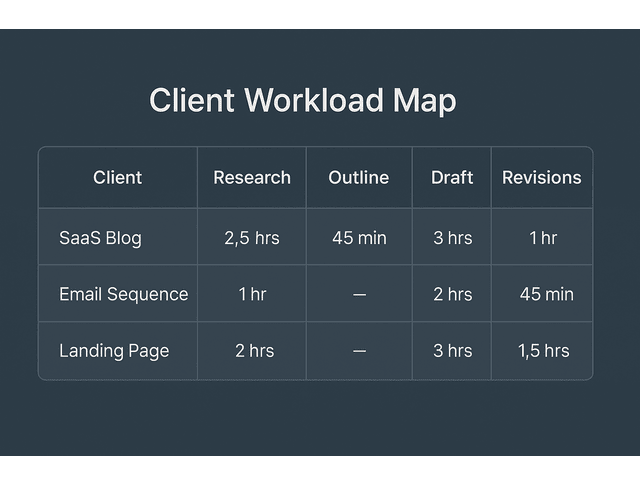
Once you see this written down, it becomes obvious where machine learning can take over the heaviest, most repetitive chunks.
Turn Repeat Requests into Simple Systems
Next, look at client patterns:
- Do you keep writing similar “what is X?” sections for the same niche?
- Are you routinely asked for FAQs, pros/cons, or comparison tables?
- Do clients request similar SEO structures (H2s, FAQs, meta descriptions, snippets)?
Turn these into small, reusable workflows:
- A standard brief template
- A base outline for each content type
- A saved “research + summarize” prompt
- A checklist for SEO elements
You’re not handing your work over to a robot. You’re building little rails, then using ML-powered tools to run along them faster.
Time-Saving Wins with Machine Learning for Content Creation
You don’t have hours to babysit another tool to save a few minutes. Here, you’ll see specific, low-friction ways machine learning for content creation can shave real time off research, outlining, and drafting—without wrecking your voice.
Use Topic Clusters to Plan Smarter Content
One of the strongest ways writers can utilize machine learning is by leveraging topic clustering. Many SEO tools can group related keywords and search queries into themes, giving you a ready-made starting point for pillar pages and their supporting posts. In simple terms, topic clustering means grouping similar searches so that your content plan aligns with how people actually look for information.
For you, that means:
- Faster ideation: one seed topic becomes 10–20 related posts
- Clearer structure: pillar → clusters → internal links
- Stronger pitches: you can propose mini content campaigns, not isolated posts
Instead of manually sorting keyword lists, let the tool handle the clustering for you. You step in to decide which clusters matter for your client’s audience and offers.
Let NLP Summaries Cut Research Time
Long whitepapers, technical docs, and dense articles can quietly kill your energy. NLP-based summarization tools now condense lengthy texts into concise, structured summaries, highlighting the main ideas and key points.
A simple workflow:
- Drop the source into a summarizer.
- Ask for: 5 key points, top stats, and a short plain-language summary.
- Scan the output and click into the original only where necessary.
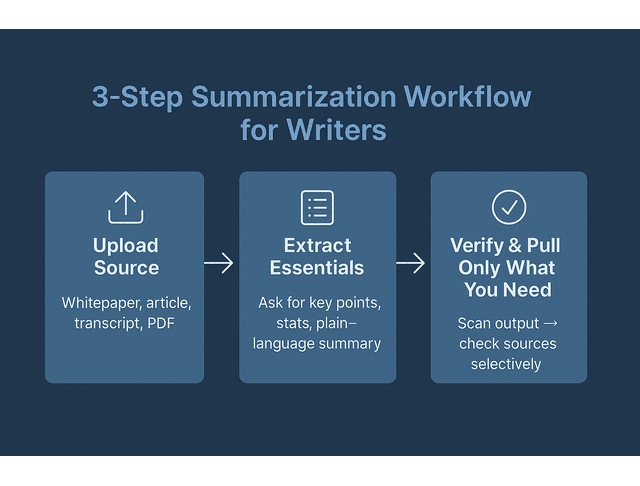
You still verify facts and nuance, but you skip the “read everything line by line” grind.
Case Study: Cutting Research Time for a SaaS Blog Writer
Consider a mid-career freelance writer specializing in long-form SaaS blog content. Before using NLP summarization, they spent roughly three hours reading and extracting notes for each 2,500-word article. After building a workflow around summaries and key-point extraction, research time decreased to approximately 75–90 minutes per piece, while the depth and accuracy of the articles remained unchanged. Over a month of four to six similar posts, that shift translated into an extra working day they could allocate to higher-paying strategy work instead of pure reading.
Example Workflow: SaaS Blog with ML Support
To see how this looks end-to-end, imagine a standard 2,000–2,500-word SaaS blog:
- Start with a keyword list from your SEO tool and let ML-powered clustering group them into 3–5 tight themes.
- Choose one cluster and ask your AI assistant to propose a pillar-style outline with H2s and H3s that match that theme.
- Feed 2–3 key sources into a summarizer to get main ideas, stats, and definitions instead of reading everything from scratch.
- Have the tool draft “version 0” for predictable sections, such as definitions, feature overviews, or simple FAQs, then rewrite and layer in your angle, examples, and client voice.
- Finish with an ML-assisted on-page check for meta descriptions, alt text, internal links, and skimmability, then conduct a final human review before sending.
You still retain ownership of the thinking, structure, and quality control. Still, the machine removes much of the mechanical reading and friction associated with first drafts.
Plug Machine Learning for Content Creation into Drafts
Drafting is where many writers either overuse or underuse AI.
A balanced approach:
- Use AI to create a rough outline based on your cluster and brief.
- Ask it to generate a first pass for sections you find repetitive (definitions, feature lists, or basic FAQs).
- Rewrite, reorder, and refine in your own voice.
Industry case studies and marketing analyses consistently demonstrate that AI performs best when humans act as editors and decision-makers, rather than passive consumers of raw output.
The machine provides you with clay; you decide what sculpture to create.
Case Study: Doubling Output Without Losing Voice
A small B2B tech content studio conducted a three-month experiment to track what actually changed. They utilized machine learning for content creation to generate outline-based first drafts for their standard blog formats, then handed those drafts to senior writers for refinement and personalization. That simple shift allowed them to increase from about eight publishable posts a month to 16, without adding anyone to the team. Client feedback scores and engagement numbers remained steady, and the writers reported feeling less exhausted because they spent more time editing and refining ideas, rather than struggling with a blank page.
Choosing Machine Learning for Content Creation Tools
The wrong AI stack turns into another noisy tab; the right one becomes a quiet, reliable assistant. This section helps you distinguish between flashy demos and tools that actually support your expertise, boundaries, and client results.
Machine Learning for Content Creation vs Basic Chatbots
Not all AI tools are equal.
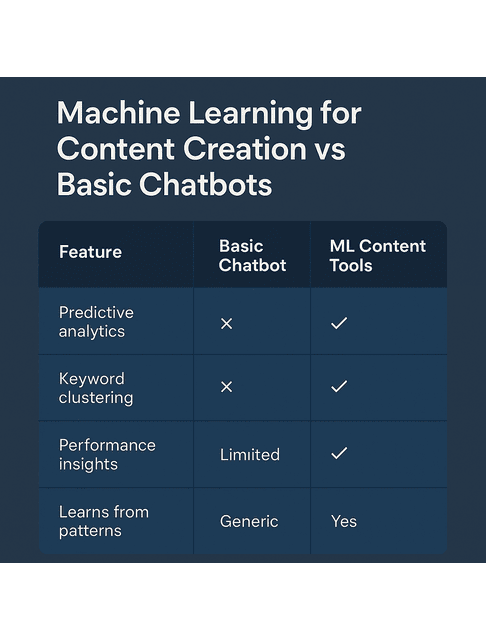
- Basic chatbots reply to prompts but don’t necessarily learn from patterns in your workflows or analyze large structured datasets.
- Tools built on machine learning for content creation often incorporate capabilities such as keyword clustering, predictive analytics, and insights into content performance.
In practice, that might look like:
- An ML-driven SEO suite can suggest topics based on search behavior.
- An email platform can predict which subject lines will get more opens.
- A recommendation engine can surface older content for reuse or repurposing.
You don’t need the most advanced stack. You need tools that clearly link their features to outcomes you care about, such as time saved, better briefs, and stronger results.
Key Features Writers Should Look For
When evaluating new tools, begin with the basics. Can you actually tell what the tool is doing—whether it’s grouping keywords, rating ideas, or pulling out key points—or does it hide everything behind vague outputs? And once it generates something, can you shape it the way you want by adjusting tone, length, and structure, or do you end up fighting the interface?
Third, does it integrate well with the rest of your stack, such as your CMS, documents, or project management tools? Finally, check how the company handles your data and whether they clearly explain how they store, use, and protect it.
Google’s own guidance on helpful content emphasizes experience, expertise, authoritativeness, and trustworthiness (E-E-A-T). The tools you choose should help you demonstrate those qualities—not undermine them with vague outputs or risky data practices.
If you write SEO-heavy blogs and landing pages, prioritize tools that offer keyword clustering, SERP analysis, and on-page optimization suggestions; if you handle long-form thought leadership, look for strong summarization, outline generation, and citation support; if your work leans on email and funnels, focus on platforms that test subject lines, predict send times, and segment audiences based on behavior.
Keep Control of Strategy and Voice
No matter how good the tool is, it doesn’t understand:
- Your client’s politics and internal dynamics
- The subtle positioning differences between competitors
- The lived experience you bring from years of writing for a niche
Treat AI suggestions as drafts, not decisions. You make the final call on:
- What angle to take
- Which claims are ethical and accurate
- How far are you willing to lean on automation for a given project
That’s how you maintain trust with clients and audiences.
Scaling Client Work with Machine Learning for Content Creation
If every new client means less sleep, you don’t have a business—you have a slow-motion burnout plan. In this final section, you’ll learn how to use machine learning for content creation to scale your income, protect your calendar, and keep your nervous system in the green.
Automate Onboarding Without Losing the Personal Touch
Client onboarding is full of repetitive but important steps:
- Sending welcome emails and questionnaires
- Collecting brand voice samples
- Sharing timelines and expectations
You can use ML-powered forms and email tools to:
- Auto-tag clients by niche, package, and content type
- Generate draft welcome emails tailored to each project scope.
- Suggest initial content ideas based on their website and FAQs.
You still customize final messages, but the machine handles the boilerplate.
Use Simple Metrics to Track Time Saved
To know whether your AI workflows actually help, track:
- Time spent on research before vs after using summarization
- Number of drafts per piece before vs after using outline support
- Energy levels at the end of the day (even a 1–5 quick rating works)
Marketers and content teams that track AI ROI often find major gains in speed and volume once they use tools for the right tasks.
Apply the same thinking to your solo business. If a workflow doesn’t save you time or mental load, tweak it or drop it.
A simple snapshot might look like this:
- Week 1 (no ML): 3 hours research + 4 hours drafting per blog → 2 blogs shipped, end-of-day energy: 2/5
- Week 4 (with ML): 1.5 hours research + 3 hours drafting per blog → 3 blogs shipped, end-of-day energy: 3–4/5
Seeing the numbers side by side makes it easier to decide which workflows to double down on and which ones to retire.
Case Study: Reclaiming a Day a Week for High-Value Work
A solo content strategist began logging time and energy levels before and after adopting ML-based research, clustering, and template-driven drafting. Within six weeks, they found they were saving roughly 6–8 hours per week across three retainer clients—time they redirected into upselling strategy sessions and building a small productized offer. Revenue increased, but more importantly, they reported fewer late nights and a more predictable, less chaotic schedule.
Common Mistakes When Using ML in Your Workflow
As you experiment, watch out for a few easy traps:
- Automating too much, too fast—if you hand off whole drafts immediately, you risk bland, off-brand content and eroding client trust.
- Skipping measurement—if you don’t track time, output, and energy before and after, it’s hard to tell whether a workflow actually helps or feels novel.
- Trusting outputs unquestioningly—fact-check claims, verify stats, and make sure examples fit your client’s context instead of assuming the tool “must be right.”
Catching these early keeps ML as a support system, rather than another source of cleanup work.
Reinvest Time from Machine Learning for Content Creation
Time saved is only useful if you use it well.
Instead of filling every spare slot with more low-value work, deliberately reinvest:
- Some time into a higher-value strategy and consulting for clients
- Some into deep work on your best-paying projects
- Some into actual rest, so you don’t edge toward burnout.
Final Thoughts
When you treat machine learning for content creation as a quiet assistant—one that spots patterns, surfaces ideas, and handles busywork—you take back the attention you need for the parts of your craft no tool can touch. Your clients get better work, and you build a business that no longer drains your entire nervous system to stay afloat.
If you want a clear, writer-first guide to using machine learning for content creation without overwhelm, explore my books on Amazon. They break down practical workflows, show exactly where ML fits into real client work, and help you protect your attention while delivering better results. Visit my Amazon Author page to find the book that matches how you want to work next.
Frequently Asked Questions About Machine Learning for Content Creation
Machine learning for content creation refers to using algorithms that learn from data (search behavior, text patterns, user interactions) to help plan, generate, or optimize content—things like keyword clustering, text summarization, predictive analytics, and draft generation.
ML-powered tools can cluster keywords, summarize lengthy sources, suggest outlines, and generate first-draft sections, which significantly reduces research and drafting time, allowing human creators to focus on editing and strategy instead of starting from a blank page.
Current evidence and expert opinion suggest that AI won’t replace skilled writers. Tools still lack the strategic judgment, domain insight, and lived context that strong writers bring to briefs, client relationships, and nuanced topics.
You can use these tools safely when you stick with reputable providers, read their data policies, keep highly sensitive information out of your prompts, and double-check what they produce. Many platforms also clearly outline how they use your content and provide options to opt out of training, where available.
Used effectively, ML can support SEO by helping you create topic clusters, optimize on-page elements, and generate content that prioritizes people more consistently. Rankings still depend on overall quality, relevance, and E-E-A-T—not just the use of AI tools.

Florence De Borja is a freelance writer, content strategist, and author with 14+ years of writing experience and a 15-year background in IT and software development. She creates clear, practical content on AI, SaaS, business, digital marketing, real estate, and wellness, with a focus on helping freelancers use AI to work calmer and scale smarter. On her blog, AI Freelancer, she shares systems, workflows, and AI-powered strategies for building a sustainable solo business.