
You finish the draft, you hit send, and you think, Finally—done. Then the comments come back: “This reads a little harsh,” “This example doesn’t make sense here,” or the one that really stings: “This feels culturally off.” Suddenly, you’re stuck in revisions you didn’t budget for, explaining intent instead of delivering outcomes. That’s the hidden cost of writing for a global audience: it’s not harder because your English is “wrong,” but because your assumptions are invisible until someone from another context reads them.
This isn’t about walking on eggshells. It’s about writing in a way that stays clear, respectful, and effective even when your reader’s cultural defaults aren’t the same as yours—so you ship confidently and cut down the revision loop.
And the stakes aren’t theoretical. CSA Research surveyed 8,709 consumers across 29 countries and found 76% prefer buying when product information is in their native language, while 40% say they’ll never buy from websites in other languages.
Everything I’ve shared here—and more—is in my book, available on Amazon. Click the link if you’re ready to take the next step.
How Writing For A Global Audience Changes Your Content
Most global writing problems aren’t grammar problems. They’re context problems. The content that sounds “natural” to you can land as confusing, sharp, or even disrespectful to someone who doesn’t share your cultural defaults.
Audience Mapping Across Regions, Dialects, And Reading Context
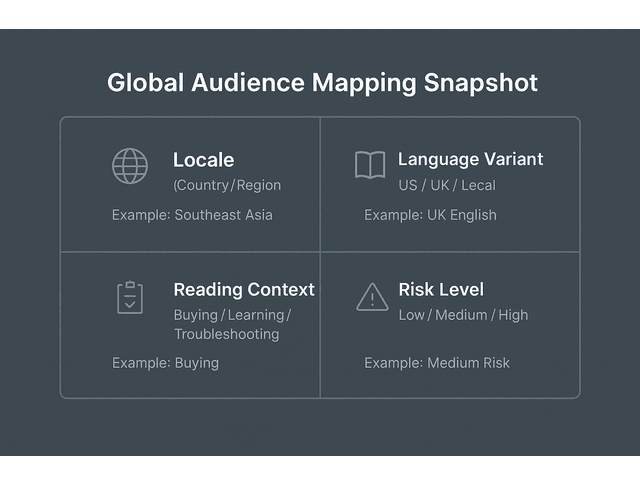
Beginners often imagine a global audience as a big group. In reality, “global” means you’re writing for people with different:
- English proficiency (native, fluent, functional, beginner)
- cultural norms around directness and politeness
- work contexts (corporate vs startup vs government vs academia)
- reading habits (mobile skimmers vs desktop researchers)
A simple way to map this without overthinking it is to run a quick four-part check. First, name the locale you’re targeting (country or region). Next, decide whether spelling and terminology should lean towards US, UK, or a specific local variant (for example, “CV” versus “resume”). Then clarify the reading context—are they buying, learning, or troubleshooting? Finally, set the risk level: is this a low-stakes blog post or a high-stakes page where pricing, policy, legal, or health implications raise the bar?
Why this matters: the ITU reports that in 2024, 5.5 billion people were online—about 68% of the global population—so your content routinely reaches readers outside your “default” context, even when you didn’t plan it that way.
Writing For A Global Audience And Tone Alignment Across Cultures
Tone is where “good writing” gets misunderstood fastest.
Some cultures prefer direct statements and clear asks. Others interpret the same directness as rude or overly aggressive. Your goal isn’t to please everyone—it’s to choose a tone that travels well.
A “Global-Safe” Tone Default
- Warm + clear rather than clever or overly casual
- Direct, but softened with context (“Here’s why…”, “A safer default is…”)
- Specific instead of punchy (“Reduce review time” beats “Move fast”)
Example: same point, different global readability
- Risky: “Stop overthinking it. Just do X.”
- Better: “If you’re not sure, start with X. It’s the safest default and reduces rework.”
Avoiding Idioms, Humor Traps, And US-Centric Assumptions
This is the quickest win for beginners.
What to remove or neutralize (common global tripwires):
- Idioms: “hit the ground running,” “ballpark,” “cut corners.”
- Humor/sarcasm: it often doesn’t translate and can be read as an insult
- Sports references: baseball/football metaphors are especially US-centric
- Holiday/seasonal assumptions: “this Thanksgiving,” “summer plans.”
- “Everyone knows” references: local TV shows, school systems, and pop culture
Rewrite the pattern you can use every time
- Idiom → plain meaning
- “Clever” → concrete
Example:
- “Let’s circle back next week.” → “Let’s follow up next week after you review the draft.”
- “That feature is a game-changer.” → “That feature reduces manual work by removing step X.”
Cultural Sensitivity Rules For Writing For A Global Audience
Cultural sensitivity is less about perfection and more about avoiding predictable harm: stereotyping, exclusion, and language that lands as disrespectful in contexts you didn’t consider.
Bias-Free Language, Identity Terms, And Respectful Framing
Two beginner rules cover most cases:
Rule 1: Don’t label people unless it’s relevant.
If identity doesn’t matter to the point, leave it out. Unnecessary labels create unnecessary risk.
Rule 2: Prefer neutral descriptors over loaded ones.
Words like “primitive,” “third-world,” “exotic,” or “illegal” (when you mean “undocumented,” depending on context) can carry heavy cultural and political weight.
A safer default is to:
- Describe the situation (“limited access to infrastructure”)
- Name the audience precisely (“customers in rural areas”)
- Avoid generalizations (“Asians,” “Europeans,” “the West”)
Examples That Travel Well In Writing For A Global Audience Across Markets
This is the replacement side: what to use instead of culture-bound references.
When you need examples that work across markets, lean on universal work scenarios and common business actions—deadlines, approvals, budgets, onboarding, billing, scheduling, and handoffs. Add neutral daily-life contexts like planning, learning, and comparing options.
A small “safe example bank” you can reuse
- “If you’re writing for first-time buyers…”
- “If your client is comparing two options…”
- “If a reader is scanning on mobile…”
- “If this will be translated, keep the sentence structure simple…”
These are boring in the best way: they travel.
Risk Topics, Taboos, And “Red Flag” Phrasing To Screen Before Publishing
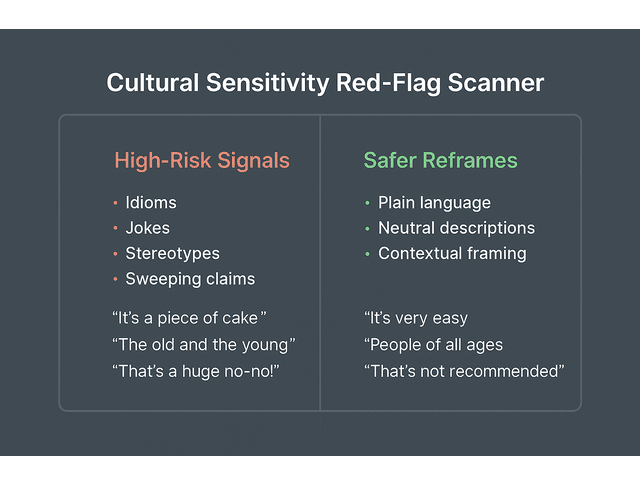
Some topics carry different cultural sensitivities and legal contexts across markets. If your content touches any of these, add a review step:
- religion
- politics and conflict
- gender and sexuality
- alcohol/drugs
- health and medical claims
- national identity and stereotypes
- humor about groups of people
Beginner “Red Flag” scan
Before you publish, search your draft for:
- “Obviously,” “everyone knows,” “normal people.”
- jokes aimed at a group
- sweeping statements (“They all…”, “In that culture…”)
- claims that could be regulated (health, finance, legal)
When in doubt, reframe from judgment to description:
- Judgment: “They’re conservative about…”
- Description: “In some markets, messaging is expected to be more formal.”
Localization-Ready Workflow For Writing For A Global Audience
Here’s the part that saves you time: a repeatable workflow you can run on every global-facing piece, even when you’re overloaded.
Before you build the workflow, decide how far you need to go for this specific piece.
Quick decision rule: when to keep it neutral vs. when to localize
When the goal is to sell—landing pages, email sequences, or pricing pages—plan for localization. Teaching content like blog posts, guides, and explainers usually works well with a global-ready neutral core. In regulated or high-risk areas (health, finance, legal, HR policy), treat local review as non-negotiable.
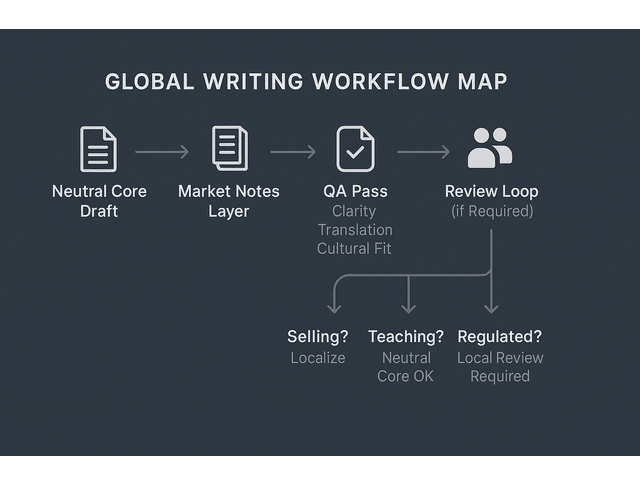
Write A Neutral Core, Then Add Market Notes And Glossaries
Think of your draft in two layers:
Layer 1: Neutral Core (publishable everywhere)
- plain language
- no culture-bound jokes/idioms
- clear definitions and context
Layer 2: Market Notes (where needed)
- Spelling variant: US vs UK
- Terminology: “VAT” vs “sales tax.”
- Examples: swap a US example for a local one
- Compliance notes: claims/wording that need review
Beginner-friendly glossary setup
Create a tiny glossary for any recurring terms:
- Preferred term
- Terms to avoid
- “Do-not-translate” items (brand names, product names)
This keeps consistency and reduces back-and-forth with editors or translators.
QA Checks For Clarity, Translation, And Cultural Fit
Run your QA in this order: start with a clarity pass to confirm a non-expert can understand the meaning on the first read. Then do a translation pass to catch anything that won’t travel well when language and context shift. Finish with a cultural fit pass to spot stereotypes, loaded identity labels, or “jokes” that could land as disrespectful or exclusionary outside your home context.
Review Loop With Regional Readers For Writing For A Global Audience
You don’t need a giant review committee. You need the right reviewer for the stakes.
Low stakes (blog post):
A quick read from someone who isn’t in your culture bubble (even one person helps).
High stakes (sales page, brand statement, policy):
Use a professional local editor or localization specialist.
To make the review loop actually useful (and not a vague “thoughts?” message), send reviewers a tight brief: the target market, the intended tone (warm, formal, direct), and the goal of the piece. Then ask for three specific checks: what feels confusing, what feels culturally odd or risky, and what sounds unnatural or overly literal. Capture the feedback in a simple “Issue → Fix” log so you don’t lose time debating opinions.
Writing For A Global Audience: Practical Examples And Templates
This is where beginners go from “I get it” to “I can do it.”
Before-And-After Rewrites For Landing Pages, Emails, And Blog Intros
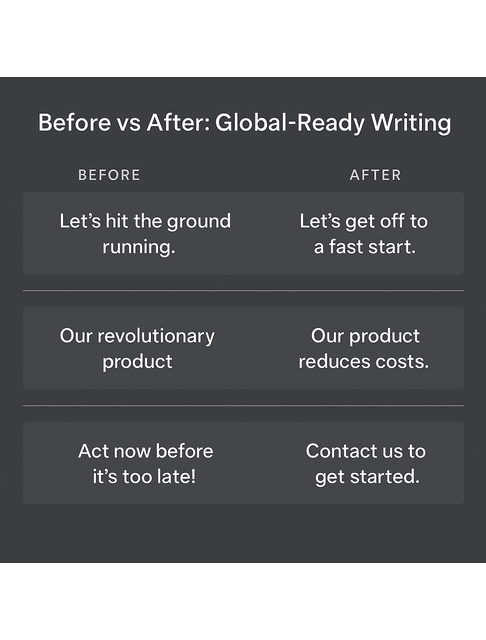
1) Landing page headline
- Before: “Crush your workload with our killer toolkit.”
- After: “Reduce manual work with a toolkit that streamlines your weekly tasks.”
2) Email follow-up
- Before: “Just bumping this to the top of your inbox.”
- After: “Following up in case you missed this—do you want me to proceed with option A or B?”
3) Blog intro
- Before: “If you’ve been living under a rock, you’ve seen…”
- After: “If you’re new to this topic, here’s the quick context you need before we dive in.”
4) Call-to-action line
- Before: “Jump on this before it’s too late.”
- After: “If you’d like to move forward, here’s the next step and the timeline.”
5) Pricing/offer clarity
- Before: “We’ll tailor something that fits you.”
- After: “We offer three options. Each includes X, takes Y days, and starts at Z.”
6) Feature benefit statement
- Before: “This makes your workflow a breeze.”
- After: “This reduces manual steps by automating X, so you spend less time on Y.”
These rewrites remove slang, idioms, and humor that can read as insulting or confusing outside your in-group.
One-Page Cultural Sensitivity Checklist For Faster Approval Cycles
Use this before sending to a client or publishing:
Clarity
- Did I define acronyms on first use?
- Did I avoid vague “this/that/it” references?
Global readability
- Did I remove idioms, slang, and culture-bound jokes?
- Are examples understandable without local knowledge?
Cultural sensitivity
- Did I avoid stereotypes and sweeping generalizations?
- Did I remove unnecessary identity labels?
- Did I avoid “red flag” phrases (“normal people,” “everyone knows”)?
Localization readiness
- Are dates/units/currency unambiguous?
- Do I need a glossary or market notes?
Global Style Sheet Template And “Do-Not-Translate” List For Consistency
Create a simple template you can reuse across projects:
Global Style Sheet
- Tone: warm, clear, professional
- Reading level: general audience
- Avoid: idioms, sarcasm, group-based jokes
- Spelling: US / UK
- Numbers: choose one format (1,000 vs 1.000)
- Dates: spell month (13 Dec 2025 / December 13, 2025)
Do-Not-Translate List
- brand/product names
- feature labels inside the app
- legal names and trademarks
This is what makes global writing scalable instead of exhausting.
Final Thoughts
Once you keep these assets consistent, you’ll see fewer “tone feels off” comments and faster approvals—because your process does the heavy lifting before your client ever sees the draft.
Writing for a global audience gets easier when you stop treating it like a creativity problem and start treating it like a workflow: remove culture-bound friction, choose examples that travel, and run a simple QA + review loop when the stakes are high. One last practical reminder as you write: users rarely read every word on a web page—Nielsen Norman Group found readers have time to read at most 28% of the words during an average visit (and 20% is more likely)—so your headings, examples, and plain-language defaults do a lot of heavy lifting.
If you want ready-to-use templates, workflows, and step-by-step writing systems you can apply immediately, visit my Amazon Author Page.
Frequently Asked Questions About Writing for a Global Audience
Use plain language, avoid idioms and culture-specific humor, and choose examples that don’t require local context. For high-stakes pages, add a regional review step.
Translation converts words into another language. Localization adapts meaning, tone, examples, and context so the content feels natural in the target market.
Avoid stereotypes and sweeping generalizations, remove jokes aimed at groups, and use a “red flag” scan for loaded language. When the stakes are high, ask a regional reviewer to check tone and references.
Not always. If you’re targeting specific markets commercially, localized versions often perform better. If the goal is broad reach, start with a global-ready English version, then translate the best-performing pages.
The most common mistakes are idioms, slang, culture-bound metaphors, unclear formatting (dates/units), and assuming the reader shares your norms about tone and directness.

Florence De Borja is a freelance writer, content strategist, and author with 14+ years of writing experience and a 15-year background in IT and software development. She creates clear, practical content on AI, SaaS, business, digital marketing, real estate, and wellness, with a focus on helping freelancers use AI to work calmer and scale smarter. On her blog, AI Freelancer, she shares systems, workflows, and AI-powered strategies for building a sustainable solo business.