

You’re juggling three client blogs, a landing page, and a “quick revision” that’s somehow on its third pass. In the middle of all that, you click into a shiny new AI tool that claims it will “revolutionize your workflow” with machine learning. A couple of minutes later, you’re staring at terms like supervised vs unsupervised learning, “labels,” and “clusters,” and all you can think is, I do not have time for this.
You’re not the only one drowning in promises. According to the 2024 Work Trend Index from Microsoft and LinkedIn, 75% of knowledge workers now utilize generative AI at work. Recent freelancer research suggests that around 73–75% of freelancers have already incorporated AI tools into their work. Most of that use is reactive and ad hoc—not built into calm, deliberate systems.
You don’t need another rabbit hole. You need just enough understanding of supervised vs unsupervised learning to pick the right tools, avoid the hype, and save real hours in your week. That’s what this guide gives you—no math, no jargon, just clear examples tied to your actual writing workflow.
Everything I’ve shared here—and more—is in my book, available on Amazon. Click the link if you’re ready to take the next step.
Supervised vs Unsupervised Learning in Plain Language for Writers
At a high level, machine learning is just pattern spotting at scale. The model examines numerous examples, identifies patterns, and leverages those patterns to assist with new inputs—such as emails, reviews, headlines, keywords, or full articles.
Where things split is how the model learns those patterns.
Supervised vs Unsupervised Learning as Two Ways to “Teach” a Model
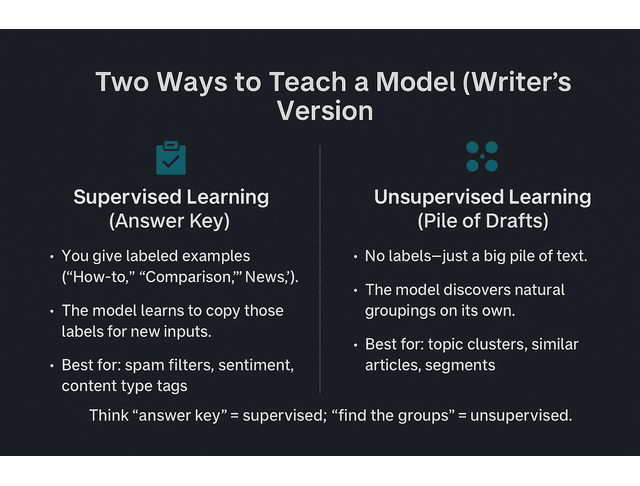
Imagine you’re training a junior writer. With one approach, you give them a stack of sample articles, each labeled clearly: “Product comparison,” “How-to guide,” and “Thought leadership.” You explain why each piece fits its label, then test them on new drafts.
That’s supervised learning. The model learns from examples that come with an answer key—each item in the training set has a label. Over time, it gets good at assigning those labels to new inputs, like:
- Is this email spam or not?
- Is this review positive, neutral, or negative?
- Does this article belong under “SEO basics” or “content strategy”?
When you see tools that “classify,” “predict,” or “tag” things into known categories, you’re usually looking at supervised learning under the hood.
Labeled Data, Feedback, and Why “Answer Keys” Matter for AI Tools
In supervised learning, the quality of the labeled data matters more than the buzzwords. If the training set has clear, consistent labels, the model can learn to mimic them. If the labels are messy, biased, or incomplete, the model will copy that mess.
As a freelance writer, you bump into supervised learning when you:
- Run a grammar checker that flags errors and style issues.
- Use sentiment analysis to determine whether customer feedback is predominantly positive or negative.
- Work with tools that label content as “top-of-funnel,” “bottom-of-funnel,” or “product-led.”
Those “corrections” and labels come from supervised training. Knowing that helps you treat AI outputs as strong suggestions, not absolute truth—especially in niche industries where the training data may not match your clients.
Clustering, Patterns, and How Unlabeled Text Still Teaches the Machine
Now imagine a different scenario: you dump every article you’ve ever written into a giant digital pile and ask, “What groups naturally appear here?” You don’t tell the system which posts are “SEO” or “copywriting.” You just let it surface clusters based on similarity.
That’s unsupervised learning. There are no labels in advance. The model looks for structure in the chaos. It might group:
- Articles about pricing, proposals, and scope.
- Guides on SEO strategy and keyword research.
- Pieces focused on product copy and onboarding.
In your world, unsupervised learning shows up when tools:
- Build topic clusters from a keyword list.
- Segment audiences by behavior or interests.
- Suggest “similar articles” or “related posts” on a blog.
In short, you can use this mental shortcut:
- If a tool discusses labels, categories, and predictions, consider supervised learning.
- If it involves clusters, segments, or patterns, consider unsupervised learning.
How Supervised vs Unsupervised Learning Shows Up in Your Writing Workflow
You don’t use the phrases in your day-to-day life. Still, supervised vs. unsupervised learning already shapes how your tools behave when you research, draft, and edit. Once you see it, you can make better choices about which tools earn space in your stack.
Spotting Client Intent: From Keyword Labels to Content Types
Every brief you get has intent, even if the client doesn’t name it clearly. Supervised models can help you interpret that intent faster by assigning labels like:
- “Informational” vs “transactional” keyword.
- “Awareness” vs. “Consideration” Stage Content.
- “Educational blog” vs “sales landing page.”
Tools that auto-tag keywords or classify content types rely on supervised learning. They’ve seen thousands of labeled examples and learned to recognize similar patterns in new inputs. You still double-check the labels, but they can quickly point you in the right direction before you draft anything.
From Brief to Draft: Where Supervised vs Unsupervised Learning Fits
As you move from brief to draft, both learning styles can support you at different points.
Supervised learning helps with clear-cut decisions:
- Grammar and style corrections.
- Detecting likely tone problems, like overly negative phrasing.
- Labeling a draft as “too long for mobile” or “missing core keyword.”
Unsupervised learning helps with exploration and structure:
- Grouping keywords into topic clusters so your outline flows logically.
- Finding related ideas you might combine into a more comprehensive post.
- Surfacing similar pieces to reference, update, or link to.
Here’s a simple three-step routine you can run for almost any new blog project:
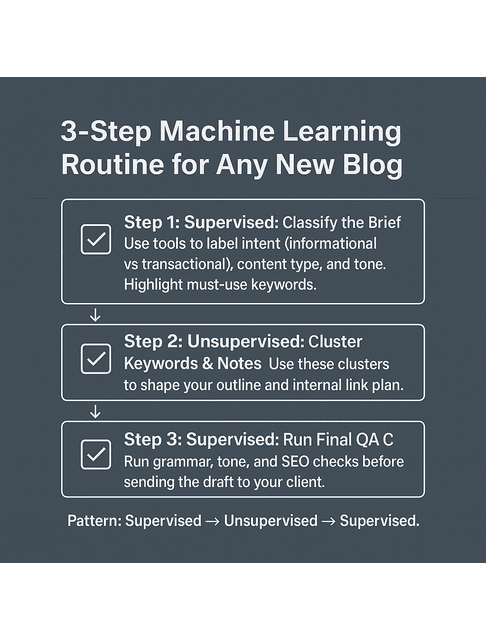
- Use supervised-style tools first to classify the brief (intent, content type, tone) and highlight must-use keywords.
- Use unsupervised-style clustering on your keyword list and research notes to shape your outline and internal link plan.
- Run supervised-style checks at the end to confirm that the grammar, tone, and SEO basics match your standards before sending the draft to your client.
To see how this works in real life, imagine you get a brief for a “2,000-word SEO blog on CRM migration for SaaS founders.” A supervised-style tool can review the keyword list, categorize primary and secondary keywords, determine that the intent is “informational with a product-led slant,” and flag that your working title is too long for search. Then, an unsupervised-style clustering tool can group your keywords into themes, such as “migration steps,” “data cleanup,” and “change management,” which become your core sections. After you draft, supervised models come back in to check grammar, tone, and SEO basics before you deliver.
Real-Life Examples: Subject Lines, Topic Clusters, and Content Buckets
Here’s how this plays out in everyday tasks:
- Subject lines: A supervised model can analyze past campaign performance and suggest which subject lines are likely to get higher opens (“questions vs statements,” use of urgency, etc.).
- Topic clusters: An unsupervised model can scan hundreds of keywords, cluster them into related themes, and help you build a content hub around each cluster.
- Content buckets: Over time, unsupervised learning can show you which topics you write about most, so you can organize your portfolio into clear buckets—and spot where you’re thin.
You’re still the strategist. Machine learning gives you fast, pattern-based input instead of forcing you to scan every spreadsheet and doc manually.
Choosing AI Tools: What Supervised vs Unsupervised Learning Means for Your Process
When you weigh up different AI tools, you’re really choosing the kind of assistance you want from the model behind them. Once you understand supervised vs unsupervised learning, you can look past the buzzwords and ask, “Is this tool making a specific prediction for me, or is it mainly sorting and grouping my data?”
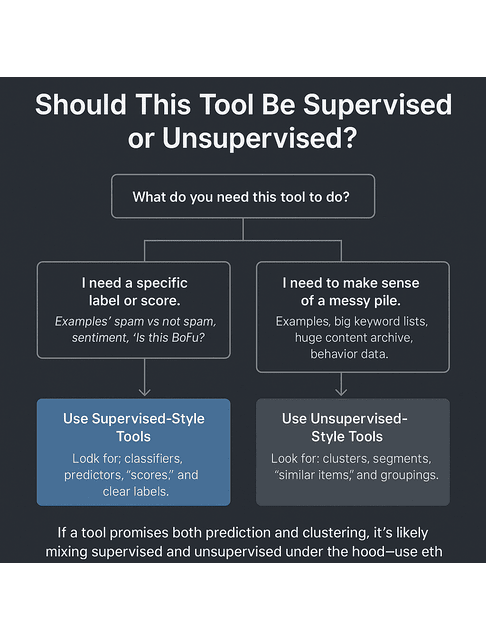
Grammar Checkers, SEO Assistants, and Other Supervised Models for Writers
Tools built primarily on supervised learning are ideal when you want consistent, repeatable checks. Examples:
- Grammar and spelling correction based on labeled examples of correct vs incorrect usage.
- SEO tools that rate titles or meta descriptions and predict click-through potential.
These tools are strongest when you already know what “good” looks like—your brand voice, style guide, or SEO goals—and you want a second set of eyes trained on those patterns.
When a tool markets itself with claims like “We know what high-converting headlines look like” or “We predict which blogs will perform best,” you can treat that as supervised logic under the hood. A useful follow-up question is: “What data did you train on, and how close is it to my niche?” That one question alone helps you decide whether to trust the recommendations as they are or treat them as rough suggestions.
Topic Clustering, Audience Segments, and Unsupervised Pattern Discovery
Tools that rely on unsupervised learning are best for discovery and planning. They shine when you’re trying to make sense of a large, messy pile of information:
- Turning a long list of keywords into coherent topic clusters.
- Grouping readers with similar behaviors into segments so you can tailor content.
- Organizing a huge archive of posts into logical categories without labeling each one by hand.
When a tool promises “automatic clustering” or “smart grouping,” you can assume unsupervised learning plays a role. You’re not getting a right-or-wrong answer; you’re getting a helpful map of the terrain.
You can also ask better questions here: “Can I rename, merge, or split the clusters?” and “Can I see which articles or keywords ended up in each group?” The more control you have over how those clusters get used, the more strategic value you can pull out of the tool.
Pattern-Spotting, Clustering, and Supervised vs Unsupervised Learning
In reality, many tools mix both approaches. A platform might use unsupervised learning to identify clusters of similar content, then apply supervised models to classify those clusters or predict performance.
When you understand pattern-spotting, clustering, and supervised vs unsupervised learning, you can:
- Trust tools to handle repetitive checks and sorting.
- Push back when a tool acts too confidently in contexts that don’t match its training.
- Stack tools intelligently, rather than expecting one dashboard to do everything.
Turn Client Chaos Into Systems With Supervised vs Unsupervised Learning
If your week feels chaotic, it’s usually not the writing that breaks you—it’s the constant re-sorting of information: figuring out what’s urgent, what’s waiting, what’s blocked, and what’s next. Thinking in terms of supervised versus unsupervised learning provides a surprisingly useful lens for designing calmer systems.
In a chaotic week, everything looks equally urgent. You jump from inbox to draft to Slack DM, relying on memory and anxiety to decide what to tackle. In a supervised-style week, your work is clearly labeled and grouped; you can open a single view and see what’s due today, which client is waiting on you, and which tasks can safely wait until tomorrow.
Mapping Your Client Projects to Simple Machine Learning Use Cases
Start by treating your projects the way a supervised model treats data: give them clear, consistent labels. For example:
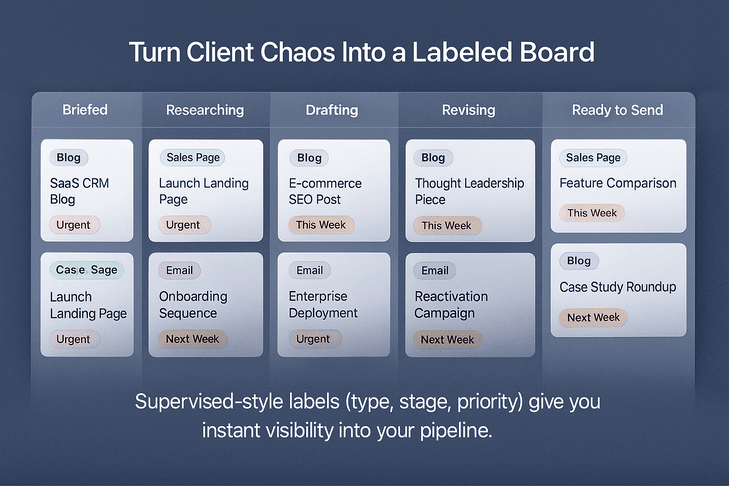
- Project type: blog, email, sales page, case study.
- Stage: briefed, researching, drafting, revising, ready to send.
- Priority: Urgent, to be completed this week or next week.
You can set this up in a project management tool or even a basic spreadsheet, and then add simple AI to recommend or apply labels based on what it has seen before. With those supervised-style labels in place, you can scan your pipeline in seconds, rather than relying on memory.
Building Repeatable Research, Outline, and Draft Routines With AI
Next, employ unsupervised thinking to categorize your work into repeatable workflows, rather than treating each project as a one-off. For example:
- Cluster similar briefs and batch research for them.
- Group related keywords into content clusters and build outlines around those.
- Utilize AI summaries to condense lengthy source material into concise reference notes.
Once those patterns are clear, you can build small routines—“research stack,” “outline stack,” “edit stack”—and plug AI tools into the right step instead of randomly throwing prompts at a chatbot.
In practice, that might look like this on a Tuesday morning: you open your board and filter for “researching” blogs due this week. You run AI summaries on all source documents in one sitting and use a clustering tool to organize the combined keyword list into three or four content hubs. Draft outlines for each hub in one focused block. Instead of juggling five different cognitive modes in an afternoon, you stay inside one workflow and let the tools handle the sorting.
Red Flags, Limitations, and When to Rely on Human Judgment Over Models
Machine learning doesn’t remove your responsibility as the human in the loop. There are clear moments where you stay in charge:
- High-stakes claims that require primary sources, not AI guesses.
- Sensitive topics where tone, empathy, and ethics matter more than speed.
- Situations where the training data likely doesn’t match your client’s niche.
Final Thoughts
You don’t need to read research papers to benefit from supervised vs unsupervised learning as a freelance writer. You need to know which type of learning sits behind your tools, what each one excels at, and where your judgment still makes the final call.
You’re not trying to become an “AI expert.” You’re building a writing business where the models do the sorting, and you stay free to think, deciding, and creating that no system can replace.
If you want a practical, writer-first guide to using AI tools without the jargon, explore my books on Amazon. They show you exactly where these tools fit in a freelance workflow, how to keep your judgment and voice in charge, and how to deliver faster without sacrificing quality. Visit my Amazon Author page to pick the book that fits what you’re working on right now.
Frequently Asked Questions About Supervised vs Unsupervised Learning for Writers
Supervised learning trains on labeled examples so the model can predict known categories or values (like “spam vs not spam” or positive vs negative sentiment). Unsupervised learning works with unlabeled data and looks for structure on its own, grouping similar items into clusters or segments.
Neither option wins in every situation; each handles different jobs. Use supervised learning when you already know what you want to predict or classify, such as sentiment or topic. Turn to unsupervised learning when you want to explore a dataset, spot patterns, or group similar items without setting labels in advance.
Examples include spam filters, sentiment analysis tools, grammar and style checkers, and content classifiers that label pieces as “how-to,” “news,” or “comparison,” all of which learn from large sets of labeled examples.
Clustering is a classic unsupervised learning method that groups similar items—such as keywords, articles, or users—based on shared patterns, without the need for predefined labels.
Understanding the difference helps you choose tools wisely and set realistic expectations. You’ll know when to use supervised models for quality checks and tagging, when to use unsupervised models for strategy and planning, and how to design workflows where AI handles repetitive sorting while you stay focused on high-value creative and strategic work.
Often, yes—some tools let you upload examples of your best work, import style guides, or create custom categories. That’s essentially giving the supervised side more accurate labels to learn from. Even when a tool doesn’t support full customization, you can still “fine-tune by feedback” by accepting the suggestions that match your standards and rejecting those that don’t, then adjusting how heavily you rely on the tool for that type of decision.

Florence De Borja is a freelance writer, content strategist, and author with 14+ years of writing experience and a 15-year background in IT and software development. She creates clear, practical content on AI, SaaS, business, digital marketing, real estate, and wellness, with a focus on helping freelancers use AI to work calmer and scale smarter. On her blog, AI Freelancer, she shares systems, workflows, and AI-powered strategies for building a sustainable solo business.


Pingback: Machine Learning for Content Creation: A Practical Guide - The AI Freelancer