
Most creators don’t struggle with ideas. What slows them down is turning those ideas into finished work consistently. A draft sits open while the cursor blinks, a promising newsletter topic suddenly requires research and examples, and social media posts remain unfinished because the day fills with meetings, client work, and administrative tasks. Many professionals now rely on AI tools for content creators to help move ideas from rough notes to finished content more efficiently.
This challenge explains why AI tools for content creators are becoming part of everyday creative workflows. Instead of managing research, drafting, editing, formatting, and publishing entirely by hand, creators can build a small toolkit that supports each stage of the process. These tools work best when they handle repetitive preparation and organization tasks so the creator can concentrate on explaining ideas, sharing insights, and connecting with readers.
Everything I’ve shared here—and more—is in my book, available on Amazon. Click the link if you’re ready to take the next step.
Why AI Tools for Content Creators Help You Publish Consistently Without Doing Everything Manually
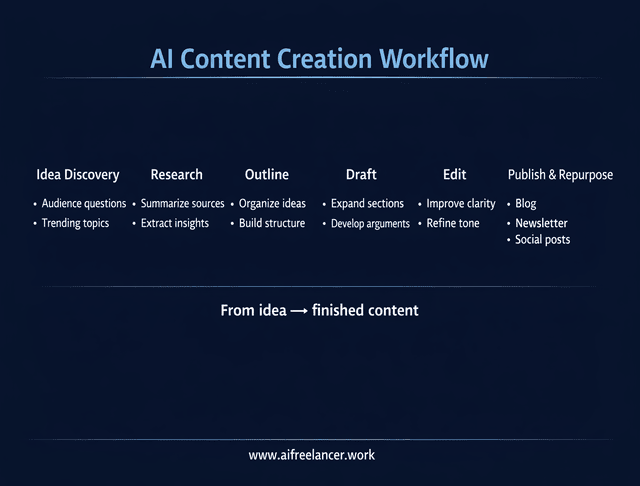
Producing useful content involves more than writing. Before the first paragraph appears, creators often spend significant time researching the topic, reviewing sources, and organizing their ideas. Even experienced writers find that the preparation stage can take as long as the drafting stage itself.
According to the Content Marketing Institute, more than 70% of B2B marketers say content creation is their most important marketing activity, yet many still struggle to maintain consistent publishing schedules.
This challenge appears across many professions. A consultant writing LinkedIn insights, a designer publishing case studies, and a founder explaining industry concepts all face the same constraint: producing thoughtful content while managing daily responsibilities.
A typical content workflow includes several stages:
- researching the topic
- reviewing source material
- outlining the article
- drafting the content
- editing and refining the message
- adding visuals or examples
- publishing and promoting the work
When these steps accumulate, content production begins to feel heavier than expected. Tools that simplify research, outlining, and drafting help creators maintain momentum through the entire workflow.
The Growing Pressure to Publish Blogs, Posts, and Newsletters Consistently
Content has become one of the most effective ways professionals demonstrate expertise and build trust with their audience. Consultants publish articles to explain ideas, founders use blog posts to educate customers, and creative professionals share project stories to attract new work. Consistent publishing, therefore, becomes part of how professionals communicate value in their field.
Without a structured process, however, publishing becomes irregular. Weeks pass without new material, and then a sudden burst of writing appears before the cycle slows again. Systems that reduce the time spent on preparation and drafting help creators sustain a more stable publishing rhythm.
How AI Reduces Research Time and Creative Bottlenecks
Research is often where the workflow slows down. Creators frequently open multiple browser tabs, skim several articles, bookmark reports, and still feel uncertain about how to begin writing.
AI research assistants shorten this stage by summarizing information and highlighting key ideas. Tools such as ChatGPT and Perplexity AI can analyze long articles, explain unfamiliar concepts, and surface useful patterns across multiple sources. Instead of reading dozens of pages before drafting, creators can quickly understand the central ideas and decide how to approach the topic.
Which Content Tasks AI Can Realistically Automate, and Which Still Require Human Input
AI is particularly helpful for tasks that involve structure and repetition. It can generate outlines, summarize research findings, produce preliminary drafts, and suggest improvements to grammar or clarity. These functions allow creators to move through the workflow more efficiently.
Interpretation and perspective remain human responsibilities. Readers value insight, judgment, and experience, which cannot be generated automatically. AI therefore supports the writing process, but the ideas and conclusions still come from the creator.
Where Content Creators, Consultants, and Founders Typically Lose Time in the Content Process
The most time-consuming stage of writing often occurs before the article begins. Creators frequently spend long periods gathering research, organizing notes, and reshaping the opening section of an article. When these early stages stretch too long, finishing the piece becomes difficult.
Tools that assist with research summaries and outlining help creators move more quickly from preparation to drafting.
Finding Ideas Faster with AI Tools for Content Creators
Generating content ideas consistently becomes easier when creators understand what their audience is already curious about. Instead of waiting for inspiration, many writers now look for patterns in the questions people ask online.
How AI Tools for Content Creators Uncover Trending Topics and Audience Questions
Search engines and discussion platforms contain a constant stream of questions from readers. AI tools analyze these conversations to identify recurring themes and emerging topics. Because these questions come directly from audiences, they often lead to practical and relevant content ideas.
AI Research Assistants That Summarize Reports and Articles
Industry reports and research studies frequently contain useful insights but require significant time to review. AI research assistants summarize these documents and highlight the sections most relevant to a topic. Creators can then read the original material with a clearer understanding of the central findings.
Keyword Discovery and Topic Clustering Tools
Keyword research tools reveal how audiences search for information and which related topics appear together. Instead of focusing on a single keyword, creators can explore clusters of related questions and themes.
Tools commonly used for this work include:
- BuzzSumo
- Google Trends
- Ahrefs
- Semrush
These platforms help creators identify themes that can support multiple articles or posts.
How AI Tools for Content Creators Turn Scattered Ideas Into Structured Content Angles
Ideas often begin as fragments of notes, links, or observations. AI tools can organize these fragments into outlines that show how a topic might develop into a full article. Once a structure exists, the drafting stage becomes easier because the writer can focus on explaining each section.
Turning Audience Questions Into Blog Posts, Newsletters, and Social Content
A single audience question can lead to several pieces of content. An article answering the question might later become a newsletter discussion, a short social media post, or a video script. This approach allows creators to explore one topic in several formats without starting from scratch each time.
Writing and Drafting with AI Tools for Content Creators
Drafting is often where writers feel the greatest hesitation. Even when the topic is clear, the opening paragraphs can take time to develop because writers want the structure to make sense.
Using AI Tools for Content Creators to Draft Blog Posts, Captions, and Scripts
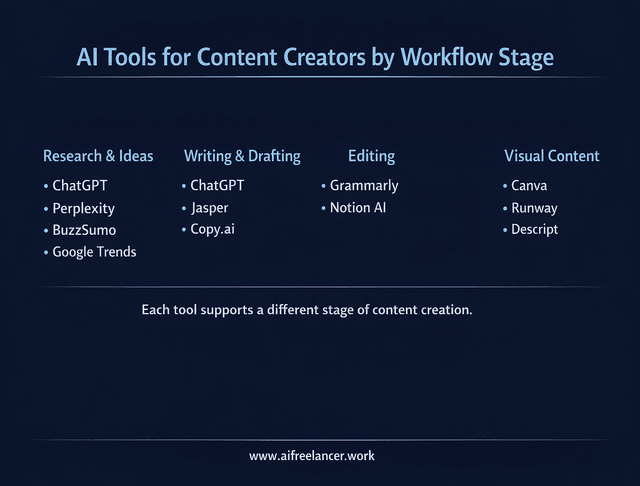
Writing assistants such as:
- Jasper AI
- Copy.ai
can generate early drafts or expand bullet points into full paragraphs. Creators typically revise this material so it reflects their own voice and perspective.
How AI Tools for Content Creators Support Outlines, First Drafts, and Rewriting
A practical workflow often begins with an outline produced by AI. This outline becomes the framework for the article, allowing the writer to expand each section gradually. Because the structure already exists, the drafting stage focuses on refining ideas rather than building the article from scratch.
Editing Assistants That Improve Clarity, Tone, and Flow
Editing tools such as Grammarly help improve readability by identifying awkward phrasing, grammar issues, and overly complex sentences. These tools function as an additional editorial pass before publication.
How AI Tools for Content Creators Repurpose Content Across Platforms
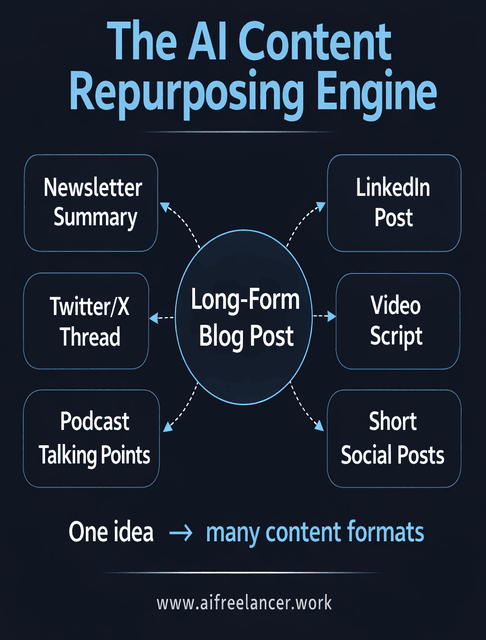
Once a long article is complete, its key ideas can be adapted into several smaller formats. An article might become a short newsletter summary, a series of social media posts, or talking points for a video. Research from MIT found that professionals using generative AI for writing tasks completed their work about 40% faster, while the quality of the output improved by roughly 18%.
Final Thoughts
The rise of AI tools for content creators has changed how ideas move from concept to publication. Instead of managing research, drafting, editing, and multimedia creation manually, creators can rely on tools that support each stage of the process.
For consultants, founders, and creative professionals who want to share ideas consistently, building a small toolkit can make content creation more structured and sustainable. If you want to explore practical frameworks for building these workflows, visit my Amazon Author page to learn more about the systems and writing strategies described in my books.
Frequently Asked Questions About AI Tools for Content Creators
The best AI tools for content creators usually support different stages of the content workflow rather than replacing the entire process. Many creators combine tools for research, drafting, editing, and design. ChatGPT is widely used for brainstorming ideas and outlining articles, while Jasper focuses on marketing and blog copy. Canva simplifies visual design for posts and graphics, Notion AI helps organize research and plan content, and Grammarly improves grammar and clarity during editing. A small, focused toolkit where each tool supports one stage of content creation is usually the most effective setup.
AI tools help creators produce more content by reducing time spent on repetitive tasks such as research, outlining, and editing. Instead of starting from a blank page, creators can use AI to generate topic ideas, summarize sources, and build structured outlines. This allows writers, consultants, and founders to move more quickly from preparation to drafting while focusing their energy on explaining ideas and refining the message.
AI can assist with content creation, but it cannot replace the human thinking behind meaningful writing. Tools can organize information, generate drafts, and improve clarity, but they do not have personal experience or professional judgment. Readers respond to insight, perspective, and expertise, which come from the creator. In practice, AI works best as an assistant that speeds up the writing process while the human author shapes the ideas and final message.
AI tools are generally safe to use, but creators should treat them as assistive tools rather than final authorities. AI-generated content can sometimes include incorrect or incomplete information, so important facts should always be verified. Many creators use AI mainly for brainstorming, outlining, and summarizing research, then rely on their own editing and expertise to ensure the final content is accurate.
Yes, studies suggest AI writing tools can improve productivity when used within a clear workflow. Research from the MIT Sloan School of Management found that professionals using AI writing assistants completed certain writing tasks about 40% faster while maintaining quality. These gains usually come from reducing time spent on preparation tasks such as summarizing research, outlining ideas, and drafting early versions of content.

Florence De Borja is a freelance writer, content strategist, and author with 14+ years of writing experience and a 15-year background in IT and software development. She creates clear, practical content on AI, SaaS, business, digital marketing, real estate, and wellness, with a focus on helping freelancers use AI to work calmer and scale smarter. On her blog, AI Freelancer, she shares systems, workflows, and AI-powered strategies for building a sustainable solo business.