
If you’re trying to figure out how to stay updated with AI trends, you’ve probably noticed the same pattern: you see something useful, save it, and move on. You bookmark articles, collect tools, and tell yourself you’ll come back to them later. Most of the time, you don’t.
Over time, those saved ideas pile up. What felt relevant in the moment fades before it ever becomes part of your workflow. You stay informed, but nothing actually changes in how you work.
That’s where most people get stuck. The issue isn’t a lack of access to AI updates. It’s what happens after you encounter them—and whether they ever turn into something you can actually use.
Everything I’ve shared here—and more—is in my book, available on Amazon. Click the link if you’re ready to take the next step.
Why Most Advice on AI Trends Doesn’t Work
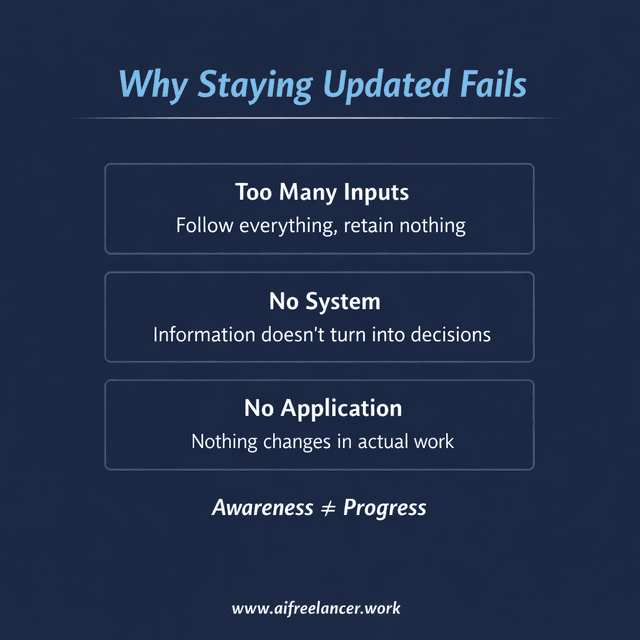
Most advice assumes your problem is not knowing where to look, so it tells you to follow more sources—more newsletters, more creators, more tools. That approach works if your goal is awareness, but it breaks if your goal is better work. You end up consuming more without actually improving anything in your process.
Research from Microsoft shows that 75% of knowledge workers are already using AI, yet many still struggle to improve output because adoption alone doesn’t change how work gets done. This matters because it shows that access is no longer the bottleneck. The real constraint is integration—whether new tools and ideas actually change how work happens.
Most articles increase input without improving decisions. That’s why the problem persists even when you’re actively trying to keep up.
How to Stay Updated with AI Trends Without Wasting Time
Most professionals already follow AI updates, but the inconsistency shows up after the initial exposure. You read something useful, but you don’t test it, integrate it, or revisit it. Over time, nothing compounds, and even strong ideas fade before they can influence your work.
The issue isn’t that you’re not keeping up. It’s that your inputs are disconnected from action. Without a way to process and apply what you see, even high-quality insights lose their value quickly. What you need is a repeatable way to handle information—from the moment it catches your attention to the moment it changes your workflow.
The 4-Layer System for Staying Up-to-Date with AI Trends
1. Filter: Decide What AI Trends Actually Matter
Most updates look useful at first glance, but that doesn’t mean they deserve your attention. When everything feels relevant, you end up treating everything as equally important, which leads to overload and scattered focus.
Before saving anything, run it through a quick check. Does it affect your core work? Is it useful now, or just interesting for later? Will it change how you produce, deliver, or communicate? Is there a clear benefit tied to time, output, or positioning? These questions force you to slow down and evaluate instead of reacting.
Some trends fall into a middle category. They don’t affect your workflow today, but they may influence expectations or direction over time. Instead of treating them as urgent, keep them in a light “watch” category. You stay aware without letting them take up space in your active system.
If the answers are unclear and there’s no near-term relevance, skip it. For example, a new AI writing feature may be worth testing if you draft regularly. If you don’t, it’s simply noise—regardless of how widely it’s discussed. Being selective at this stage removes most of the clutter before it builds up.
2. Capture: Build a Simple AI Trend Tracking System
Once something passes your filter, store it in a way you’ll actually revisit. This is where most systems break down. People collect ideas across tabs, notes, and bookmarks, then never return to them, which makes the entire process feel pointless.
Keep your inputs small and intentional. Follow a limited number of high-signal sources and prioritize people who show real use of AI in their workflows rather than those summarizing trends. This reduces repetition and keeps your inputs grounded in actual application.
A practical distinction helps here. Primary sources show what changed. Practitioners show how it’s used. Commentary often repeats both without adding value. If most of your inputs fall into commentary, your system will feel active but unproductive.
Use one capture point instead of spreading notes across multiple tools. When everything is in one place, it becomes easier to review and act on. Be honest with your habits. If you don’t revisit something within a week, it wasn’t important enough to keep. That constraint forces better decisions upfront.
3. Process: Stay Up to Date with AI Trends Weekly
Checking updates throughout the day creates the illusion of progress, but it rarely leads to meaningful change. What actually works is a consistent review rhythm that allows you to step back and make decisions with clarity.
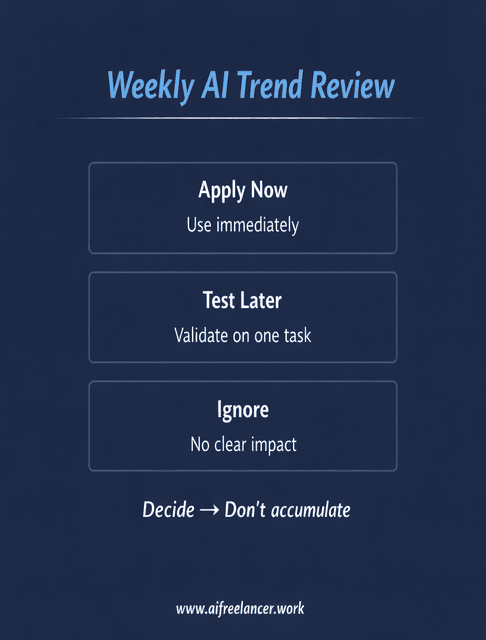
Set aside time once a week to go through what you’ve saved. As you review, decide whether each item is something to apply now, test later, or ignore. This forces you to move from passive consumption into active decision-making.
The key is making decisions at a small scale. If a new AI workflow promises faster content creation, you don’t need to rebuild your entire process. Test it on one task. If it improves speed without reducing quality, keep it. If it creates friction, remove it.
Ask practical questions as you review. Will this change something you’re already doing? Does it save time or improve output clearly? Is it repeatable, or just a one-off experiment? Anything that stays in “test later” for too long should be removed.
A study from MIT Sloan School of Management found that professionals completed tasks around 40% faster when AI tools were integrated into structured workflows. That gain only shows up when tools are tested and incorporated deliberately, not just explored.
4. Apply: Turn AI Trends Into Real Output
This is where most people stop too early. They read, understand, and move on, but the value only appears when something changes in their work. Without application, even the best insights remain theoretical.
The application works best when it is controlled. Not every useful idea should be adopted immediately. Testing first allows you to evaluate impact without disrupting what already works.
For example, a writer might test an AI-assisted editing workflow on one article instead of applying it across all projects. If it reduces revision time and maintains quality, it becomes part of the process. If it adds cleanup work later, it gets dropped.
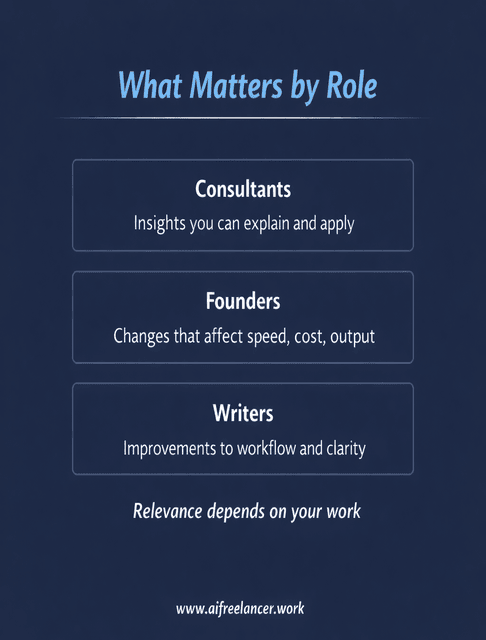
The application looks different depending on your role. A consultant may turn a trend into a clearer client explanation or framework. A founder may test it within a workflow or content process. A writer may use it to reduce drafting or editing time.
A simple pattern helps: test, adjust, integrate, then repeat. If nothing changes after you consume something, it wasn’t useful to you.
How to Stay Updated with AI Trends Based on Your Role
Not every update deserves the same level of attention. What matters depends on what you’re trying to improve in your work, and this is where many people lose clarity by following the same information as everyone else.
Consultants often overvalue being early. They comment on trends before they can explain them clearly, which weakens authority instead of strengthening it. A better approach is to prioritize trends you can translate into client insight or decision-making frameworks and ignore those that don’t connect to real client needs.
Founders tend to overvalue tools that promise efficiency. The risk is adding complexity without improving outcomes. Focus on changes that affect speed, cost, or communication, and ignore anything that adds steps without measurable improvement.
Writers often overvalue features and underweight process. A tool may look powerful, but if it doesn’t reduce revision cycles or make the workflow more predictable, it won’t hold up over time. Prioritize anything that makes your process clearer and more repeatable.
Across all roles, the same question applies: Does this help you do your work better, or is it just interesting?
How to Stay Updated with AI Trends Without Overload
Overload doesn’t happen all at once. It builds as you add more inputs, more tools, and more things to “try later.” Eventually, tracking trends becomes its own task, which defeats the purpose of trying to stay efficient.
Keeping your system tight prevents this. Limit your sources, review them on a fixed schedule, and avoid adding new tools unless they replace something you already use. Most importantly, protect your production time so tracking doesn’t interfere with execution.
According to McKinsey & Company, AI improves productivity when it is integrated into workflows, not layered on top of them. In practice, this means every addition should replace or improve something that already exists. Otherwise, it adds friction instead of value.
Common Mistakes When Following AI Trends
Many habits that feel productive actually slow you down over time. Checking updates throughout the day fragments your attention, while saving links without revisiting them creates clutter that you never clear.
Switching tools too often prevents any system from becoming effective because nothing stays long enough to prove its value. Treating every new release as urgent creates pressure to react instead of evaluate.
These patterns don’t just slow you down—they shift your focus away from execution and toward constant consumption.
A Minimal AI Trend Monitoring Setup (No Complexity)
A system only works if you can maintain it consistently, and complexity makes that harder rather than easier. Many setups fail because they require too many decisions to sustain.
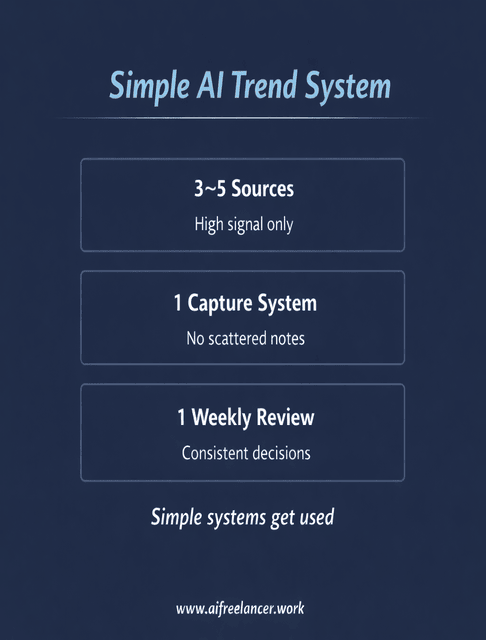
A simple setup is enough. Follow a small number of trusted sources, store what matters in one place, and review it once a week. This reduces decision fatigue and makes consistency easier.
The key tradeoff is intentional simplicity. You give up breadth in exchange for clarity and follow-through. Expand your system only when your current setup is producing consistent output. Otherwise, you’re adding more to manage without gaining more value.
Final Thoughts
You don’t need to follow everything happening in AI. You need to notice what actually affects your work and act on it. When you focus on relevance instead of volume, staying updated becomes manageable instead of overwhelming.
If you’ve been trying to figure out how to stay updated with AI trends, the answer isn’t more information. It’s a simple system that helps you filter, review, and apply what matters. That’s how you stay relevant without adding more noise to your day.
If you want to build stronger writing workflows, reduce revisions, and use AI in a way that actually improves your output, you can explore my books on my Amazon Author page.
Frequently Asked Questions About How to Stay Updated With AI Trends
Limit your inputs and control when you review them. Instead of checking updates throughout the day, set up a weekly review to filter what actually matters. Most overwhelm comes from unstructured consumption, not lack of discipline.
The most effective way is to combine three habits: follow a small number of high-signal sources, store insights in one place, and review them consistently. The key is not where you get information, but how you process and apply it.
For most professionals, once a week is enough. Daily checking increases noise and reduces focus, while a weekly review allows you to see patterns and decide what’s worth acting on.
Prioritize primary sources, such as product updates and official releases, and practitioners who demonstrate real use of AI in their workflows. Avoid sources that only summarize or repeat existing information.
A trend is worth testing if it improves how you produce, deliver, or communicate your work. If it doesn’t lead to a clear change in your workflow or output, it’s not worth prioritizing.

Florence De Borja is a freelance writer, content strategist, and author with 14+ years of writing experience and a 15-year background in IT and software development. She creates clear, practical content on AI, SaaS, business, digital marketing, real estate, and wellness, with a focus on helping freelancers use AI to work calmer and scale smarter. On her blog, AI Freelancer, she shares systems, workflows, and AI-powered strategies for building a sustainable solo business.