
You sit down to write, and what should take two hours stretches into six. You rewrite the introduction three times, polish sentences that you later delete, and still end up with a draft that doesn’t feel right. It looks complete, but something is off, so you start again. If that cycle feels familiar, the problem isn’t your skill. It’s your process. Learning how to reduce revisions in writing isn’t about becoming a better editor. It’s about preventing the kind of mistakes that force you to rewrite in the first place.
Research from McKinsey & Company shows thatproductivity gains from AI only happen when work is structured properly, not when tools are used randomly. That applies directly to writing. Without a clear workflow, AI may speed up drafting, but it often increases the number of revisions needed to make the output usable because it accelerates unclear thinking.
This guide breaks that cycle by showing where revisions actually start and how to stop them before they happen.
Everything I’ve shared here—and more—is in my book, available on Amazon. Click the link if you’re ready to take the next step.
Why Reduce Revisions in Writing Starts Before You Draft
Most writers treat revision as something that happens after the draft. That assumption is where the problem begins. Revisions are not discovered at the end. They are introduced at the start, when key decisions are still unclear, but writing begins anyway.
To Reduce Revisions in Writing, Define the Outcome Before Drafting
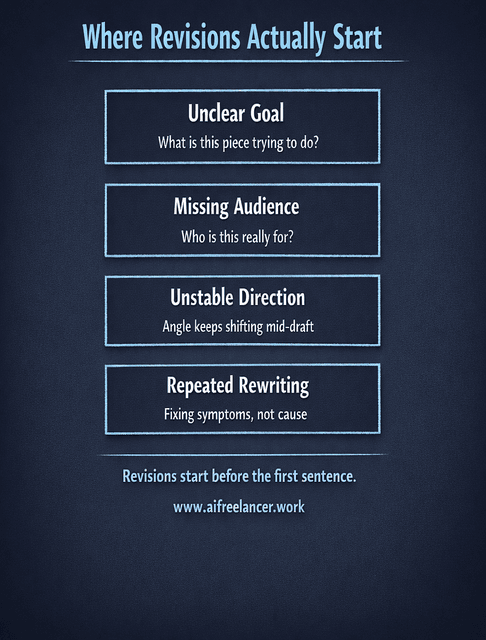
Before you write, several elements need to be clear: the purpose of the piece, the audience it’s meant for, what must be included, and the level of depth and tone required. When these are not defined, every paragraph becomes an attempt to figure things out instead of executing a plan.
But “define the outcome” is often treated too loosely. In practice, it means locking a set of specific decisions before drafting begins:
- The exact goal of the piece (inform, persuade, convert, position authority)
- The reader it is written for, including their level of awareness and expectations
- The angle or perspective the piece will take
- The scope—what is included and what is intentionally left out
- What success looks like (what the reader should understand, feel, or do after reading)
When even one of these is unclear, the draft becomes unstable. You are not refining an idea—you are still forming it while writing.
This is where AI quietly makes things worse. It fills gaps with plausible language, so the draft looks coherent even when the thinking behind it is incomplete. It adds transitions, expands points, and smooths tone, creating the impression that the structure is sound.
The problem is that these additions are often generic. They do not resolve the missing decision—they cover it. You only see the gap later, when the piece needs to be rewritten at a structural level.
A study highlighted by the MIT Sloan School of Management found that professionals using AI tools completed writing tasks significantly faster, but only when they had clear direction before using the tool. Without that clarity, time saved in drafting is lost during revisions.
What Happens When You Skip This Step and Fix It Later
When direction is unclear, editing becomes a substitute for thinking. You revise structure, then arguments, then wording, moving the same piece around without ever stabilizing it.
This creates the illusion of progress. You are producing more text, but the core problem remains untouched. The draft keeps shifting because the decisions behind it were never finalized.
In practice, this shows up as repeated re-entry into the same sections. You revisit the introduction, adjust the angle, then change supporting paragraphs to match. Each adjustment introduces new inconsistencies, which require more revision.
Over time, this is what slows you down. Not the writing itself, but the accumulation of unresolved decisions that keep the work open.
Where Reduce Revisions in Writing Breaks Down in the Process
The impact of those early decisions does not stay hidden. It shows up the moment drafting begins—and it follows a predictable pattern.
To Reduce Revisions in Writing, Separate Thinking From Drafting
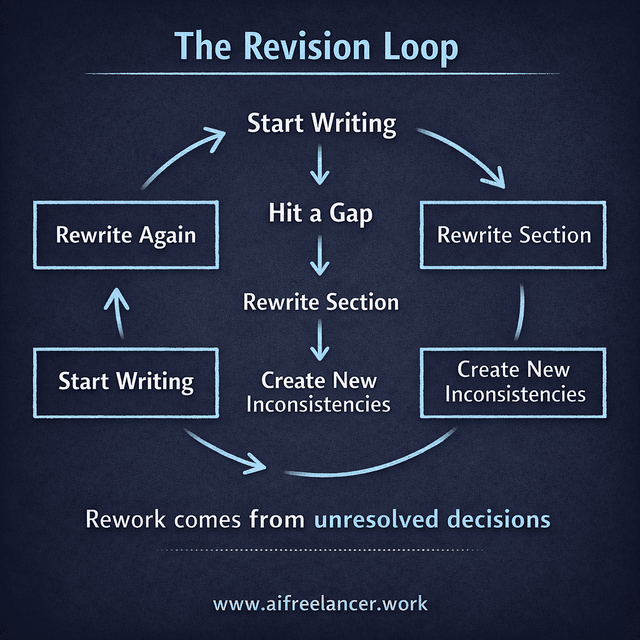
When ideation and drafting happen at the same time, structure collapses under its own weight. You begin with a direction, but as you write, new decisions appear. Instead of pausing to resolve them, you rewrite the paragraph in front of you.
The pattern is predictable. You start writing without a clear structure, hit a gap halfway through, and then patch it by rewriting. That patch introduces new inconsistencies, which require more rewriting later.
A common example is rewriting an introduction multiple times. The issue is not the sentence. It is the missing decision behind it. Until the angle is fixed, every version of the introduction will feel slightly wrong.
Why Most Drafts Fail Even When They Look Complete
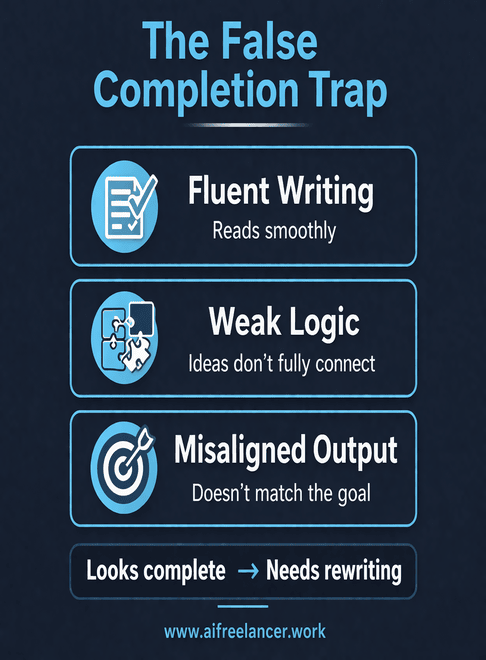
Some drafts do not look messy. They look finished. The sentences flow, the paragraphs are clean, and the piece feels readable. But it still fails.
This is false completion. The writing is fluent, but the logic is underdeveloped or misaligned. The piece answers a version of the question, but not the one it was meant to address.
AI amplifies this problem in a specific way. It introduces:
- smooth transitions that connect ideas that were never fully developed
- balanced paragraphs that hide gaps in reasoning
- generalized statements that feel complete but lack precision
Because the draft reads well, the underlying issue goes unnoticed until later. By the time you detect it, fixing it requires restructuring entire sections, not just editing sentences.
According to Microsoft’s Work Trend Index, a large percentage of knowledge workers now use AI in daily tasks. But increased usage does not automatically improve output. Many still revise heavily because the initial content feels complete but lacks precision.
A System to Reduce Revisions in Writing Using AI
Once you see how revisions are introduced and how they spread during drafting, the solution becomes clearer. You do not need to edit more. You need to control when decisions are made and when they are executed.
Reduce Revisions in Writing With an AI-Assisted Workflow
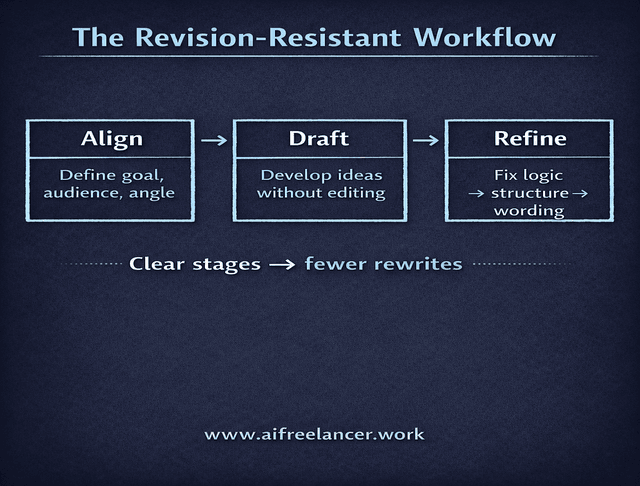
A simple framework helps: Align, Draft, Refine. The strength of this system is not in the labels, but in the boundaries between them.
In the Align stage, you define the goal, audience, angle, and constraints. This is also where you make the draft testable. You should be able to answer: “What would make this piece clearly correct?” before writing begins. If that answer is unclear, drafting will create rework.
In the Draft stage, the focus shifts to developing ideas. You are building the argument and shaping the structure. The key is to protect momentum. You are not fixing sentences—you are constructing meaning.
AI can help here, but only within a defined frame. It can:
- Expand a point into multiple variations
- Suggest alternative structures
- Help you explore how ideas connect
What it should not do is decide the direction. If you use AI to generate the core idea, you are outsourcing the most important decision in the workflow.
In the Refine stage, you improve clarity, flow, and tone. Editing belongs here—and in a specific order:
- Fix logic first
- Then fix the structure and transitions
- Then refine wording
If you reverse that order, you polish sentences that may not survive.
One rule prevents most revision loops: do not edit while drafting. The moment you start fixing sentences while the idea is still forming, you introduce instability that spreads across the draft.
Using AI Without Increasing Rework or Losing Control
AI is not inherently efficient. It becomes efficient only when it operates inside a clear structure.
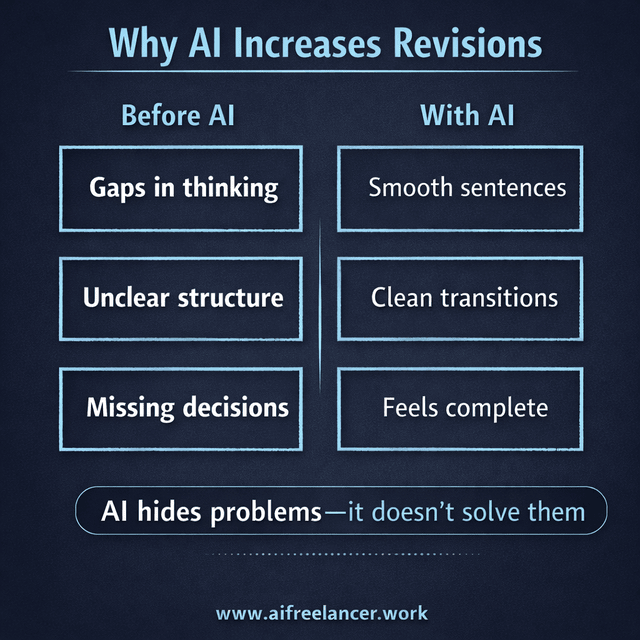
The real risk is not bad output. It is a convincing output. AI produces language that feels usable, which delays the moment you question whether it is correct.
Mechanically, this happens because AI:
- Fills gaps with broadly applicable statements
- Smooths transitions between weak or unrelated ideas
- Generates a structure that appears logical but is not anchored to your goal
These traits make the draft feel complete too early. You move forward assuming the foundation is solid, and only discover the problem when later sections stop fitting.
A typical example is an AI-generated section that sounds complete but answers the wrong question. You build the rest of the draft around it, then realize the mismatch. At that point, fixing it requires a full rewrite, not a small adjustment.
Used correctly, AI does something different. It helps you:
- restructure existing ideas
- compress or expand sections intentionally
- test variations once direction is fixed
In that role, AI reduces revision. Outside of it, it often increases it.
How to Reduce Revisions in Writing Without Burning Out
When drafts keep reopening, and decisions stay unresolved, the impact is not just on output. It shows up in how the work feels—and how long you can sustain it.
Reduce Revisions in Writing to Lower Cognitive Load
Every unresolved decision stays active in your mind. When you restart drafts, shift direction, or keep editing the same sections, you carry that unfinished work longer than necessary.
Burnout in writing often comes from this accumulation. It is not the number of tasks, but the number of open loops. Each unfinished section pulls attention back, even when you are trying to move forward.
This is similar to what psychologists describe as attention residue—part of your focus remains tied to previous work. When your workflow forces you to revisit the same piece repeatedly, that residue builds up.
Clear stages reduce this effect. When a stage is complete, you can mentally close it. Without that closure, the work never fully resets.
Build a Repeatable System That Improves Every Draft
A structured workflow changes how the work behaves over time. Instead of rebuilding your approach for every project, you rely on a consistent system that reduces variability and stabilizes output.
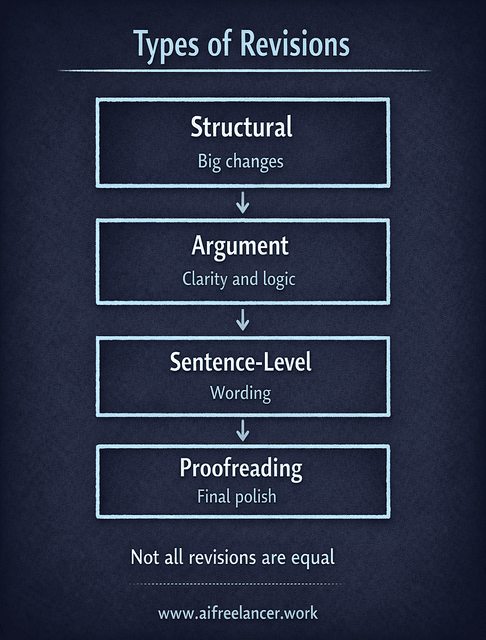
It also clarifies what kind of revision you are doing. Structural revisions reshape the piece. Argument revisions improve logic. Sentence-level edits refine wording. Proofreading handles final polish.
The goal is not to eliminate revisions. It is to remove the kind that forces you to rebuild the piece from the ground up. When early-stage decisions are solid, later-stage work becomes lighter, faster, and more predictable.
Final Thoughts
If you want to truly reduce revisions in writing, the shift is not in how you edit. It is in how you structure your work before and during drafting.
Revisions are not a sign that you need more effort. They are a signal that something earlier in the process was left unresolved. When you define direction upfront, separate each stage, and use AI with intention, your drafts become more stable from the start.
That stability shows up in tangible ways. You stop reopening the same sections. Your first drafts hold together longer. You spend less time reconstructing and more time refining. The work moves forward instead of looping back.
If you want to go deeper into building structured writing systems and using AI without losing your voice, check out my books on my Amazon Author page. They are designed for freelancers who want to write faster, think more clearly, and deliver stronger work with fewer revisions.
Frequently Asked Questions About How to Reduce Revisions in Writing
To reduce revisions in writing, make the key decisions before you draft. That means defining the goal, audience, angle, scope, and what a successful piece needs to do. Most major rewrites do not come from weak sentences. They come from missing decisions upstream. When the direction is clear, drafting becomes execution instead of guesswork.
You usually keep rewriting drafts because you are thinking and drafting at the same time. You start with a partial idea, hit a gap in logic or structure, and then try to fix it inside the paragraph you are writing. That creates a cycle of patching, shifting, and reopening sections. The issue is often not the wording itself. It is that the draft is carrying unresolved decisions.
You usually keep rewriting drafts because you are thinking and drafting at the same time. You start with a partial idea, hit a gap in logic or structure, and then try to fix it inside the paragraph you are writing. That creates a cycle of patching, shifting, and reopening sections. The issue is often not the wording itself. It is that the draft is carrying unresolved decisions.
Improve first-draft quality by separating planning, drafting, and editing into distinct stages. Lock the outcome before you write, focus on developing ideas while drafting, and save sentence-level polishing for the end. A stronger first draft is not usually the result of better phrasing. It is the result of clearer direction and better stage control.
Too many revisions usually come from a predictable set of problems: unclear briefs, weak structure, premature editing, and AI output that sounds right but does not match the goal. These problems often create false completion, where a draft looks polished but still fails the brief. When that happens, the writer is forced into structural rewriting instead of light refinement.
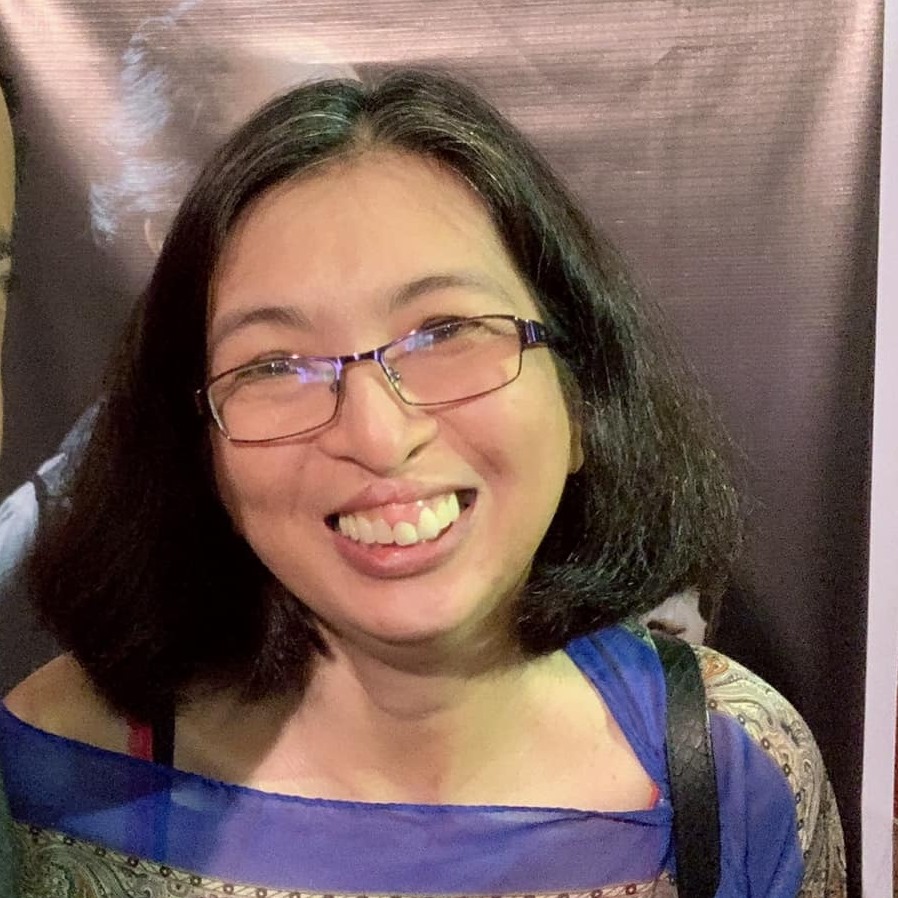
Florence De Borja is a freelance writer, content strategist, and author with 14+ years of writing experience and a 15-year background in IT and software development. She creates clear, practical content on AI, SaaS, business, digital marketing, real estate, and wellness, with a focus on helping freelancers use AI to work calmer and scale smarter. On her blog, AI Freelancer, she shares systems, workflows, and AI-powered strategies for building a sustainable solo business.