AI has revolutionized many fields, and freelance writing is no exception. As a freelance writer, you might have heard various AI myths that have created confusion and uncertainty about integrating this technology into your work. Comprehending the truths behind these myths is crucial for embracing AI as a valuable tool rather than fearing it as a replacement. This blog aims to debunk AI myths and provide clarity, empowering you to navigate the evolving landscape of AI in freelance writing with confidence and control.
Everything I’ve shared here—and more—is in my book, available on Amazon. Click the link if you’re ready to take the next step.
Common AI Myths in Freelance Writing
AI myths spread fastest when writers are under pressure to keep up. Tight deadlines, rising competition, and nonstop talk about automation make it easy to assume the worst before understanding what’s actually happening. In freelance writing, these myths don’t just create confusion. They shape decisions, slow adoption, and fuel unnecessary fear. Before deciding whether AI is a threat, a crutch, or a tool you can ignore, it helps to separate assumptions from reality. The following myths show up again and again in freelance conversations, and each one deserves a closer look grounded in how writers really work today.
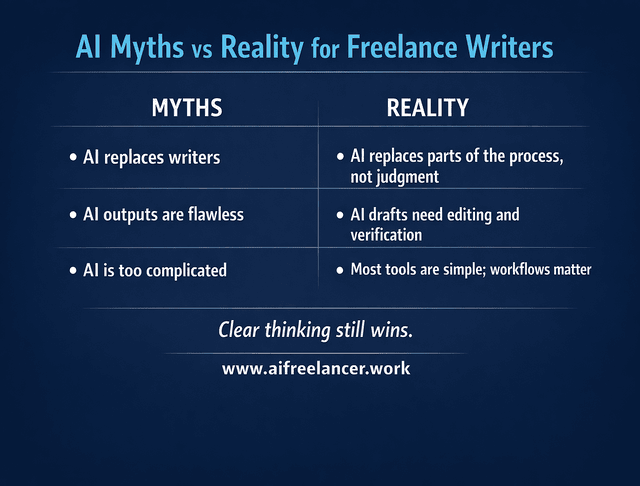
Quick Reality Check: AI Myths vs What Actually Happens
- Myth: AI replaces writers → Reality: AI replaces parts of the process, not the writer’s judgment and voice.
- Myth: AI outputs are flawless → Reality: AI drafts still need editing, fact-checking, and tone control.
- Myth: AI is too complicated → Reality: most tools are point-and-click; the real challenge is choosing a workflow.
AI Myths: AI Will Replace Human Writers
One prevalent AI myth is that AI will replace human writers entirely. This notion fuels anxiety among freelance writers, who fear obsolescence and a future in which machines dominate the writing landscape. However, the reality is quite different: AI is a partner, not a replacement.
AI tools can handle repetitive and mundane tasks, such as summarizing sources, organizing notes, outlining, and producing a rough first draft, freeing up your time for more creative and strategic aspects of writing.
For instance, AI can generate drafts based on your input, providing a solid foundation for your work. However, the final touch always requires your unique human insight to ensure the content aligns with the intended tone, style, and context. The creative nuances, emotional intelligence, and deep understanding of audience preferences are areas where human writers excel, and AI cannot replicate these attributes.
Supporting this perspective, HubSpot’s 2024 AI Trends for Marketers report found that 68% of marketers say AI has helped grow their careers. This reflects a growing recognition of AI as a tool that supports and advances human work rather than replacing it. Instead of fearing AI, embracing it as an ally can lead to more efficient workflows and higher-quality output, ultimately strengthening the role of freelance writers in the digital age.
AI Myths: AI Can Write Flawlessly Without Human Intervention
Another common AI myth is that AI can produce flawless content without human touch. While AI has made significant strides, it still requires human oversight. AI-generated content often needs editing for tone, style, and accuracy. For example, tools like Grammarly can suggest grammatical corrections but might miss context-specific nuances you can only catch.
AI can need help understanding context, idiomatic expressions, and the subtleties of language that human writers naturally grasp. This limitation means that AI-generated content might be technically correct but lacks emotional depth and cultural relevance, making it less likely to resonate with readers. Additionally, AI may need to fully understand the target audience’s preferences and sensitivities, which can result in content that feels off-mark.
A study led by MIT Sloan found that when professionals used generative AI within appropriate boundaries, their performance improved by nearly 40% compared with those who didn’t use it — underscoring that human-AI collaboration, not AI alone, drives better outcomes.
The “flawless output” myth is also a risk issue. Even when AI writing reads well, you still need to watch for:
- Wrong or outdated facts
- Made-up citations or quotes
- Overconfident explanations that don’t match the source
- Tone mismatches that weaken credibility
AI Myths: AI Is Too Complicated for Freelance Writers to Use
A third AI myth is that freelance writers need simplified AI tools to use them effectively. This misconception stems from the belief that AI technology is inherently complex and requires specialized technical knowledge. As a result, many freelance writers may feel intimidated by the prospect of incorporating AI into their work, fearing they will need more skills to navigate these advanced tools.
However, many AI tools are designed to be user-friendly, making them accessible even to those with limited technical expertise. Platforms like Jasper and Copy.ai exemplify this trend by offering intuitive interfaces that streamline the writing process. These tools provide capabilities that simplify content generation, idea brainstorming, and SEO optimization, enabling you to use AI effectively without extensive technical knowledge or feeling overwhelmed.
For instance, Jasper provides templates and guided workflows that help you create various types of content, from blog posts to social media updates, in just a few clicks. Similarly, Copy.ai offers a simple interface where you can input your content requirements and receive AI-generated suggestions for refinement and use. These tools also come with tutorials and customer support to help you get the most out of their features.
You don’t need to be a tech expert to benefit from AI. The key is to select the proper tools that align with your workflow and take advantage of the resources available to learn how to use them effectively. By doing so, you can harness the power of AI to enhance your writing process without feeling overwhelmed by its complexity.
A simpler truth: tools aren’t the hard part. Most writers don’t struggle with AI because the interface is confusing. They struggle because they don’t have a repeatable workflow for using it without losing voice, accuracy, or control.
Debunking AI Myths: The Realities of AI in Freelance Writing
AI myths don’t just create fear. They also hide the real advantages already reshaping freelance writing. Once you move past the idea of AI as a threat or a shortcut, a clearer picture emerges: AI works best as a force multiplier. It strengthens productivity, sharpens quality, and opens creative doors without replacing the writer at the center of the work. This section breaks down what actually happens when freelancers use AI intentionally and shows how the right tools can support better output, not just faster drafts.
Debunking AI Myths: Enhancing Productivity and Efficiency
AI significantly boosts productivity and efficiency in freelance writing by automating repetitive tasks, allowing you to focus on crafting compelling narratives. Tools like ChatGPT for outlining and drafts, and AI-assisted writing features in platforms like Google Docs or Notion, can speed up planning, rewriting, and iteration, saving you hours of manual effort. This automation decreases the time spent on everyday chores and improves overall workflow efficiency.
According to McKinsey, up to 45 percent of paid work activities could be automated using already-demonstrated technologies. Over time, with generative AI and other advances, that figure rises toward 60-70 percent of the time employees currently spend working. This means as a freelance writer, you can offload more of the repetitive and time-consuming tasks, allowing you to take on more projects, meet deadlines faster, and improve the quality of your work — without feeling overwhelmed.
Debunking AI Myths: Improving Content Quality
AI is pivotal in enhancing content quality and transforming how freelance writers produce polished and engaging work. Grammar and style checkers like ProWritingAid and Hemingway are invaluable tools that help ensure your writing is clear, concise, and error-free. These AI-driven platforms go beyond simple spell-checking; they analyze your text for inconsistencies, awkward phrasing, and complex sentence structure, offering suggestions for improvement. By streamlining the editing process, these tools save time and enhance the overall readability of your content.
Research by Acrolinx has shown that content improved by AI tools is 25% more engaging, highlighting the tangible benefits of incorporating AI into your writing process. The ability to quickly refine and elevate your writing quality with AI assistance allows you to focus more on creativity and strategic thinking, ultimately leading to higher-quality outputs that resonate better with your audience.
Debunking AI Myths: Expanding Creative Possibilities
AI expands creative possibilities by assisting in brainstorming and idea generation, transforming how freelance writers and creative professionals approach their work. Tools like ChatGPT are invaluable for overcoming writer’s block, providing a steady stream of topic suggestions, generating outlines, and even drafting initial versions of content based on your input. This collaborative approach between AI and human creativity sparks innovation. It enables you to explore new angles and perspectives you might not have considered otherwise. By offering fresh ideas and diverse ways to present them, AI helps keep your work dynamic and engaging.
A 2022 Adobe survey revealed that 74% of creative professionals use AI to enhance their creative process, emphasizing AI’s significant role in fostering innovation. This widespread adoption among creatives highlights how AI can be a potent tool in breaking through creative barriers and driving the development of unique and compelling content.
Practical Tips for Integrating AI in Freelance Writing
AI only becomes useful when it fits how you actually work. Without clear intent, even the best tools turn into distractions, half-used subscriptions, or shortcuts that don’t improve your output. Integrating AI into freelance writing isn’t about chasing every new platform or automating everything at once. It’s about making deliberate choices that support your workflow, protect your voice, and scale what already works. The following tips focus on practical ways to adopt AI so it enhances your process instead of complicating it.
Choosing the Right AI Tools
Choosing the right AI tools is crucial for successfully integrating them into your freelance writing workflow. When evaluating AI tools, consider ease of use, functionality, and cost. User-friendly platforms with versatile features can significantly streamline your work. Jasper and Copy.ai are popular choices among freelance writers due to their intuitive interfaces and broad range of applications. These tools assist with tasks from content generation to optimization, making them valuable assets in your toolkit.
A 2023 survey by the Content Marketing Institute found that 56% of content creators use AI tools to enhance their work, underscoring the growing reliance on these technologies. The survey also revealed that users experienced improved efficiency and quality in content creation. AI tools’ growing popularity and effectiveness demonstrate their critical role in modern freelance writing, making it essential to select tools that best fit your needs and workflow.
Quick tool-picking filter (so you don’t collect subscriptions)
- If you need faster drafts, choose one drafting assistant and master it
- If you need cleaner writing, choose one editor (grammar + clarity)
- If you need consistency, choose one style/voice checklist and reuse it
- If you need speed: build templates for briefs, outlines, and revisions
Combining AI with Human Skills
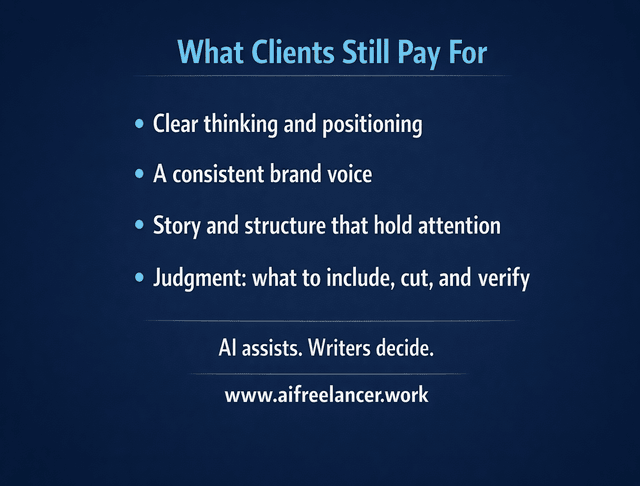
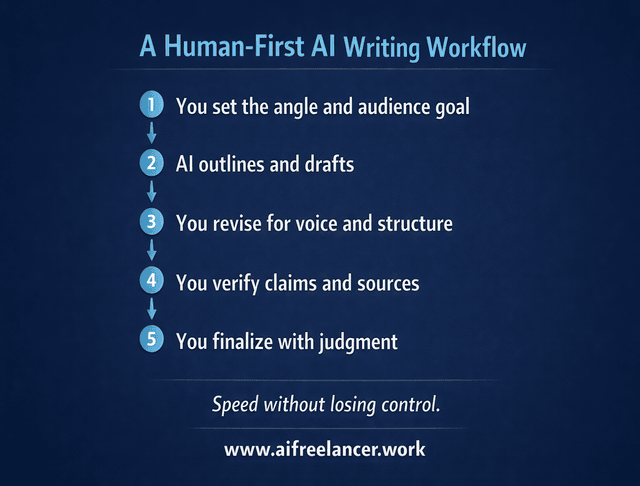
Effective collaboration between AI and human writers is critical to maximizing AI’s benefits. AI can handle research, drafting, and editing tasks, but your unique human touch adds the necessary personality and context. For instance, you might use AI to generate a draft article. Still, your voice and expertise refine and polish it, making it engaging. AI can provide efficiency, handling repetitive tasks and offering suggestions, but your creativity transforms this raw material into compelling narratives.
Successful freelance writers understand this synergy, leveraging AI for its strengths while applying their unique insights to ensure the content is nuanced and resonant. By combining AI’s capabilities with your creative prowess, you can produce high-quality content that meets technical standards and connects with readers on a deeper level, making your work stand out in a crowded digital landscape.
Continuous Learning and Adaptation
Staying up to date with AI advancements is essential to leveraging its full potential in freelance writing. The AI landscape is constantly evolving, introducing new tools and features that significantly enhance your work. A strong starting point is a foundational AI guide for freelance writers that explains how these tools work and where they fit into your day-to-day workflow. To keep abreast of these developments, actively participate in webinars, read industry blogs, and join relevant online communities. These platforms furnish insights into the latest fads and innovations in AI.
Additionally, enrolling in AI writing courses can be highly beneficial. Resources like Coursera and Udemy offer comprehensive classes that provide you with the understanding and skills to integrate AI into your workflow effectively. By investing time in continuous learning and adaptation, you can stay ahead of the curve in the competitive freelance writing industry, ensuring that you are always utilizing the most advanced and efficient tools available. This assertive strategy will help you retain a competitive edge and consistently deliver high-quality, innovative content.
What to learn first (so you don’t get overwhelmed)
- Prompting basics for outlining, rewriting, and tone control
- A repeatable editing checklist (accuracy, voice, clarity, structure)
- A safe way to handle client data and sensitive info
- A “tool cap” rule so you don’t tool-hop
Final Thoughts
Debunking AI myths is essential for freelance writers to embrace AI as a powerful ally rather than a threat. Understanding the realities behind AI myths—such as AI replacing human writers, producing flawless content without intervention, or being too complicated to use—helps you make informed decisions about integrating AI into your work. By enhancing productivity, improving content quality, and expanding creative possibilities, AI offers tremendous benefits for freelance writers. Embrace AI as a valuable tool, continuously learn and adapt, and position yourself at the forefront of the evolving freelance writing industry.
If you want a clear, practical way to use AI without losing your voice, your standards, or your sanity, explore my books on Amazon. They’re written specifically for freelance writers who want real workflows, not hype, and tools that support their work instead of replacing it. Visit my Amazon Author page to see the full collection and choose the guide that fits where you are right now in your freelance journey.
Frequently Asked Questions About AI Myths
No. AI handles repetitive tasks like research, outlining, and basic editing, but it can’t replace your judgment, lived experience, or emotional nuance. It’s a partner that supports your work, not a substitute for you.
AI can create clear, structured drafts, but it doesn’t truly understand context, audience, or emotion. It’s great for first passes and ideas, while humans still shape the message, voice, and depth.
It depends on how you use it. AI is ethical when it acts as an assistant—helping with ideas, drafts, and edits—while you stay responsible for originality, accuracy, and honesty with clients about your process when needed.
No. Most AI tools are built for non-technical users. If you can use a standard web app and write clear prompts, you can start using AI. Good editorial judgment matters far more than coding skills.
Yes, when you use it intentionally. AI can speed up research, drafting, and editing so you can take on better projects, meet deadlines more comfortably, and spend more time on high-value creative work.

Florence De Borja is a freelance writer, content strategist, and author with 14+ years of writing experience and a 15-year background in IT and software development. She creates clear, practical content on AI, SaaS, business, digital marketing, real estate, and wellness, with a focus on helping freelancers use AI to work calmer and scale smarter. On her blog, AI Freelancer, she shares systems, workflows, and AI-powered strategies for building a sustainable solo business.