
You finish an AI-generated article in minutes, only to spend another two hours correcting facts, removing repetitive sentences, and fixing the tone. The draft came quickly, but your deadline still feels uncomfortably close. If this sounds familiar, automated content creation might not be saving you as much time as you expected.
That’s the problem with choosing AI writing software based on how quickly it generates text. A useful tool should also reduce the work involved in researching, editing, and preparing content for publication.
Jasper and Writesonic approach these tasks differently. Both offer AI-powered content creation, but their emphasis on brand control, SEO, automation, and pricing can make one more suitable than the other. Here’s how they compare when your goal is to finish better content with less unnecessary work.
Everything I’ve shared here—and more—is in my book, available on Amazon. Click the link if you’re ready to take the next step.
Jasper vs. Writesonic: Which Is Better for Your Workflow?
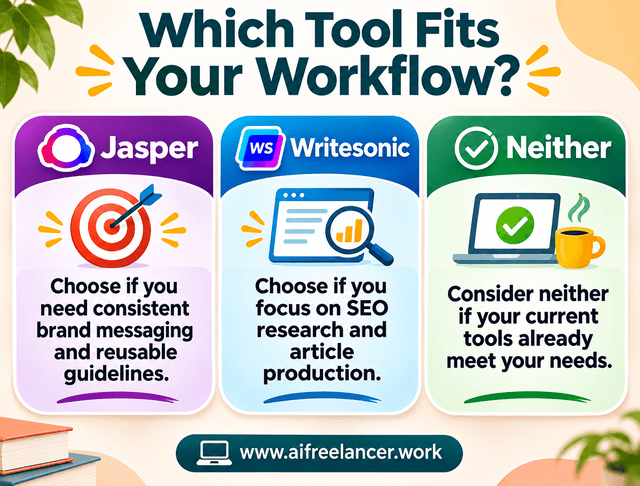
Choose Jasper if brand voice and marketing consistency are your priorities. Writesonic is the more relevant starting point if your work revolves around SEO research, article production, and AI-search visibility. Neither automatically wins on writing quality or time saved.
Some advanced automation and SEO features are limited to higher-priced plans. This is a feature- and workflow-based comparison drawing on official product documentation, pricing information, and independent reviews, including Zapier’s Jasper versus Writesonic comparison. It evaluates documented capabilities and their practical applications rather than claiming firsthand testing or measured differences in product performance.
Jasper at a Glance
Jasper is an AI marketing platform designed to help businesses produce content that follows their brand guidelines. Its Jasper IQ system stores information about brand voice, target audiences, style requirements, and company knowledge.
Jasper’s Pro plan includes two Brand Voices, five Knowledge assets, and three Audiences. More advanced marketing automation, custom agents, and expanded brand controls belong to its custom-priced Business offering. These distinctions are documented on Jasper’s official pricing page.
For writers handling recurring marketing assignments, Jasper’s main attraction is the ability to reuse brand context instead of rebuilding instructions for every draft.
Writesonic at a Glance
Writesonic combines AI content creation with SEO and AI-search visibility tools. Its AI Article Writer describes a workflow involving audience research, competitor analysis, outlines, drafting, and optimization.
Writesonic also offers visibility monitoring across AI-powered search experiences such as ChatGPT, Gemini, and Google AI Overviews. These capabilities may appeal to founders and writers whose content production starts with search demand rather than an established brand campaign.
Access to its AI agents, SEO tools, and visibility monitoring depends on the plan.
Quick Comparison of Their Capabilities
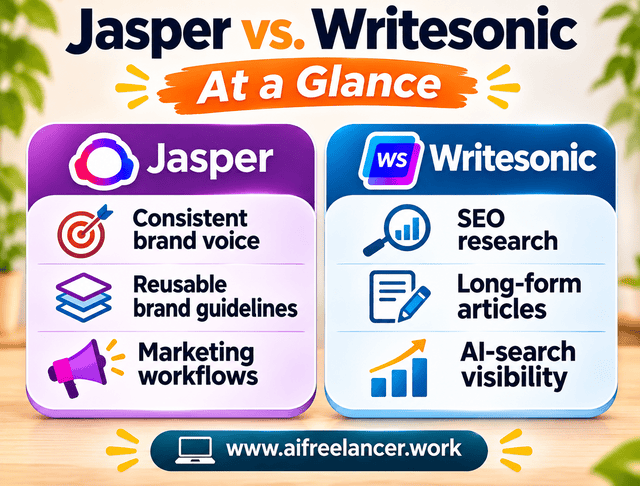
The main difference is what each platform prioritizes. Jasper focuses on maintaining a consistent brand across marketing content. Writesonic brings research, SEO writing, and search visibility tools into the content process. Understanding the capabilities of AI writing platforms can help you evaluate these differences, but what matters is whether the plan you can afford includes the features you actually need.
What Is Automated Content Creation?
Automated content creation uses AI software and connected workflows to perform repetitive tasks involved in producing content. Depending on the tools, this can include research, outlining, drafting, optimization, repurposing, and publishing. Some steps happen automatically, while others require instructions, approvals, or human review.
The goal is not necessarily to remove people from the writing process. It’s to reduce the work that doesn’t require their full attention.
AI Content Generation vs. Workflow Automation
Generating an article from a prompt is AI-assisted writing. Connecting multiple tasks into a repeatable process is workflow automation.
Asking AI to create an outline is an assisted task. If an approved draft automatically moves into your project management system, you’ve automated part of the workflow. Connect preparation, approval, scheduling, and publishing, and you have a more complete process.
Research from the National Bureau of Economic Research found that workers reported generative AI time savings equivalent to 1.4% of total work hours across the surveyed workforce, including non-users. Among recent AI users, the average reported saving was 5.4% of work hours. These are self-reported estimates, not measured improvements from Jasper or Writesonic.
The findings demonstrate potential time savings from AI use, but they do not establish that workers automated complete workflows. For content creators, that distinction matters when choosing between software designed to generate text and tools that connect several production tasks.
Where Human Input Is Still Necessary
AI can help prepare a first draft, but it cannot assume responsibility for the accuracy or suitability of your published work. Research still requires verification, client content must follow agreed guidelines, and final editorial decisions need appropriate review.
A study published in Science found that ChatGPT reduced completion time for experimental professional writing tasks by 40% while increasing independently rated output quality by 18%. The researchers studied 453 college-educated professionals, not users of Jasper or Writesonic. The findings demonstrate AI’s potential, not a guaranteed productivity gain from either platform.
An automation might generate a 1,500-word article with the requested headings, yet it could still fail to meet the client’s requirements. That’s why a reliable content workflow needs a quality checkpoint, not merely confirmation that the software completed its task. A dependable AI-generated content workflow should include fact-checking and editorial review before delivery.
How Jasper and Writesonic Handle Content Production
A quality checkpoint helps you catch problems, but a good content workflow should also prevent unnecessary corrections. Research may be incomplete, the structure may need work, or the client’s instructions may require several revisions.
Consider a typical assignment: a 1,500-word SEO blog article with a defined audience, target keyword, research requirements, and brand guidelines. Here’s how the platforms’ documented features fit into that process.
Research, Content Briefs, and Outlines
Jasper is particularly useful when you already have reliable information about your business or client. You can establish the brand’s tone, audiences, and reference material, then reuse that context for recurring assignments.
However, you must first provide accurate guidelines and relevant information, maintain those assets, and confirm that the resulting brief reflects the assignment.
Writesonic’s AI Article Writer describes a process involving audience research, SERP analysis, positioning, outlining, and multi-step drafting. Instead of assembling every part of an initial SEO brief manually, you can use its guided process to bring research and outlining together.
You still need to review the selected sources, confirm the intended audience, and check whether the proposed structure answers the searcher’s actual question.
First Drafts and Content Generation
Both platforms support AI-generated marketing content, including long-form writing. Jasper uses established brand information to guide content generation, whereas Writesonic combines research, outlining, and drafting in a more guided process.
The important question is not which platform can produce 1,500 words fastest. It’s which produces a draft that requires fewer substantial corrections.
Consider asking both platforms to prepare a 1,500-word article about reducing client revisions. The brief requires practical examples, credible research, a conversational tone, and recommendations that freelance writers can apply.
A usable draft would explain why revisions happen, distinguish unclear briefs from changing client requirements, and provide realistic ways to prevent repeated corrections. It would also support factual claims with verifiable sources and follow the requested tone.
A weaker draft might meet the word count and include every heading but repeat generic advice about communicating clearly and setting expectations. That content still needs substantial rewriting, even if the sentences sound polished.
This example illustrates how to judge the output, not the results of an actual product test. Both platforms would need to complete equivalent assignments before their writing quality could be compared reliably.
Editing and Maintaining Brand Voice
Brand voice becomes especially important when you’re writing for several clients. One client may prefer technical explanations and conservative language. Another may want short, conversational content with a warmer tone.
Jasper’s reusable Brand Voices and Knowledge assets provide a documented way to maintain separate writing instructions. Its Brand Voice documentation explains how users can upload writing samples so Jasper can analyze their tone, style, and other characteristics. Writesonic also provides AI editing functionality, including features for rephrasing, shortening, expanding, and changing tone.
Writesonic supports configurable writing styles as well, with its pricing plans listing one writing style for Starter, five for Basic, and ten for Growth. This gives users another way to manage content consistency, although the number of available styles depends on the subscription.
Jasper’s saved brand instructions guide content from the beginning, while Writesonic’s editing functions are useful when you need to refine an existing passage.
More importantly, not all revisions are equal. An article with weak reasoning or a poorly organized argument needs structural corrections before sentence-level polishing. Improving its tone won’t solve missing evidence, confusing explanations, or sections that fail to answer the reader’s question.
When reviewing AI-generated content, correct the logic first, then the structure and transitions, and finally the wording. A writing assistant for editing and proofreading can help refine the finished draft, but it won’t replace your judgment about the argument, evidence, or organization.
Integrations and Repetitive Task Automation
Writing becomes exhausting when every article involves moving material between several applications. You research in one place, write in another, send the draft for review, update your task tracker, and prepare the final version for publishing.
Microsoft’s 2025 Work Trend Index found that the most frequently interrupted employees experienced 275 interruptions per day, measured through meetings, emails, and chats across 24 hours. That is not a statistic about freelance writers specifically, but it illustrates the fragmentation many knowledge workers face.
Jasper provides marketing agents and connected tools, with more extensive custom automation and API access on Business plans. Its official plan comparison lists custom AI agents, a no-code agent builder, and API access under Business. Writesonic offers guided content workflows and agent-based functions, although access varies by plan.
Transferring a draft into a shared document and notifying a reviewer are different tasks from generating the article itself. Jasper’s advanced API options may support more specialized connections, while Writesonic’s content workflow helps organize earlier production stages.
You may still need to export a draft, configure a third-party service, or obtain client approval. Verify whether your plan supports the specific Google Docs, WordPress, or project management action you need.
The best automation candidates are repeatable tasks that follow clear rules and produce reviewable results. Also consider supervision: a workflow that saves five minutes of copying but requires frequent troubleshooting may not save time overall.
The strongest distinction is at the beginning of the assignment. If you already have approved brand information, Jasper can apply that context to new content. If you usually start with a keyword and need help developing the research and outline, Writesonic’s guided process is more relevant.
Both platforms can support drafting and revisions, but the amount of work saved will depend on the assignment, subscription features, and how well the tool fits your existing process.
SEO Content Creation: Which Tool Offers Better Support?
If your main goal is researching and producing SEO articles, Writesonic’s guided writing process is the more relevant starting point. If you already have a research process and primarily need consistent branded content, Jasper may be the better fit.
Jasper also offers SEO, AEO, and GEO capabilities, including advanced research and optimization features associated with its Business offering. The distinction is not whether one platform supports SEO and the other does not, but which functions are emphasized and available at the subscription level you’re considering.
Specialized SEO functions are not always available in the lowest-priced subscription, so check which features your chosen plan includes.
Keyword Research and Search Intent
Search intent determines what readers expect when they enter a query. Someone searching for “how to automate content creation” needs an explanation or process. Someone searching for “Jasper vs. Writesonic” is comparing potential purchases.
Writesonic’s article-writing workflow emphasizes search research, competing pages, positioning, and content development. Jasper can use supplied keywords, audiences, and marketing context, while advanced research and optimization capabilities may depend on the Business plan.
Keyword information becomes useful when it helps you answer the reader’s actual question. A tool-generated outline may identify common topics, but you still need to decide which points belong in the article and what additional explanation readers need.
Content Optimization and AI Search Visibility
Traditional SEO and AI-search visibility are related but distinct. SEO content optimization focuses on helping a page satisfy search intent and communicate its subject clearly. AI-search visibility monitoring examines whether and how a brand appears in AI-generated search experiences.
Consider a freelance writer preparing an article targeting “automated content creation.” Their concerns include understanding search intent, reviewing competing content, and choosing relevant subtopics.
A founder asking whether ChatGPT or Google AI Overviews mentions their company has a different problem. They may need to monitor brand mentions, compare visibility with competitors, and identify gaps in how AI-powered search tools describe their business.
Writesonic includes AI visibility monitoring in its current platform positioning. Its Starter plan lists monitoring for ChatGPT, Gemini, and Google AI Overviews, while more extensive visibility and agent-related capabilities appear on higher tiers. Jasper also offers GEO-related capabilities, including advanced features associated with its Business offering.
These functions may be valuable for businesses measuring their visibility across search systems. For a freelance writer producing occasional client articles, they may be unnecessary expenses.
Google’s guidance emphasizes original, helpful content rather than special formatting tricks for AI search. Its guide to optimizing for generative AI in Google Search also explains that established SEO practices remain foundational and that original, useful information matters more than supposed AEO or GEO shortcuts. A platform can suggest improvements, but it cannot guarantee search rankings or AI citations.
Jasper vs. Writesonic Pricing: Which Offers Better Value?
A subscription only represents good value when you can access the features you need and use them often enough to justify the cost. A lower monthly price means little if essential functions require another subscription.
Plans, Features, and Usage Limits
As of November 2026, the official pricing pages list the following options:
| Plan | Price | Important details |
| Jasper Pro | $59/month, billed annually | One seat, two Brand Voices, five Knowledge assets, three Audiences |
| Jasper Pro, monthly billing | $69/month | Same plan, without the annual commitment |
| Jasper Business | Custom pricing | Advanced agents, custom workflows, API access, and expanded brand controls |
| Writesonic Starter | $79/month, billed annually | 15 AI articles monthly, AI-search monitoring, 10 trial agent runs |
| Writesonic Basic | $199/month, billed annually | 25 AI articles monthly, expanded monitoring, 50 trial agent runs |
| Writesonic Growth | $399/month, billed annually | 50 AI articles monthly, sentiment analysis, Action Center trial (5 on-page and 5 off-page actions/month), 100 trial agent runs |
Sources: Jasper pricing and Writesonic pricing.
These prices are not necessarily equivalent purchases. Jasper Pro focuses on branded marketing content, while Writesonic Starter includes AI-search visibility and site-auditing capabilities that some writers may not need.
Writesonic Starter includes 15 AI articles per month, so someone producing twenty would need to consider another plan. Its agentic workflows also have limited access at lower tiers.
Jasper’s advanced automation belongs primarily to its Business offering, which does not have a publicly listed fixed price. Some advanced Business features also consume credits. Check the current terms before subscribing, particularly when an annual commitment is involved.
The Hidden Cost of Editing and Additional Tools
The subscription fee does not tell you how much producing an article actually costs. You still need to account for research verification, editing, formatting, and any additional applications required to complete the assignment.
A simplified calculation is:
Cost per finished article = (Total monthly tool costs + total monthly editing costs) ÷ Number of finished articles
Suppose a tool costs $60 monthly and you produce ten articles. The subscription contributes $6 per finished article before accounting for your labor. If each article then requires an additional hour of editing valued at $15, the combined tool and editing cost becomes $21 per finished article.
These figures are hypothetical. If a more expensive tool consistently reduces necessary editing, it could provide better value, although you would need comparable results from your own assignments to establish that advantage.
Value for Different Content Volumes
A founder producing four articles monthly has different requirements from a freelance writer producing twenty. These examples calculate subscription cost allocated per finished article, not the full production cost, and exclude research, editing, and additional software. They assume that the stated number of articles is completed and meets the required quality standard.
For four monthly articles, Jasper Pro’s annual-billing equivalent of $59 represents $14.75 in subscription costs allocated per article. Writesonic Starter’s $79 represents $19.75 per article.
At twenty articles monthly, the subscription decision changes. Writesonic Starter’s allowance is insufficient, while its Basic plan lists 25 AI articles monthly.
At $199 per month when billed annually, Writesonic Basic would represent $9.95 in subscription costs allocated per finished article if you completed twenty articles that month. Its allowance covers AI-generated articles, which may still require editing before they qualify as finished deliverables.
Jasper Pro does not advertise an equivalent simple monthly article allowance in the reviewed pricing information. Its $59 monthly equivalent therefore cannot be compared directly with Writesonic’s article quota as though both platforms measure usage in the same way.
Producing more articles can spread a subscription’s cost across more finished work, provided the plan allows that volume. However, a higher-priced plan does not automatically produce a lower cost per article.
Which AI Writing Platform Fits Your Needs?
Choosing between Jasper and Writesonic becomes easier when you identify the problem you need to solve first. You may need more consistent writing across clients, faster research for weekly content, or fewer manual transfers between applications.
If You Write for Several Clients
If you frequently switch between clients with different writing guidelines, Jasper’s reusable brand context is a practical advantage. You can maintain information about their audiences, terminology, and style requirements instead of reconstructing those instructions for every assignment.
However, Jasper Pro’s limits on Brand Voices and Knowledge assets matter if you manage many clients simultaneously. Check whether the available customization accommodates your workload.
Before uploading confidential briefs or proprietary information to either platform, review its current privacy policy, data controls, content usage terms, and ownership provisions.
If You Need Marketing Content Every Week
If you publish SEO articles every week, Writesonic’s research and article-writing workflow is the more relevant starting point. Its guided process may reduce the work involved in moving from keyword research to a structured draft.
Jasper may be more appropriate when you already have a content calendar and research process but need consistent branded messaging across emails, blog posts, and campaigns.
If Your Workflow Has Too Many Manual Steps
Start by identifying the most repetitive task. Perhaps you regularly copy drafts into Google Docs, reconstruct the same brief, or manually update your publishing tracker.
Then check whether either platform supports that particular workflow through an included feature or supported integration. Focus on the specific handoff you want to eliminate rather than choosing software simply because it offers advanced automation.
When Neither Tool Is Worth the Subscription
You may not need Jasper or Writesonic if your existing writing tools already handle research, drafting, and editing effectively.
This is especially true when you publish only a few articles monthly, manage one brand voice, or have no need for advanced SEO monitoring. A smaller content system also means fewer subscriptions, integrations, and files to manage.
Before purchasing, ask yourself:
- Which part of content creation consistently takes too much time?
- Which tool addresses that problem without introducing unnecessary complexity?
- Will the expected benefit justify the subscription and any additional work?
If you cannot identify a specific task the new platform will improve, it may be better to refine your current process first.
What Is the Best AI Tool for Automated Content Creation?
There is no single best tool for every content workflow. Jasper is worth considering for brand-aligned marketing content, while Writesonic is more relevant for SEO-oriented article production and AI-search visibility.
Your choice should depend on the features included in your subscription, the content you produce, and the amount of editing or manual work that remains.
Can AI Automatically Create SEO-Friendly Blog Posts?
Yes. AI tools can generate structured blog posts, incorporate relevant keywords, and suggest content improvements. Some also provide search research and optimization capabilities.
However, generating an SEO-friendly draft does not guarantee rankings. You still need to verify the information, meet search intent, and provide useful content that goes beyond generic explanations.
Do You Need Coding Skills to Use Jasper or Writesonic?
You generally do not need coding skills for basic content generation, editing, or built-in writing workflows.
Advanced integrations and customized automation may require additional configuration or technical knowledge. Check the specific feature and subscription plan before assuming it will work without setup.
Can AI-Generated Articles Be Published Without Editing?
Technically, AI-generated content can be published without manual rewriting, but doing so introduces avoidable risks.
AI can produce incorrect facts, unsupported claims, repetitive explanations, and content that misses the intended audience. Google’s guidance on generative AI content emphasizes accuracy, quality, relevance, and fact-checking before publication.
Can Jasper or Writesonic Publish Blog Posts Automatically?
Automated publishing may be possible through supported integrations or connected workflows, depending on the platform, plan, and destination website.
However, article generation and publishing automation are separate capabilities. Confirm that your intended CMS is supported, whether third-party services are needed, and how editorial approvals are handled before setting up unattended publishing.
References
- Bick, A., Blandin, A., & Deming, D. J. (2025). The rapid adoption of generative AI (NBER Working Paper No. 32966, originally issued September 2024; revised February 2025). National Bureau of Economic Research.
- Bick, A., Blandin, A., & Deming, D. J. (2025, February 27). The impact of generative AI on work productivity. Federal Reserve Bank of St. Louis.
- Google Search Central. (n.d.). Google Search’s guidance on using generative AI content on your website. Google for Developers.
- Google Search Central. (2026, May 15). A new resource for optimizing for generative AI in Google Search. Google for Developers.
- Jasper. (2026, May 4). Brand Voice. Jasper Success Center.
- Jasper. (2026, September 17). Jasper IQ. Jasper Success Center.
- Jasper. (n.d.). Plans and pricing.
- Microsoft. (2025). 2025: The year the Frontier Firm is born. WorkLab.
- Noy, S., & Zhang, W. (2023). Experimental evidence on the productivity effects of generative artificial intelligence. Science, 381(6654), 187–192.
- Writesonic. (n.d.). AI Article Writer: The agentic content pipeline.
- Writesonic. (n.d.). Plans and pricing.
- Zapier. (2025, June). Writesonic vs. Jasper: Which AI writing tool is best?.
Final Thoughts
Jasper and Writesonic approach content creation from different directions. Jasper emphasizes brand-aligned marketing, while Writesonic places greater emphasis on SEO, research-driven article production, and AI-search visibility.
The right investment in automated content creation isn’t necessarily the platform with the longest feature list. It’s the one that helps you complete your actual work with fewer unnecessary steps, reasonable costs, and appropriate editorial control.
Before subscribing, try the same representative assignment in the plans you’re considering. Pay attention to the work that remains after the first draft, because that’s where the real value of automation becomes clear.
Even a capable AI platform works better when you have a reliable process for researching, drafting, reviewing, and publishing. If you want to develop better AI writing systems, manage your workload more effectively, and make technology work for your freelance business, explore my books and practical resources on my Amazon Author page.

Florence De Borja is a freelance writer, content strategist, and author with 14+ years of writing experience and a 15-year background in IT and software development. She creates clear, practical content on AI, SaaS, business, digital marketing, real estate, and wellness, with a focus on helping freelancers use AI to work calmer and scale smarter. On her blog, AI Freelancer, she shares systems, workflows, and AI-powered strategies for building a sustainable solo business.


Pingback: AI-Generated Content for Freelancers: Start Smart, Ship Fast - The AI Freelancer