Artificial Intelligence (AI) is changing diverse industries, and freelance writing is no exception. However, the rise of AI in this field raises several issues that need clarification to hinder its practical use. Understanding AI is crucial for leveraging its full potential in freelance writing. This blog will address and debunk common misconceptions about AI to help you make informed decisions.
Everything I’ve shared here—and more—is in my book, available on Amazon. Click the link if you’re ready to take the next step.
Misconceptions about AI Capabilities
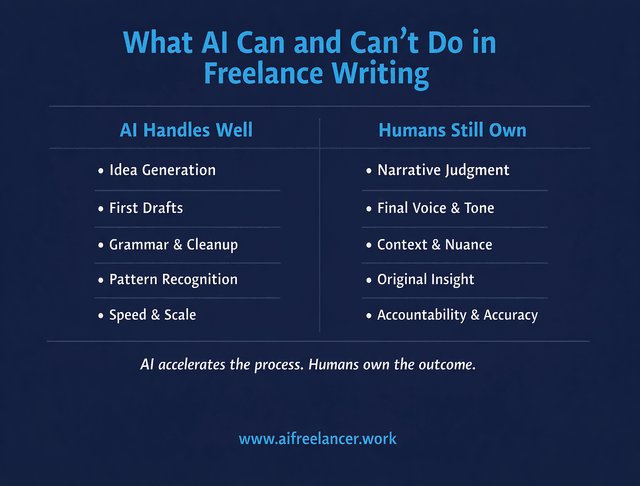
AI can feel like magic when it spits out a clean paragraph in seconds. That’s exactly why so many freelancers and clients end up overestimating what it can do, then getting frustrated when the results fall flat. Before you build a workflow around any tool, it helps to separate impressive output from real capability. This section clears up the biggest myths so you can use AI with confidence, without handing it jobs it cannot actually handle.
Can AI Write High-Quality, Original Content on Its Own?
One of the biggest misconceptions about AI is that it can generate high-quality, original content independently. While AI tools can produce coherent sentences and even entire articles, they heavily rely on human input and guidance to create meaningful content. AI lacks true creativity and emotional intelligence, which are essential for writing that resonates with readers. If you want a clearer overview of what AI can and can’t do, it helps to step back and look at a broader AI guide that explains how these systems actually work.
In practice, most professionals already treat AI as a helper, not a ghostwriter. A 2024 Orbit Media survey reported by HubSpot found that 54% of content marketers use AI to generate ideas. However, only 6% rely on it to write entire articles from start to finish—underscoring that humans still own structure, judgment, and final voice.
For instance, AI can assist in generating ideas, providing drafts, and suggesting improvements. However, the final touch and quality assurance—elements that ensure the content is engaging, accurate, and contextually appropriate—are provided by human writers. This collaboration between AI and humans is not about replacing the other but about harnessing both strengths. It’s about combining AI’s efficiency in data processing with the human touch that infuses writing with creativity and emotional depth, making each writer an integral part of the process.
Does AI Truly Understand Context and Nuance?
Another common myth is that AI fully understands the context and nuances of language. AI models like GPT-5.1 analyze language by identifying patterns within the data used for their training. Still, they need to comprehend the subtleties and complexities of human communication. This constraint leads to mistakes and misinterpretations, especially in nuanced writing tasks. For instance, an AI might misinterpret idiomatic expressions or cultural references, resulting in unnatural or inappropriate content. This underscores the significance of human oversight in ensuring that AI-generated content is accurate, contextually appropriate, and resonates with the intended audience.
Will AI Replace Human Writers?
There is widespread concern that AI will entirely replace freelance writers. AI aims to boost human creativity, not replace it, and it can handle repetitive and mundane tasks, freeing writers to focus on more creative and strategic aspects of their work. For instance, AI can assist with grammar checks, content suggestions, and even preliminary research, but cannot replicate a human writer’s unique voice and perspective. This collaboration between AI and human writers leads to more efficient content creation while maintaining the originality and emotional depth that only humans can provide.
AI takes over tedious tasks, allowing writers to dedicate more time to developing their ideas and crafting engaging narratives. This symbiotic relationship ensures that the content is high-quality and uniquely tailored to the audience. By freeing up time from repetitive tasks, AI empowers writers to focus on the more creative and strategic aspects of their work, enhancing productivity and output quality.
Misconceptions about AI Usage
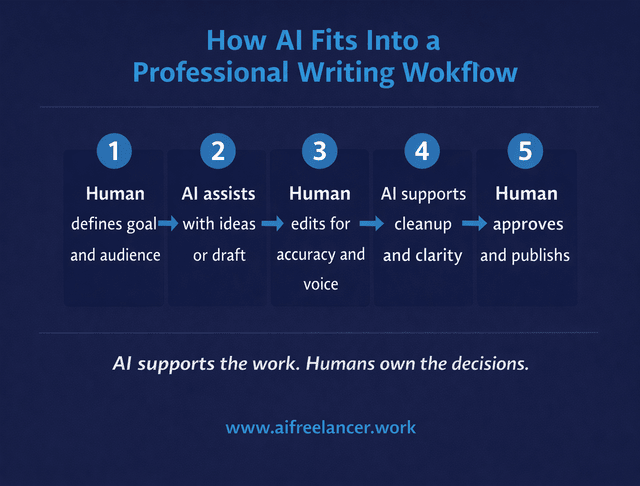
AI tools often get sold as instant upgrades: sign up, type a prompt, and suddenly your workflow is “optimized.” That promise sounds appealing, especially when time and budget are tight. But it skips over the practical realities of learning, cost trade-offs, and ethical responsibility. Before you decide whether AI belongs in your writing process, it helps to clear up how these tools actually fit into real-world freelance work, not the marketing version.
Is AI Really Plug-and-Play for Writers?
Some believe that AI tools are plug-and-play with no learning curve. However, effectively using AI requires understanding its capabilities and limitations. Writers must learn to interact with AI tools, interpret their outputs, and integrate them into their workflows. This learning process involves familiarizing oneself with the specific functions and features of the AI tool, such as how it processes language, the types of tasks it can assist with, and its accuracy in generating content.
Additionally, writers must practice and refine their use of tools to ensure that AI-generated content aligns with their style and meets quality standards. This learning process is essential for maximizing the benefits of AI in writing, enabling writers to leverage AI’s strengths while mitigating its weaknesses, ultimately enhancing their productivity and creativity.
Is AI Too Expensive or Out of Reach for Freelancers?
Another common misconception is that AI tools are relatively inexpensive for freelance writers. While it is true that some advanced AI tools come with a high price tag, this doesn’t mean all AI solutions are out of reach for budget-conscious freelancers. Many affordable and even free options can significantly enhance your writing process. Tools like Grammarly, which offer free and premium versions, help improve grammar and clarity. The Hemingway App provides a straightforward interface to make your writing bolder and clearer, with a focus on readability.
Additionally, various AI-powered content generators, such as Copy.ai and Writesonic, offer budget-friendly solutions tailored to different writing needs. These tools collectively provide a range of capabilities, from simple grammar checks to sophisticated content creation, making AI assistance accessible to writers of all budgets. So, regardless of your budget, there’s an AI tool out there that can significantly enhance your writing process.
Is Using AI for Writing Unethical or “Cheating”?
Using AI for writing is often viewed as unethical, primarily due to concerns about plagiarism and transparency. These concerns arise from instances where AI-generated content has been either directly copied from existing sources or produced without proper acknowledgment of its origin.
Ethical use of AI involves clear communication about AI’s role in the writing process, ensuring that any content generated by AI is both original and appropriately cited. This means integrating AI tools responsibly to assist in idea generation, editing, and enhancing creativity while maintaining human oversight to ensure the authenticity and ethical standards of the final output. By doing so, AI can be a valuable tool that complements human creativity without compromising ethical integrity.
Misconceptions about AI Outcomes
When people talk about AI outcomes, the conversation usually swings to extremes. Either AI content is dismissed as low-quality filler, or it’s framed as an unstoppable force that will flatten every writer’s voice. Both views miss what’s actually happening in practice. To understand where AI genuinely adds value—and where it still depends on human judgment—it helps to look closely at what today’s tools can produce, how they shape writing style, and where they’re headed next.
Are All AI-Generated Articles Low Quality?
A common misconception is that AI-generated content is always subpar. While early AI tool versions produced lower-quality outputs, significant advances in natural language processing (NLP) have drastically improved the quality of AI-generated content. Modern AI tools like GPT-5.1 use sophisticated algorithms that enable them to understand context, generate coherent, engaging text, and even mimic specific writing styles.
AI can produce high-quality content that meets professional standards with proper guidance and human editing. In a peer-reviewed study published in Science, professionals who used ChatGPT to assist with writing tasks completed their work about 40% faster, and independent evaluators rated the quality of their output roughly 18% higher than those who worked without AI support—showing how powerful AI can be when humans stay in the loop.
For instance, many reputable companies now use AI to draft articles, marketing materials, and even creative writing pieces, demonstrating its ability to generate valuable, relevant content when humans stay responsible for accuracy and final decisions.
Where AI Output Still Breaks Down (Even With Strong Models)
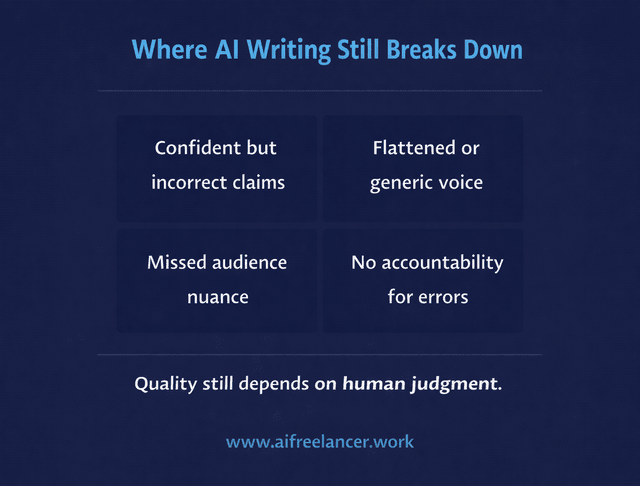
Even strong AI output can fail in predictable ways, especially when the topic requires accountability. It can sound confident while being wrong, flatten nuance, miss what matters to a specific audience, or “average out” a voice into something generic. It also cannot take responsibility for claims, sources, or outcomes. That is why professional-quality AI writing still depends on human judgment, fact-checking, and final editorial control.
Can AI Mimic a Writer’s Style and Voice?
Many believe that AI cannot mimic personal writing styles and voices. However, with sufficient data, AI can adapt to individual styles remarkably well. AI can identify and learn stylistic elements such as tone, vocabulary, and sentence structure by analyzing a writer’s previous works. This enables AI to generate content that closely aligns with a writer’s unique voice, maintaining consistency across pieces.
For instance, an AI writing tool can study a freelancer’s blog posts, articles, and other writings to develop a comprehensive understanding of their style. Consequently, the AI can produce new content that seamlessly integrates with the writer’s established voice, making it invaluable in ensuring uniformity and coherence across different projects. This capability highlights AI’s potential to enhance, rather than replace, human creativity in the writing process.
Will AI Keep Improving, or Is This the Plateau?
Some believe that AI will stagnate and not improve further. However, this perspective overlooks the dynamic nature of AI technology. Researchers and developers constantly labor to strengthen AI capabilities, leading to significant advancements. These improvements will integrate AI deeply into the writing process, offering freelance writers increasingly sophisticated tools.
For example, AI models like GPT-5.1 already demonstrate improved language processing, and future iterations will likely offer even more nuanced and contextually accurate content generation. This ongoing evolution ensures that AI remains a valuable and ever-improving asset for writers.
Final Thoughts
Addressing and debunking these misconceptions about AI can help us better understand its potential in freelance writing. AI is not a menace but a potent tool that, when used correctly, can enhance creativity, improve efficiency, and maintain high-quality standards. The advantage goes to writers who treat AI like a system inside a workflow: clear inputs, tight review, and human ownership of accuracy, voice, and judgment. Embrace AI as a beneficial ally in your writing journey and stay informed about its evolving capabilities to remain competitive in the freelance writing landscape.
If you want to go deeper and see exactly how to apply this in real freelance workflows, you’ll find everything expanded and practical in my books. Visit my Amazon Author page to explore guides on using AI responsibly, efficiently, and without losing your voice—so you can write smarter, work faster, and stay competitive as the tools evolve.
Frequently Asked Questions on Misconceptions About AI
No. AI can speed up research, drafting, and cleanup, but it can’t replace lived experience, judgment, or a distinct voice. It works best as a support tool, not a substitute.
It depends on how you use it. It becomes unethical when you copy AI output verbatim, skip fact-checking, or hide it in contexts that require transparency. Used as an assistant—with human oversight and edits—it’s just another tool.
No. Generic prompts often produce generic text, which fuels this myth. With clear instructions, good editing, and fact-checking, AI can produce strong drafts you refine into publishable pieces.
Most writing tools are built around simple chat boxes and editors. You don’t need coding skills; you need basic prompt skills and a habit of reviewing AI’s work, especially for nuanced topics in AI in freelance writing.
Not always. Many tools have free tiers or low-cost plans (grammar, style, and drafting assistants). Start with budget-friendly options and upgrade only when AI clearly saves time or prevents income loss due to misconceptions about AI.

Florence De Borja is a freelance writer, content strategist, and author with 14+ years of writing experience and a 15-year background in IT and software development. She creates clear, practical content on AI, SaaS, business, digital marketing, real estate, and wellness, with a focus on helping freelancers use AI to work calmer and scale smarter. On her blog, AI Freelancer, she shares systems, workflows, and AI-powered strategies for building a sustainable solo business.