
You spend hours on a blog post, case study, or email sequence—and then the numbers go nowhere. A few clicks, almost no time on page, no real leads, and a client who still wants “better results” without a better budget. If you’re a mid-career freelance writer or content strategist, that cycle is more than frustrating. It’s exhausting. You don’t have the time or energy to keep guessing what might work. You need a way to see which ideas are more likely to perform before you pour a whole afternoon into them. That’s where predictive analytics for content marketing comes in.
Instead of picking topics and formats based on gut feel, you look at your past results and use that data to make better bets. The goal isn’t to turn you into a data scientist. The goal is to protect your time, improve client results, and back up your recommendations with something stronger than “this sounds good.”
McKinsey reports that companies that leverage customer behavioral insights outperform peers by 85% in sales growth and more than 25% in gross margin. When you apply even a small version of that mindset to your content planning, you stop guessing and start using evidence.
This guide will walk you through what predictive analytics means in plain language and how you can use it as a solo writer.
Everything I’ve shared here—and more—is in my book, available on Amazon. Click the link if you’re ready to level up.
How Predictive Analytics for Content Marketing Actually Works
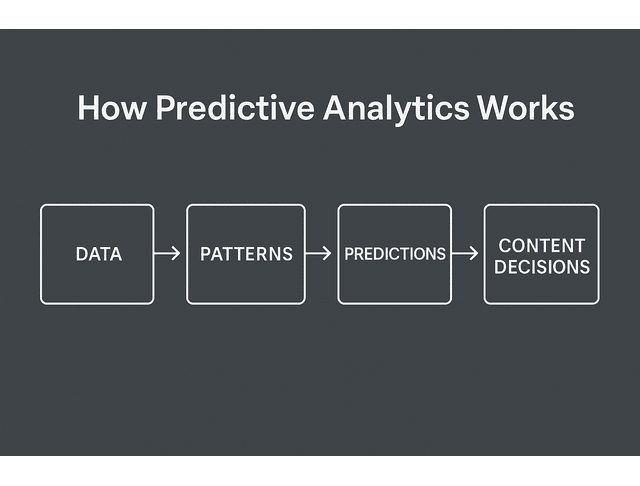
Let’s strip away the jargon. Predictive analytics means: looking at what has happened before to make a smart guess about what will happen next.
In content marketing, that looks like:
- Checking which posts, emails, or pages did well in the past
- Noticing patterns in topics, formats, and calls to action
- Using those patterns to decide what you should create or update next
The “data” you use can be simple:
- Google Analytics or GA4 to see your top pages, time on page, and conversions
- Google Search Console to see which searches bring people in
- Email stats (open rates, click-throughs, replies)
- Social stats (saves, shares, comments)
Predictive tools and reports analyze those numbers to find patterns you might miss. Instead of staring at random charts, you start to see messages like: “People who read these two posts often become newsletter subscribers” or “This type of content gets traffic but rarely leads to a signup.”
Researchers studying predictive analytics in marketing keep finding the same thing. When teams use past data and forecasts to guide decisions, they achieve better results with the same or smaller budgets. You’re not trying to predict the future perfectly. You’re trying to make smarter, safer bets.
Predictive Analytics for Content Marketing as Your Editorial Compass
Think of predictive analytics for content marketing as a compass for your editorial calendar.
You still decide:
- What do you want to be known for
- Who you want to attract
- How you want your brand to sound
But you let the data point you toward ideas that are more likely to work.
A simple monthly review might look like this:
- Open your analytics and list your top pieces by real business results (signups, contact form submissions, booked calls, purchases), not just views.
- Look for patterns. Detailed tutorials convert better than opinion pieces. Would comparison posts send more people to your services page?
- Turn those patterns into decisions: create more of what leads to action, and less of what only creates empty traffic.
At a bigger scale, this is exactly what high-performing companies do. McKinsey’s research on customer analytics found that intensive users of customer analytics are 23 times more likely to clearly outperform competitors in new customer acquisition, 9 times more likely to outperform competitors in customer loyalty, and almost 19 times more likely to achieve above-average profitability. You don’t need their tools or team size, but you can borrow the same habit: look at what works, then intentionally do more of it.
Key Terms Without the Jargon Overload
You’ll see a few terms around predictive analytics. Here’s what they mean in simple English:
- A model is a set of rules a computer uses to analyze past data (for example, which pages people visited and what they did next) and estimate what they might do in the future.
- A forecast is the model’s best guess about a number in the future—like how much traffic or how many leads you might get next month if things continue as they are.
- Journey insights are patterns in how people move through your content. For example, “people who land on X blog post often go on to read Y, then visit the pricing page.”
You don’t have to build any of this yourself. Most of the time, you are reading helpful summaries inside tools you already use and turning them into content decisions.
Using Predictive Analytics for Content Marketing to Know Your Audience
Once you understand the basics of how predictive analytics works, the next step is using those insights to see your audience more clearly.
Most clients hand freelance writers vague personas like “busy marketing manager” or “startup founder,” but predictive analytics lets you focus on actual behavior instead of guesswork.
Seeing Behavior-Based Segments Instead of Flat Personas
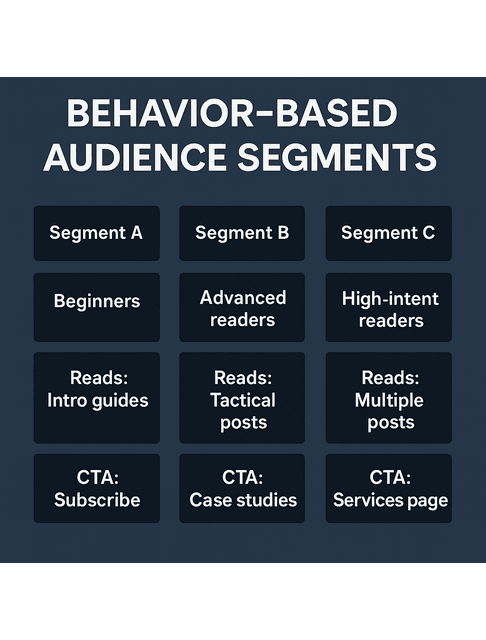
Over time, your analytics will show you different groups of readers based on how they act, such as:
- People who mainly read beginner guides
- People who always click through to in-depth, advanced content
- People who read several posts in one visit, then sign up for your list
These patterns tell you a lot. You can see where people are in their decision-making and which content helps them move forward. Instead of publishing random posts, you can build paths:
- A mini-sequence of blog posts for beginners who need basic concepts first
- A set of advanced pieces for readers who already understand the basics
- A path from blog → case study → services page for high-intent visitors
Predictive models help you spot “turning point” content: pieces that often appear just before someone signs up or gets in touch. Those are the types of topics and formats you want to protect, update, and expand.
Why Your Clients Care About Predictive Analytics for Content Marketing Outcomes
Clients don’t really care about page views. They care about leads, sales, and renewals. Predictive analytics links your content more clearly to those outcomes.
Imagine being able to say:
- “We’re focusing on this topic cluster because it has the strongest history of leading to demo requests.”
- “We should add a follow-up piece here, because people often drop off after this article with nowhere relevant to go next.”
That sounds very different from “I think we should write about this because it’s interesting.”
It also aligns with how seriously marketing teams already work. According to Salesforce, 88% of marketers use analytics or measurement tools to guide their work. When you can talk analytics—even in a simple way—you fit much more naturally into higher-value projects and retainers.
Spotting High-Value Topics Before You Write a Word
Predictive analytics also makes idea generation easier.
Instead of starting with a blank page, you:
- Look at which topics have led to signups or calls in the past
- Check which keywords are gaining search interest and tend to bring in engaged visitors
- Notice which angles (how-to, versus, step-by-step, case study) usually lead to action
For example, you might see that content about “AI editing workflows” doesn’t just bring in traffic—it also leads to more newsletter signups and discovery calls. That’s a strong signal to build a small content cluster around that theme: a pillar article, a comparison post, a case study, and a short email sequence.
If a topic attracts views but seldom leads to signups or inquiries, you can treat it as awareness content only—or decide you don’t need more of it.
Applying Predictive Analytics for Content Marketing in Your Workflow
Now that you can see what your audience does and which topics matter, the next move is to turn predictive analytics into a simple system you can actually run.
You don’t need a fancy data stack. You need a simple, repeatable habit that fits into your week and month.
Monthly or Quarterly Review
Start with a recurring review cycle. Every month or quarter, set aside time to review your best-performing content. But instead of ranking by views, rank by what matters for you or your client: signups, demo requests, booked calls, or sales. For example, in GA4, go to Reports → Engagement → Pages and screens to see which pages get the most views and conversions, then filter or sort by events that match your goals.
Then ask:
- Which topics keep showing up near the top of the list?
- Which formats perform best—tutorials, comparisons, case studies, or short explainers?
- Which angles make people take action—“how to,” “X vs Y,” “step-by-step,” “behind the scenes”?
Now turn those answers into a list of content ideas: more pieces around winning topics, updated versions of strong posts that are a bit out of date, and new “bridge” content that connects two high-performing pieces and gives readers a clear next step.
Weekly Workflow Rhythm
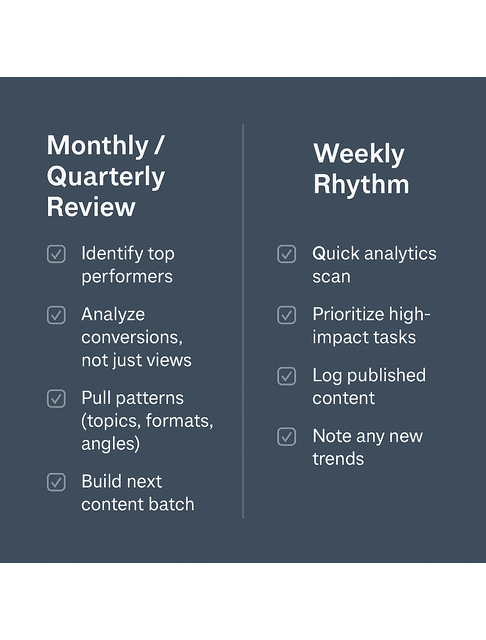
From there, layer in a light weekly rhythm. At the start of the week, open your analytics and quickly look for any big changes. Did one post suddenly perform well? Did something drop? Make a note. When you plan your tasks, put high-impact work first: content that builds on proven winners or fills a clear gap in a journey. At the end of the week, log what you published—topic, format, who it was for, what the call to action was, and where it lives. That way, future reviews are easier and your predictive picture becomes clearer over time.
You can absolutely bring AI tools into this rhythm: let them help with research, summarizing, outlines, and drafts. Your job is to decide what to create and why—and predictive analytics enables you to answer those questions.
From Gut Feel to Data-Informed Planning with Predictive Analytics for Content Marketing
Your instincts still matter. They help you spot interesting ideas and choose angles that feel human and alive. Predictive analytics doesn’t replace that. It just keeps your instincts from becoming too expensive.
A healthy balance looks like this: use intuition to generate ideas and experiments, then use data to decide which ones become a series, which you repeat, and which you quietly retire. Over time, this loop—idea, publish, measure, adjust—also trains your intuition. You’ll notice patterns faster and make better calls, because you’ve seen the same types of decisions play out in the numbers.
Measuring Results of Predictive Analytics for Content Marketing
To keep using predictive analytics (and to sell it to clients), you need to see that it’s working.
Choosing Metrics That Match Business Goals
Decide what “success” means for a specific client or for your own brand. That could be trial signups or demos, booked consultation calls, course sales, or product purchases. If you’re unsure which conversion event to track, pick the action that connects most directly to revenue or a sales conversation.
You still want to track things like time on page and scroll depth, but only as early signals. They show you whether people actually stick with your content long enough for your call to action to have a real shot at working.
Analytics-driven marketing research consistently finds improvements in campaign efficiency and ROI when teams use models and data to inform decisions rather than guess. When your content strategy follows the same logic, you’re plugging into the same kind of upside, even as a one-person shop.
Creating Lightweight Dashboards You Can Actually Maintain
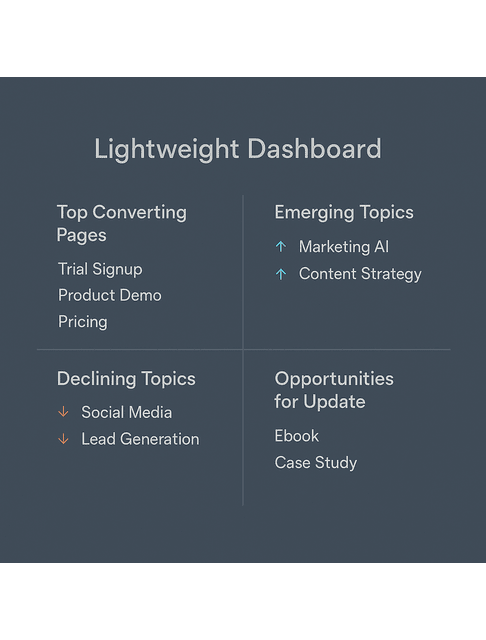
You don’t need a big business-intelligence setup. A simple view in GA4, Looker Studio, or a well-designed spreadsheet can be enough if it answers three questions:
- Which pieces of content are directly responsible for conversions?
- Which topics are gaining traction and which are fading?
- Which older assets get enough interest that they’re worth updating?
The purpose of the dashboard is to give you a quick, honest snapshot before you plan. If you can glance at it and immediately see what deserves attention, it’s doing its job.
Using Insights to Pitch Better Strategies (and Higher Rates)
Predictive analytics also changes how you talk about your work. It sharpens your recommendations and helps you position yourself as someone who understands strategy, behavior, and content personalization rather than just production.
Instead of sending a list that says, “Next month: four posts about Topic X,” you might say, “Based on last quarter’s data, we expect these four pieces to bring in more qualified leads if we publish and promote them here.” The plan shifts from “more content” to “better results.”
Because companies that lean into analytics and predictive approaches outperform their peers, clients are increasingly expecting marketing partners who think this way. When you show that you can connect content ideas to data and business goals, you move into a smaller group of freelancers who can charge for strategy, not just words.
Final Thoughts
You don’t have to become a statistician to use predictive analytics effectively in content marketing. You need a few simple habits: look at your past results, notice what actually drives signups or sales, and let that information shape what you write next.
For a busy freelance writer, the real benefit is protection. You guard your time from low-impact ideas, conserve your energy by cutting out constant guesswork, and strengthen your business by showing clients that your recommendations rest on evidence, not luck.
When you can say, “We’re doing this because the numbers support it,” you make better decisions, earn more trust, and build a writing career that doesn’t depend on burnout.
If you want a writer-first guide to using predictive analytics without the jargon, explore my books on Amazon. They show you how to use past results to make smarter content decisions, protect your time, and back recommendations with evidence clients trust. Visit my Amazon Author page to pick the guide that fits your workflow.
Frequently Asked Questions About Predictive Analytics for Content Marketing
Predictive analytics helps you see which topics, formats, and channels are most likely to succeed based on past engagement and conversion data. Instead of guessing, you use patterns in audience behavior to choose ideas that are more likely to deliver leads, signups, or sales.
You only need simple, accessible data: website analytics (GA4), search data (Google Search Console), email performance (opens/clicks), and social signals. These basics are enough to help you spot patterns in what attracts readers and what moves them toward action.
Most of the heavy lifting comes from tools you already use—such as analytics dashboards, SEO platforms, and AI assistants. You read the patterns they surface and turn those insights into better content decisions.
You may notice early improvements within a few weeks as you prioritize higher-performing topics and formats. Over a few months, the compounding effect of better decisions becomes clearer in stronger engagement and more qualified leads.
Yes. When you can explain why certain content will perform better—and show the data behind your recommendations—you move from being a writer who “creates content” to a strategist who drives business outcomes. Clients pay more for that level of clarity and insight.

Florence De Borja is a freelance writer, content strategist, and author with 14+ years of writing experience and a 15-year background in IT and software development. She creates clear, practical content on AI, SaaS, business, digital marketing, real estate, and wellness, with a focus on helping freelancers use AI to work calmer and scale smarter. On her blog, AI Freelancer, she shares systems, workflows, and AI-powered strategies for building a sustainable solo business.