
Learning how to write faster without losing quality often feels impossible when the writing process itself keeps fighting for your attention. You open the document, determined to finish quickly, but ten minutes later, you are still rewriting the first paragraph. A client revision notification appears. Research tabs pile up in the background. Halfway through the introduction, you stop again to “fix” a sentence that probably did not need fixing in the first place.
For freelancers, consultants, and overloaded creators, slow writing is rarely caused by a lack of skill. The real problem is that most people try to draft, edit, organize, research, and perfect everything simultaneously. Every unfinished sentence creates another decision. Every interruption breaks momentum. Every restart forces the brain to reload context before progress can continue.
That is why even experienced writers still struggle to finish drafts efficiently. The solution is not learning how to type faster or forcing more discipline. The real solution is reducing the mental friction surrounding the writing process itself.
Everything I’ve shared here—and more—is in my book, available on Amazon. Click the link if you’re ready to take the next step.
Why Does “How to Write Faster Without Losing Quality” Feel So Difficult
Most writing problems begin long before the final draft. The slowdown usually starts during the opening stages, when the brain is trying to make too many decisions at once.
Most Writers Try to Draft and Edit at the Same Time
Many writers unknowingly combine two completely different cognitive tasks: generating ideas and evaluating ideas. That combination creates friction immediately because the brain keeps switching between creation and criticism, rather than staying focused on momentum.
You start writing a paragraph, judge it halfway through, delete part of it, rewrite the sentence, question the tone, adjust the wording, then restart the introduction. Instead of building momentum, the draft becomes trapped in endless self-correction. This is where “Draft Momentum” matters. Draft momentum means protecting forward progress instead of polishing every sentence while the draft is still incomplete.
Freelancers experience this constantly during client work. A writer may spend thirty minutes adjusting one introduction while the rest of the article remains blank. The draft never develops enough structure to become easier to edit later.
Research from the American Psychological Association found that making repeated decisions can reduce mental stamina and self-control over time. That matters directly inside writing workflows. Every sentence-level revision, headline adjustment, and tone correction becomes another mental decision competing for attention. Writing sessions filled with nonstop micro-decisions drain energy much faster than structured workflows that separate drafting from editing.
Starting From Scratch Creates Hidden Decision Fatigue
Blank pages create pressure because every paragraph requires new choices involving structure, examples, tone, transitions, and supporting points. These “Micro-Decisions” quietly exhaust attention before the draft even develops.
This is why writers often stare at scattered notes without knowing where to begin, especially when they do not yet have a reliable system for turning rough ideas into usable drafts. The brain is not resisting writing itself. It is resisting uncertainty. When there is no structure yet, every sentence feels heavier because the writer is simultaneously trying to decide what comes next.
For freelancers juggling multiple deadlines, the problem compounds quickly. One unfinished client draft competes with proposal writing, revision requests, research tabs, Slack notifications, and inbox interruptions. Microsoft’s Work Trend Index reported that employees are interrupted every two minutes on average by meetings, emails, or notifications. For writers, those interruptions are especially expensive because every interruption breaks the drafting context. When the writer returns to the document, the brain must reload the argument, structure, tone, and unfinished ideas before progress resumes.
Why Experienced Freelancers Still Struggle With Slow Drafts
Experience improves writing skills, but it does not automatically improve workflow structure. Many experienced freelancers still reopen the same unfinished draft multiple times throughout the day. They edit sections repeatedly, lose context after interruptions, then restart mentally each time they return.
This creates what many writers experience as “The Restart Loop”: reopen the draft, reread previous sections, tweak old paragraphs, hesitate, then leave the work unfinished again. The issue is not a lack of skill. The issue is workflow friction.
A freelance writer handling three client projects in the same week may experience this constantly. They open a blog draft, remember they still need to answer revision feedback for another client, switch to email, reopen research tabs, then return to the original article twenty minutes later without remembering where the argument was going. The workday becomes fragmented, even though they technically spent hours “working.”
The Draft-First System Behind How to Write Faster Without Losing Quality
Most professional writers eventually realize something important: drafting and editing should not happen simultaneously. Once those stages become separated, the writing process usually becomes faster, lighter, and easier to sustain.
What a Draft-First Writing Workflow Actually Looks Like
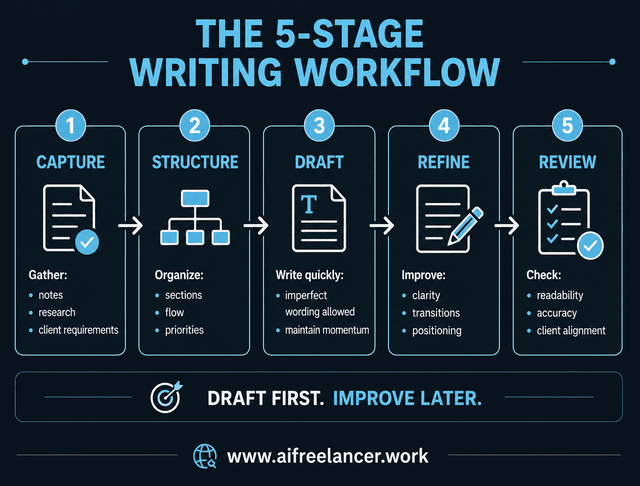
A draft-first system separates writing into clear stages:
- Capture
- Structure
- Draft
- Refine
- Review
During Capture, the goal is simply gathering material such as client notes, research, references, statistics, and audience pain points. During Structure, the material gets organized before sentence-level writing begins. Instead of improvising every paragraph in real time, the article already has directional clarity.
Only then does drafting begin. The Draft stage is intentionally imperfect because the goal is momentum, not polish. Writers move quickly, leave placeholders when necessary, and avoid stopping to perfect transitions prematurely. This is where “Temporary Imperfection” becomes useful. Rough wording is acceptable because refinement happens later.
For example, imagine two freelancers handling the same client brief.
The first freelancer opens the blank document immediately and starts writing the introduction. Ten minutes later, they stop to research a statistic. Then they rewrite the headline. Then they adjust the tone because the opening feels weak. Thirty minutes later, the article still has only two unfinished paragraphs.
The second freelancer first captures all raw material:
- client notes
- research links
- audience pain points
- examples
- desired CTA
Next, they organize those notes into sections before drafting anything polished. Once the structure already exists, drafting becomes easier because the writer is no longer inventing the flow sentence by sentence.
The Refine stage improves clarity, readability, positioning, and voice. The Review stage focuses on factual accuracy, formatting, tone consistency, and alignment with client goals. Separating these stages lowers cognitive overload because the brain focuses on one type of task at a time instead of juggling everything simultaneously.
Why Editing Is Cognitively Easier Than Creating
Creating from nothing is mentally heavier than improving existing material. When writers edit, the brain reacts to something already visible. That process is usually easier than inventing a structure from a blank page.
A rough paragraph gives the brain something concrete to improve. A blank page gives it nothing. That is why many writers discover they can revise quickly once the first draft exists, even if starting felt painfully slow.
Research published in PubMed reviewing cognitive control tasks found that increasing task demands raises cognitive effort significantly. Simultaneously drafting, organizing, and self-editing increases those demands substantially because the brain constantly changes modes. Separating drafting from editing reduces that switching pressure and allows writers to stay focused on a single type of mental task.
How to Write Faster Without Losing Quality by Lowering Friction First
Writers often assume speed comes from discipline or motivation. In reality, speed usually improves when mental resistance decreases. That resistance often comes from perfectionism, unclear structure, overloaded decisions, and repeated mental restarts.
Reducing startup pressure creates momentum. This is why many professional writers use placeholders during drafting instead of interrupting the workflow repeatedly. They may write:
- “Insert statistic here.”
- “Expand example later.”
- “Add transition.”
The goal is not perfection during drafting. The goal is to keep enough forward movement alive to complete a workable draft. Imperfect drafts often become stronger final pieces because they give the writer something concrete to refine objectively later.
Draft-and-Edit Simultaneously vs Draft-First Workflow
| Draft-and-Edit Simultaneously | Draft-First Workflow |
| Constant self-correction | Separate drafting and editing stages |
| Frequent restarts | Continuous forward momentum |
| Higher mental fatigue | Lower cognitive load |
| Repeated context switching | Clear workflow direction |
| Difficult to finish drafts | Easier to complete rough drafts |
| Editing interrupts writing | Editing happens after drafting |
Example: A Draft-First Client Blog Workflow
A freelancer handling a client blog post can reduce drafting resistance significantly by separating the process into stages instead of trying to complete everything simultaneously.
First, they capture raw material:
- Client notes
- References
- Statistics
- Audience pain points
- Desired CTA
Next, they organize those ideas into sections before drafting paragraphs. Once the article structure already exists, the writer no longer needs to invent the direction sentence by sentence.
During drafting, the goal becomes momentum instead of perfection. The writer may leave placeholders for statistics or transitions rather than interrupting the flow repeatedly. Editing happens later in a separate session focused entirely on clarity, voice, rhythm, and positioning.
For example, a consultant writing LinkedIn content between meetings may use the morning to capture ideas and rough sections quickly, then return later in the afternoon for editing once the full draft already exists. That separation reduces the mental pressure of trying to sound polished while still building the structure.
Finally, the review stage checks factual accuracy, formatting, readability, and client alignment before submission. This approach reduces hesitation because each stage has a single purpose instead of forcing the brain to multitask continuously.
Mistakes That Quietly Make Writing Slower
Before AI tools or productivity systems can help, writers often need to remove the habits that make drafting heavier than necessary. Once those habits are reduced, AI becomes more useful because it supports the workflow instead of compensating for a broken process.
Editing the First Paragraph Before the Draft Exists
Early polishing destroys momentum. Writers frequently spend excessive time adjusting the introduction before the rest of the article exists. That creates a false sense of progress while the actual draft remains unfinished.
The result is usually frustration, not quality. Strong introductions often become easier to write after the writer already understands the full direction of the draft.
Starting Without a Structure or Direction
Unclear structure increases hesitation because every new paragraph becomes another major decision. When writers jump directly into paragraphs without mapping flow first, the brain keeps pausing to decide where the article should go next.
Outlines reduce mental resistance because they eliminate uncertainty about the structure. Once the sections already exist, drafting becomes significantly easier because the writer focuses on expansion instead of constant navigation.
Asking AI for Finished Writing Instead of Usable Drafts
This is one of the biggest modern workflow mistakes. Many writers ask AI for polished final articles, then become disappointed when the output feels generic or disconnected from the client’s actual needs.
AI works best as a drafting assistant, not as a replacement for human judgment. For example, AI can:
- Turn messy client notes into H2/H3 structure
- Summarize research into usable points
- Generate multiple introduction angles
- Create first-pass proposal drafts
- Organize revision notes into clearer action steps
Human refinement still matters most during editing and review because that is where specificity, nuance, positioning, and audience understanding appear.
Treating Every Draft Like a Final Version
Professional writers rarely expect first drafts to sound polished. They expect first drafts to create raw material.
Writers who treat every paragraph like a final version often delete workable ideas simply because they do not sound refined yet. Quality usually emerges during revision, not during initial drafting.
How AI Supports How to Write Faster Without Losing Quality
Once the drafting workflow becomes lighter and more structured, AI becomes significantly more useful because it supports specific stages instead of trying to replace the entire writing process. This becomes much easier when writers build structured systems for managing freelance writing workflows.
AI Should Handle Structure, Not Your Voice
AI is most effective during the Capture, Structure, and Draft stages. It can help organize messy client notes, summarize research, structure article sections, generate rough transitions, and create first-pass drafts faster than manual setup alone.
For example, a freelancer handling a SaaS client may paste discovery-call notes into AI and ask for:
- potential article angles
- structured outlines
- objections from the target audience
- possible CTA sections
- alternative introduction hooks
That reduces setup friction dramatically before the writer begins manual drafting.
Humans remain essential during Refine and Review. That is where the writer decides whether the article needs a stronger pain-point hook, a clearer explanation, a more persuasive CTA, or a more credible example. AI may help organize the material, but the final judgment still depends on human understanding of the audience and the client’s goals.
Using Assisted Drafting Without Sounding Generic
Raw AI drafts should never become final submissions. The editing stage is where specificity returns.
This is where writers replace vague phrasing with stronger examples, clearer positioning, practical nuance, and real client situations. AI can accelerate drafting, but authenticity still depends on refinement.
For example, instead of leaving a generic sentence like:
- “Businesses need effective workflows to improve productivity.”
A freelancer might revise it into:
- “Freelancers lose hours every week reopening unfinished drafts because their writing process constantly switches between drafting, editing, and research.”
That specificity creates credibility and a stronger reader connection because it sounds grounded in real workflow experience instead of abstract productivity advice.
Reusable Prompt Systems Reduce Repetitive Thinking
Many freelance writing tasks repeat every week:
- proposals
- revision replies
- outreach emails
- blog outlines
- follow-ups
Reusable prompts reduce repetitive decision-making because writers stop rebuilding the same workflows from zero repeatedly. Instead of rewriting proposal introductions every time, they can begin with structured templates and customize from there. This is especially useful for freelancers trying to reduce the time spent drafting client proposals while maintaining consistency and clarity.
For example, a freelancer may save:
- a proposal-opening framework
- a revision-response template
- a discovery-call summary prompt
- a blog-outline generator
- a client follow-up structure
This reduces startup resistance while preserving quality.
Practical Ways to Practice How to Write Faster Without Losing Quality
Once the workflow becomes clear, the next step is making it repeatable.
Use One Repeatable Workflow for Recurring Client Work
Start with one recurring task instead of trying to redesign your entire writing process immediately. Many freelancers benefit from consistent stages involving intake notes, outlines, rough drafts, editing passes, and final review checklists.
Turning client discovery notes into structured outlines faster can significantly reduce startup hesitation because the structure already exists before drafting begins. Over time, repeatable systems also improve consistency because the writer follows the same quality checkpoints repeatedly instead of improvising the workflow every time.
Turn Weekly Writing Tasks Into Saved Templates
Reusable systems work especially well for recurring tasks such as proposal frameworks, revision responses, outreach emails, and content outlines. Many freelancers reduce startup friction further by building repeatable systems for recurring client tasks.
This becomes especially useful during busy client periods because the brain no longer spends energy recreating processes that already work.
Use a Final Review Checklist Before Client Delivery
Structured review improves confidence and consistency. Simple review checkpoints can include:
- clarity
- tone consistency
- factual accuracy
- formatting
- readability
- client alignment
This final stage protects quality without slowing drafting momentum earlier in the process. It also creates a stronger separation between drafting and reviewing, which improves objectivity before submission.
Why Faster Writing Does Not Mean Lower-Quality Writing
Many writers fear that speed automatically reduces quality. In practice, the opposite is often true because structured workflows create more room for meaningful revision.
Clarity Usually Improves During Revision
Strong writing often emerges during editing. Writers usually discover clearer transitions, sharper positioning, and stronger explanations after the first draft already exists.
A freelancer who finishes the rough draft earlier in the day has more room to check claims, tighten weak explanations, improve transitions, and strengthen the CTA before sending the work to the client. That editing space is often where the final quality improvements happen.
A Repeatable Workflow Leaves More Energy for the Final Edit
The biggest benefit of structured workflows is often mental energy preservation. Writers who spend less energy restarting drafts usually have more focus available for polishing the final version before submission.
This matters especially for overloaded freelancers, structure-seeking professionals, and burnout-prone high performers who need sustainable systems instead of constant creative strain. A repeatable workflow does not remove effort, but it reduces unnecessary cognitive waste.
Professional Writers Rarely Start Perfectly
Experienced writers rarely rely on inspiration alone. They rely on systems.
Drafting is construction. Editing is refinement. Strong final work usually comes from revision quality, not from flawless first drafts. Many professionals produce better work faster because they understand that momentum and structure matter more than perfection during the opening stages.
Final Thoughts
Learning how to write faster without losing quality starts with changing the way you approach drafting itself. Most slow writing sessions are not caused by a lack of talent. They usually come from overloaded workflows, repeated restarts, and trying to draft, edit, and organize simultaneously.
The real win is not speed for its own sake. It has enough mental space left to improve the work before it reaches the client. Writers who separate drafting from editing often produce stronger final work because they spend less energy fighting the process itself.
AI is most useful when it helps you move from scattered notes to a workable draft faster, so your attention stays focused on judgment, examples, positioning, and the final edit.
If you want deeper systems for freelance writing workflows, AI-assisted drafting, and sustainable content production, check out my books on my Amazon Author page.
Frequently Asked Questions About How to Write Faster Without Losing Quality
Yes. Many professional writers improve quality by separating drafting from editing. Faster drafting creates more time for thoughtful revision later, which often improves clarity and structure before submission.
A draft-first writing system separates writing into stages involving capture, structure, draft, refine, and review. This reduces decision fatigue because the brain focuses on one type of task at a time instead of constantly switching between drafting and self-editing.
For freelancers, this often means outlining and drafting quickly first, then reviewing later in a separate editing session. That separation protects momentum and reduces mental fatigue during long writing projects.
Editing while drafting forces the brain to switch constantly between creating and evaluating. That context switching interrupts momentum, increases mental fatigue, and creates repeated restart loops during writing sessions.
Instead of progressing through the article naturally, the writer keeps pausing to judge wording, restructure sentences, or rethink tone. Over time, that constant switching drains mental energy faster than structured drafting workflows.
AI can help organize notes, build outlines, summarize research, and generate rough drafts faster. Human writers still control tone, examples, judgment, storytelling, and final refinement, which protects authenticity and voice.
Many writers use AI successfully during the early workflow stages while keeping the final editing process entirely human-driven.
Most professionals work faster by using repeatable workflows, structured outlines, reusable templates, and separated drafting/editing stages. Reducing startup friction usually improves writing speed more effectively than trying to force creativity under pressure.
The goal is not to rush the work. The goal is to remove the unnecessary mental resistance that slows drafting down.
Sources
- American Psychological Association. “Many Choices Impair Subsequent Self-Control and Decision Making.”
American Psychological Association - Microsoft WorkLab. “Breaking Down the Infinite Workday.”
Microsoft WorkLab - PubMed. “Cognitive Control and Mental Effort.”
PubMed Study on Cognitive Effort

Florence De Borja is a freelance writer, content strategist, and author with 14+ years of writing experience and a 15-year background in IT and software development. She creates clear, practical content on AI, SaaS, business, digital marketing, real estate, and wellness, with a focus on helping freelancers use AI to work calmer and scale smarter. On her blog, AI Freelancer, she shares systems, workflows, and AI-powered strategies for building a sustainable solo business.