
An opportunity appears in your inbox, and what should be a ten-minute proposal turns into a forty-minute struggle. If you’re searching for how to write proposals faster, chances are the problem isn’t typing speed. It’s the constant cycle of rereading requirements, hunting for relevant examples, rewriting openings, and second-guessing every sentence before hitting submit.
A forgotten requirement sends you back to the job post. Then comes the search through old proposals for a relevant example. Several tone adjustments later, the draft still feels generic. Eventually, the proposal either gets over-edited or submitted in a rush simply to move on to the next piece of work.
The problem is usually not writing ability. Most experienced freelancers already know how to communicate their value. The real issue is that proposal writing forces freelancers to make dozens of small decisions repeatedly while balancing deadlines, revisions, admin work, and client communication at the same time.
Every proposal becomes a combination of research, positioning, editing, and personalization. Before a client ever sees the final draft, significant mental energy has already been spent deciding what proof to include, how much detail to provide, and how to sound relevant without sounding generic.
That is why AI-assisted proposal workflows are becoming increasingly valuable. Used properly, AI does not replace your judgment or personality. It helps reduce repetitive prep work so you can focus more on relevance, proof, and clarity instead of rebuilding the same proposal process from scratch every time. Freelancers who want to extend these benefits beyond proposal writing can also explore ways to streamline repetitive business tasks using AI-driven workflows.
Every proposal creates a chain of decisions:
- Which proof matters most?
- How much detail is enough?
- Should the tone sound formal or conversational?
- Which past project actually fits this client?
- How do you personalize quickly without rewriting everything?
For overloaded freelancers, consultants, and creators, proposal writing often becomes one of the most mentally draining parts of client acquisition.
That is why AI-assisted proposal workflows are becoming more valuable. Used properly, AI does not replace your judgment or personality. It helps reduce repetitive prep work so you can spend more time focusing on relevance, proof, and clarity instead of rebuilding the same pitch from scratch every day.
According to McKinsey & Company, generative AI could automate a significant portion of repetitive knowledge-work activities, especially tasks involving drafting, summarizing, and organizing information. That matters for freelancers because proposal writing often includes exactly those repetitive activities.
Everything I’ve shared here—and more—is in my book, available on Amazon. Click the link if you’re ready to take the next step.
Why How to Write Proposals Faster Is Really a Workflow Problem
Many freelancers assume they need better writing skills when the real problem is usually workflow friction. The slowdown often starts before the proposal draft even exists.
Freelancers reopen the client brief several times because they forgot one requirement. They search through portfolio links while the job post is still open. They scroll through old proposals, hoping to find a paragraph worth reusing. By the time the actual writing begins, much of the mental energy has already been spent on preparation instead of communication.
Freelance pitching also creates a hidden decision load. Every proposal requires multiple judgment calls at once: which experience to mention, how much detail to include, whether the tone should sound direct or consultative, and how to avoid sounding generic while still moving quickly.
Many freelancers end up trapped in small editing loops. They rewrite the first paragraph repeatedly because the proposal still feels flat. They change one sentence, then another, then suddenly twenty minutes disappear without real progress.
Templates help temporarily, but eventually, they stop solving the real problem. Clients recognize copy-paste proposals quickly because generic positioning tends to sound disconnected from the actual project.
Research from Asana Work Innovation Lab found that knowledge workers spend large portions of their week coordinating work and switching between tasks instead of executing focused work directly. Freelancers experience something similar when proposal writing repeatedly interrupts deep work and forces constant task switching.
Faster proposal writing requires structure, not typing speed.
A freelance writer handling five client deadlines in one week usually does not struggle because they cannot write. The real struggle comes from reopening the context repeatedly. One client needs a LinkedIn ghostwriter. Another wants SEO blogs. A third wants technical documentation. Every proposal requires mentally switching gears before drafting even starts.
That constant switching quietly slows proposal writing down.
The AI Proposal Workflow That Helps Freelancers Write Proposals Faster
Many freelancers misuse AI because they start prompting immediately without organizing the information first. The fastest proposal systems usually begin with preparation.
Build a Reusable Positioning Library
A reusable positioning library is one of the most useful systems you can build. Instead of reinventing your expertise every time, store reusable assets such as:
- service explanations
- industry-specific proof
- case study snippets
- client outcomes
- portfolio examples
- common objections and responses
Once those assets exist, AI becomes far more useful because the tool has meaningful context to work with. This approach becomes even more powerful when combined with systems for creating reusable content assets across multiple client projects.
Organize Client Information Before Drafting
Before drafting, organize the client details first:
- client problem
- desired outcome
- requested deliverables
- timeline
- industry context
- relevant proof
- preferred CTA
This preparation step removes a surprising amount of proposal stress because you stop searching for the same information during every application.
AI works best when it helps summarize and organize information before drafting begins. Freelancers can use it to:
- Extract project requirements
- Identify likely client pain points
- Summarize long job posts
- Surface urgency signals
- Identify missing information
Once the information becomes structured, drafting usually becomes much easier.
Use AI Prompts to Reduce Proposal Prep Time
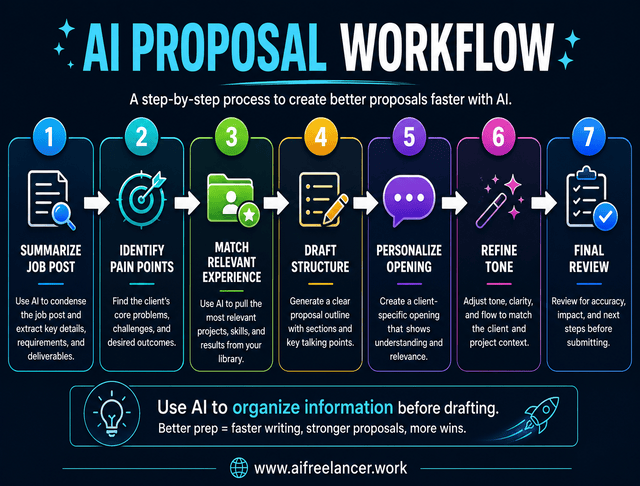
A practical AI-assisted proposal workflow often looks like this:
- Summarize the job post
- Extract the client’s likely pain points
- Match relevant experience
- Draft the proposal structure
- Personalize the opening
- Tighten clarity and tone
- Remove generic language
- Perform final review
Here is a simple prompt freelancers can reuse to summarize client requests quickly:
“Summarize this job post into the client’s likely goals, pain points, required deliverables, urgency signals, and possible objections.”
Another useful prompt helps draft a structured proposal:
“Using the information below, write a freelance proposal with a personalized opening, relevant proof, clear solution, and short CTA. Keep the tone conversational and specific.”
Freelancers can also use cleanup prompts to reduce generic AI language:
“Rewrite this proposal to sound more specific, conversational, and client-focused. Remove vague phrases and generic claims.”
The proposal itself also becomes easier when you stop overcomplicating the structure. Most freelance proposals only need a few core parts:
- personalized opening
- client problem reflection
- relevant proof
- clear proposed solution
- short CTA
A simple example looks like this:
“I noticed your team is struggling to publish SEO blog content consistently while handling product launches. I recently helped a SaaS client reduce article turnaround time by building a structured AI-assisted writing workflow that supported weekly publishing without sacrificing quality. Based on your requirements, I would focus first on creating reusable content structures and editorial systems so your team can scale production more efficiently. If helpful, I can also share examples of similar workflow projects I have completed.”
Without structure, freelancers often spend too much time improvising. With structure, proposal writing becomes far more manageable during busy weeks.
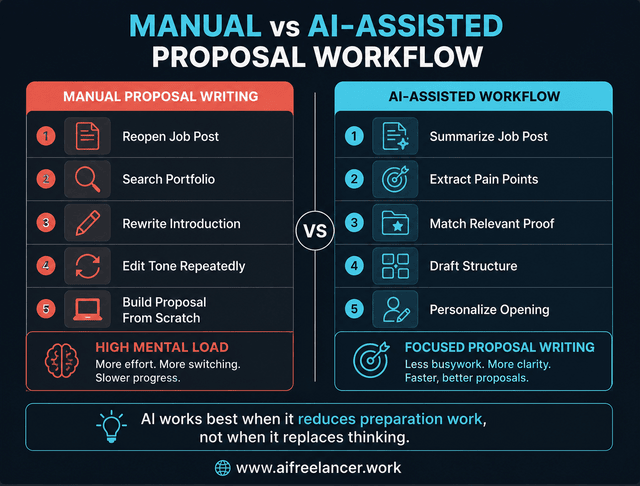
The comparison between manual proposal writing and AI-assisted proposal workflows becomes clearer once freelancers experience both approaches directly. Manual pitching usually involves repeatedly reopening the same job post, rewriting familiar expertise explanations, searching through old proposals for reusable sections, and overthinking introductions before submission.
AI-assisted systems reduce much of that repetition because the information gets organized before drafting starts. Instead of spending thirty minutes rebuilding the same proposal framework, freelancers can focus more directly on relevance, proof, and personalization.
For example, a freelancer writing proposals manually might spend:
- 10 minutes rereading the job post
- 15 minutes rewriting the introduction
- 10 minutes searching for portfolio examples
- 15 minutes editing tone repeatedly
With a structured AI workflow, much of that prep work gets shortened because the reusable proof, prompts, and proposal structure already exist.
The biggest difference is usually mental energy. When repetitive prep work decreases, proposal writing starts feeling more sustainable during heavy client weeks.
Why AI-Written Proposals Often Sound Generic
Many freelancers blame AI when the real problem is weak input. AI cannot personalize effectively without context. If the prompt contains vague instructions, the output usually becomes vague too.
Weak Inputs Create Weak Proposals
For example, a weak AI-generated opening often sounds like this:
“I am excited to apply for your project. I have extensive experience and would love to help you achieve your goals.”
There is no specificity, no client understanding, and no meaningful proof.
A stronger version sounds more grounded:
“I noticed your team is struggling to turn technical product updates into client-friendly blog content consistently. I recently helped a SaaS company reduce content turnaround time by building a repeatable AI-assisted writing workflow for weekly product releases.”
The second version feels more human because it reflects the client’s actual problem, includes a believable experience, and introduces a relevant outcome naturally. The opening immediately signals relevance instead of relying on generic enthusiasm. Freelancers who use AI regularly should also learn how to preserve their unique writing style while working with AI-generated drafts.
One overlooked problem is that many freelancers ask AI to “write a proposal” without giving enough detail first. The output then sounds broad because the instructions themselves were broad. Better inputs almost always produce stronger proposals.
Generic Authority Language Hurts Trust
Specificity builds trust faster than inflated confidence. Unfortunately, AI-generated drafts often overuse vague authority language such as:
- “results-driven”
- “highly experienced”
- “passionate professional”
- “dedicated expert”
Clients skim proposals. Generic phrases usually disappear into the background because they sound interchangeable with every other pitch.
Before sending a proposal, review a few practical questions:
- Does the proposal mention the client’s actual problem?
- Does it include relevant proof?
- Does it avoid vague buzzwords?
- Does it still sound conversational?
That review step is often what separates useful AI assistance from low-quality automation.
How to Write Proposals Faster Without Sounding Generic
Many freelancers waste time personalizing the wrong parts of the proposal. Clients usually care most about whether you understand the problem, whether you have relevant experience, and whether your solution sounds believable.
That means you do not need to rewrite every sentence every time.
Use the 20-60-20 Personalization Method
One of the simplest systems is modular proposal writing. Instead of creating entirely new proposals, freelancers can reuse flexible building blocks such as:
- service explanations
- process summaries
- discovery questions
- proof snippets
- CTA variations
Then personalize only the sections that clients pay attention to first.
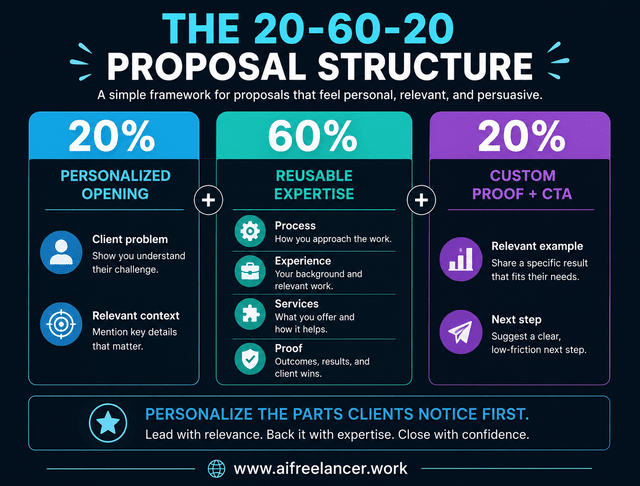
A useful structure is the 20-60-20 personalization method:
- 20% personalized opening
- 60% reusable expertise blocks
- 20% customized proof and CTA
This approach reduces rewriting while still preserving relevance.
Focus Personalization on High-Impact Sections
Clients also skim proposals differently from what many freelancers expect. Most clients do not carefully study every paragraph. They scan for relevance, clarity, proof, and confidence. That means the opening matters more than excessive polish.
Mention the client’s actual need early. Keep the proposal specific instead of overly clever. Show proof before long explanations. Make the next step obvious.
Research from Grammarly Business found that ineffective written communication reduces productivity and creates misunderstandings in professional environments. In freelance proposals, unclear messaging creates similar friction because clients often compare multiple submissions quickly.
Even with a faster system, freelancers still run into problems when speed becomes the only goal. A proposal can be fast to produce and still fail if it sounds generic, weak, or disconnected from the client’s actual situation.
Common Mistakes Freelancers Make When Trying to Write Proposals Faster
Many freelancers accidentally damage proposal quality while trying to save time.
Over-Editing Low-Fit Opportunities
One common problem is over-editing. Freelancers rewrite the opening repeatedly because the proposal still does not feel perfect. They spend thirty minutes polishing low-fit opportunities while stronger leads remain untouched.
Another mistake is applying to weak-fit jobs simply to stay active. Freelancers sometimes send rushed proposals to projects that barely match their experience, then wonder why response rates remain low. Poor-fit applications create more frustration because even strong writing cannot fix weak alignment.
Some freelancers also confuse speed with effectiveness. Fast proposals still need clear positioning, relevant proof, believable outcomes, and client understanding. Otherwise, the proposal becomes fast but forgettable.
Weak CTAs Reduce Proposal Responses
Weak CTAs create another overlooked issue. Many proposals end with generic closings such as:
- “Looking forward to hearing from you.”
- “Let me know if interested.”
Clearer CTAs often work better because they reduce uncertainty:
- “If helpful, I can share two similar project examples.”
- “I can also outline how I would approach the first phase of the workflow.”
Rejection fatigue creates another hidden problem. After several unanswered proposals, freelancers often begin overthinking every future pitch. They hesitate before applying to strong opportunities because previous rejection creates emotional drag that slows proposal writing down even further.
A freelancer who receives no replies after ten rushed proposals often starts assuming the problem is pricing or competition. In many cases, the real issue is that the proposals never established clear relevance in the first place.
A Simple Weekly System for How to Write Proposals Faster
Proposal writing becomes much easier when preparation happens before opportunities appear.
Build Swipe Files for Faster Proposal Writing
One useful system is creating proposal lanes based on opportunity type:
- fast-response jobs
- high-ticket projects
- retainer opportunities
- inbound leads
- referral opportunities
Different opportunities usually require different proposal depth and response speed.
A swipe file also helps reduce repeated thinking. Store reusable assets such as:
- successful openings
- strong CTAs
- proof statements
- objection responses
- industry examples
- discovery questions
Over time, proposal writing becomes less about improvisation and more about assembling proven pieces more efficiently.
Create a Lightweight Weekly Proposal Routine
A repeatable review checklist also reduces editing fatigue:
- client problem mentioned
- relevant proof included
- CTA clear
- tone conversational
- no generic filler language
Freelancers can also make proposal management more sustainable with a lightweight weekly routine:
- Monday: update swipe files and reusable proof
- Tuesday and Wednesday: batch proposal preparation
- Thursday: refine templates and prompts
- Friday: review replies, callbacks, and winning openings
AI becomes especially useful during busy client weeks. Instead of drafting everything manually, freelancers can:
- summarize job posts quickly
- generate structured first drafts
- adapt discovery questions
- shorten long drafts
- repurpose old proposals into reusable blocks
The goal is not maximum automation. The goal is to make proposal writing easier to sustain consistently without draining all your mental energy.
Why Faster Proposals Often Convert Better
Many freelancers assume longer proposals automatically perform better. In reality, relevance and timing often matter more.
Clients frequently review early submissions first. Faster responses increase visibility while the project still feels active and urgent. However, speed only helps when the proposal also communicates relevance clearly. In some situations, winning the opportunity starts with short outreach sequences that open conversations before a full proposal is needed.
When proposals quickly show:
- understanding of the client’s problem
- believable proof
- clear outcomes
- simple next steps
clients can evaluate fit faster without digging through unnecessary explanations.
A freelancer who responds within twenty minutes with a short but highly relevant proposal often performs better than someone who spends two hours writing a long, generic pitch filled with vague expertise claims.
Tracking proposal performance also improves results over time. Freelancers can save openings that consistently get replies, track which CTAs lead to discovery calls, and notice which proposal lengths work best for different project types. Small adjustments compound gradually until proposal writing starts feeling more predictable instead of chaotic.
Final Thoughts
Learning how to write proposals faster is not really about typing speed or generating more words with AI. The real advantage comes from reducing the repeated decisions and prep work that slow proposal writing down in the first place.
Freelancers who build structured AI-assisted proposal workflows spend less time searching for proof, rewriting introductions, and second-guessing every sentence. Instead of treating every proposal like a brand-new writing challenge, they create systems that help them respond faster while still sounding relevant and credible.
Over time, proposal writing starts feeling less mentally heavy because fewer decisions need to be rebuilt from scratch during every application. That consistency matters because freelance pitching becomes much easier to sustain when the process itself stops draining so much attention and energy.
If you want more practical systems for building repeatable freelance workflows, reducing revision overload, and using AI without sounding generic, explore the books on my Amazon Author page.
Frequently Asked Questions About How to Write Proposals Faster
Freelancers usually save time by using AI to summarize job posts, organize proposal structures, draft first versions, and rewrite weak openings. The fastest workflows still include human review for tone and relevance.
Many freelancers use ChatGPT because it can summarize client requests, organize proposal structures, generate first drafts, and help rewrite generic sections more quickly
Yes. ChatGPT can help freelancers identify client pain points, organize proposal sections, draft personalized openings, and improve clarity before submission.
Freelance proposals often become slow because writers repeatedly search for proof, rewrite introductions, reopen job posts, and overthink positioning instead of using reusable systems.
The strongest proposal systems usually combine both. Templates provide reusable structure, while AI helps personalize and organize proposals faster without starting from scratch every time.
Sources
- McKinsey & Company – The Economic Potential of Generative AI
- Asana Work Innovation Lab – Anatomy of Work
- Grammarly Business – State of Business Communication Report
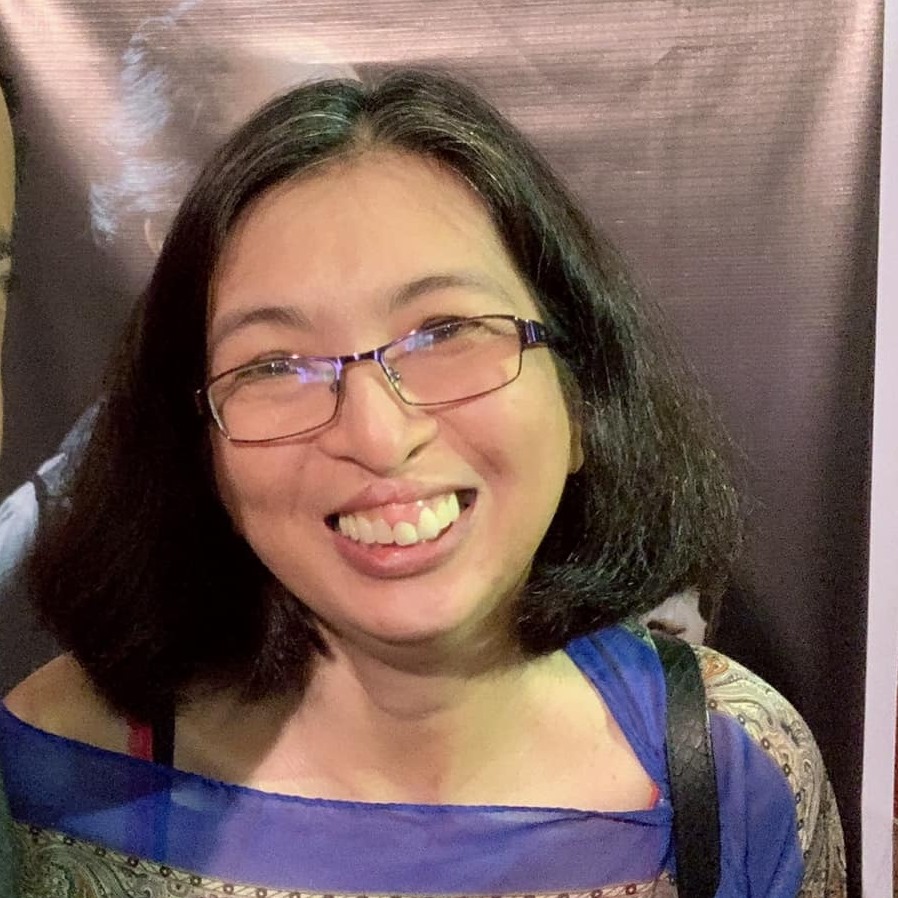
Florence De Borja is a freelance writer, content strategist, and author with 14+ years of writing experience and a 15-year background in IT and software development. She creates clear, practical content on AI, SaaS, business, digital marketing, real estate, and wellness, with a focus on helping freelancers use AI to work calmer and scale smarter. On her blog, AI Freelancer, she shares systems, workflows, and AI-powered strategies for building a sustainable solo business.