
Most time management tips for freelancers focus on schedules, routines, or productivity systems, but they rarely explain what actually breaks your day: not the workload itself, but the constant interruption of attention that forces you to restart your thinking over and over.
You are writing. The sentence is finally forming properly. Then a message appears: “Quick question.” You answer it because it feels small. But when you return, the sentence is gone. Not deleted, just mentally erased. That is the hidden cost most freelancers never account for: not the message itself, but the loss of continuity it creates.
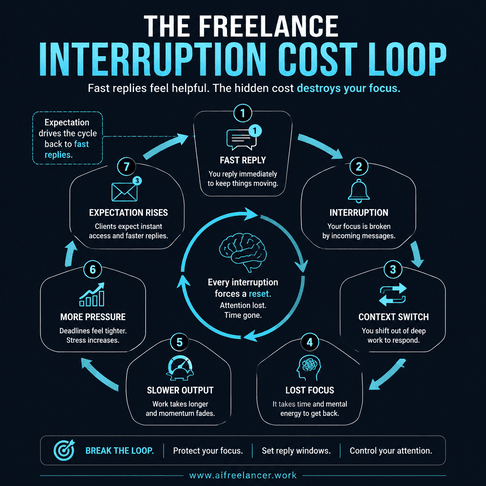
Fast replies feel responsible and professional in the moment, but over time, they quietly train clients to expect instant access. Once that expectation forms, your attention stops behaving like something you fully control.
Everything I’ve shared here—and more—is in my book, available on Amazon. Click the link if you’re ready to take the next step.
Why Your Day Keeps Breaking Even When You’re “Managing Time Well”
On paper, your schedule may look solid. You may have time blocks, task lists, and priorities clearly laid out. But the experience of your day often feels fragmented, like you are constantly restarting rather than progressing.
This happens because freelance time is not only shaped by planning. It is shaped by interruption patterns that repeatedly pull you out of focused thinking. Most interruptions are not large enough to look like a real problem. They are small, frequent, and socially reasonable, which makes them easy to dismiss.
That is why a “quick reply” can feel harmless while still damaging the shape of the workday. The message may only take a few minutes, but the switch away from the draft, brief, outline, or research carries its own cost. The American Psychological Association explains that even brief mental blocks from switching tasks can cost as much as 40% of someone’s productive time.
That is why a morning can disappear even when you only answered a few messages. Each reply looks small on its own, but each one forces you out of deep work and back into it again.
Why Time Management Tips for Freelancers Miss Client Messages
Most advice assumes the problem is how you plan your day. For freelancers, the bigger problem is how often the day gets reopened by someone else.
A single message can force a full mental shift. You stop writing, switch into response mode, then try to return to the original thought you were building. Research from the University of California, Irvine, found that interruptions increase stress and make it harder to resume complex tasks, even when people try to compensate by working faster.
That matters because freelance work is not just task execution. It is sustained thinking. You are holding structure, tone, client intent, research material, and next steps in your head at the same time.
When that continuity breaks, the visible interruption is small. The recovery is not.
Fast Replies Create a Client Expectation Loop
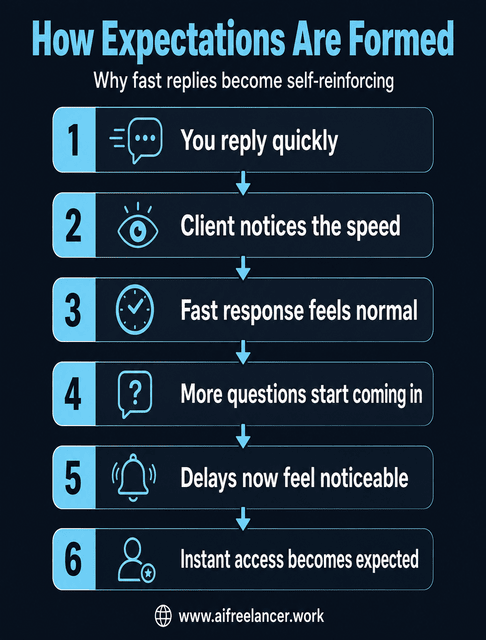
Client expectations are not usually set through formal rules alone. They are shaped through repetition.
If replies are consistently immediate, clients begin to treat immediacy as normal. If responses always arrive quickly, silence begins to feel like a delay, even when nothing is wrong.
This shift does not happen because clients are demanding. It happens because communication behavior sets a rhythm.
A fast reply becomes a signal. That signal becomes a standard. That standard becomes an expectation.
Over time, the loop becomes self-reinforcing:
- Fast reply → higher expectation → more messages → more interruptions → pressure to reply fast again.
At that point, your workday is no longer structured only by your schedule. It is shaped by communication patterns that run on autopilot.
The Real Cost of Instant Replies
Fast replies feel efficient because they resolve the immediate message quickly. But efficiency in communication does not always translate into efficiency in work.
Each interruption forces a reset. You leave structured thinking, enter reactive thinking, respond, and then return to a task that no longer feels as stable as it did before the interruption.
You may need to reread your draft, reopen your research tabs, or reconstruct the sentence you were about to write. That reconstruction is where time disappears.
Microsoft research on task interruption shows that returning to interrupted work requires additional cognitive effort, especially when the original task is complex and requires sustained attention.
Writing falls directly into that category. You are not just continuing a task—you are rebuilding mental context.
The impact is not the message. The impact is the restart.
Time Management Tips for Freelancers Work Best When You Control Access
Better time management tips for freelancers are not about doing more in less time. They are about reducing unnecessary interruptions so your attention can stay on the work long enough to produce meaningful output.
The shift is simple: stop letting every message decide when your work gets interrupted. Instead of responding the moment something arrives, you respond within structured intervals that protect focused thinking.
This does not reduce responsiveness. It stabilizes it.
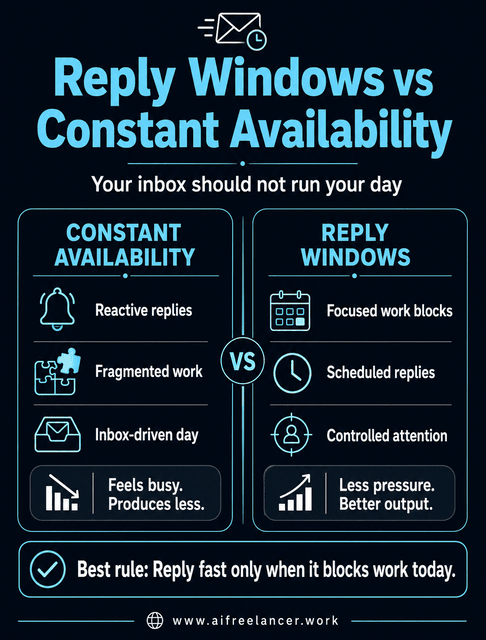
Work in Reply Windows Instead of Constant Availability
Reply windows create separation between incoming messages and working time. Instead of reacting immediately, you decide when communication happens.
Without this separation, part of your attention stays on standby, even when no messages arrive. You are not fully working—you are partially waiting.
When reply windows are defined, that background alertness disappears. You are no longer mentally tracking your inbox while trying to write.
For example, checking messages in the morning, mid-day, and late afternoon creates predictable communication without turning your entire day into response mode.
Reply windows handle timing. The next step is deciding what deserves immediate attention inside those windows.
Use One Decision Rule for Message Speed
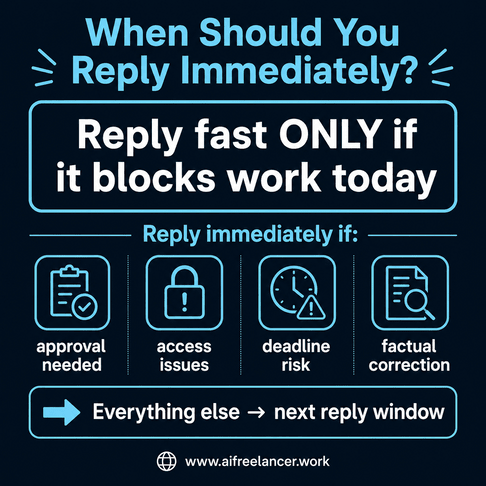
Not every message deserves the same response speed. Urgency often feels real because messages arrive immediately, not because they actually block progress.
A simple rule restores control: respond quickly only when the message blocks work today.
This includes situations like approval needed to continue, access issues, deadline risks, factual corrections, or anything that stops active progress.
Everything else can wait for the next reply window.
This removes emotional decision-making from communication. Instead of reacting to pressure, you evaluate impact.
Tell Clients When They Can Expect a Reply
A clear response expectation, such as “I respond within one business day,” changes communication behavior on both sides.
It removes uncertainty for clients, which reduces follow-up messages. It also removes internal pressure to constantly check for new input.
Clarity reduces message volume more effectively than speed. When expectations are stable, communication becomes less reactive overall.
This is where time management and communication merge. When clients can interrupt you at any moment, your schedule stops mattering as much as your inbox behavior.
Better Time Management for Freelancers Means Better Client Communication
Fast replies often feel helpful in the moment, but they can increase back-and-forth communication.
A rushed response like “Got it, will check” confirms receipt but does not resolve uncertainty about timing or next steps. That uncertainty often leads to follow-ups.
A clearer response closes the loop:
“I’ll review this during my afternoon work block and send an update by 4 PM tomorrow.”
This tells the client:
- You saw the message
- When will you act
- What they can expect
Clear replies reduce unnecessary follow-ups because they remove ambiguity.
Speed gives reassurance. Clarity gives structure.
Status Updates Reduce Interruptions
Most “just checking in” messages are not about urgency. They are about uncertainty.
When clients do not know what is happening, they naturally follow up. When progress is visible, they stop asking.
- A simple structure is enough:
- Done: what is completed
- Next: what is in progress
- Blocked: what is needed
This replaces reactive communication with predictable updates.
Less uncertainty leads to fewer interruptions. Fewer interruptions lead to longer periods of focused work.
Time Management Tips for Freelancers Should Reduce Burnout, Not Add Rules
Fast replies rarely come from strategy. They come from pressure.
Fear of seeming unavailable. Guilt about the delay. Pressure to appear responsive. These patterns slowly turn responsiveness into constant availability.
Once that happens, even when you are working, part of your attention stays open to incoming messages. You are never fully out of communication mode.
That prevents recovery between tasks. Over time, this contributes to burnout not because of workload alone, but because attention never fully resets.
The issue is not responsiveness. It is the absence of boundaries around it.
Build a Buffer Between You and Messages
A buffer reduces how often you have to switch mental states.
Instead of writing each reply from scratch, use:
- saved responses for repeated questions
- structured templates for updates
- consistent formats for status messages
- optional AI-assisted drafting for clarity through simple automation systems for freelancers
If multiple clients ask the same question weekly, you do not need to recompose it each time. You need a stable response structure that you can adjust.
The goal is not automation. The goal is fewer interruptions to thinking.
This is also where stronger, better inbox management strategies for freelancers become essential, because inbox control directly determines attention stability.
Time Management Tips for Freelancers: The Calm Reply Workflow
A stable freelance workflow follows a simple loop:
- Check messages during planned windows.
- Sort messages by urgency and impact.
- Respond with clear next steps.
- Record anything that affects timelines.
- Return to focused work without reopening communication unnecessarily.
For example, if a client asks about a revision, you check it during your window, classify it as routine, respond with the next update time, log it in your system, and return to writing.
A structured approach like this is similar in logic to the 3-message client communication system for freelancers, where clarity replaces ongoing back-and-forth.
The purpose is not complexity. The purpose is to reduce repeated decision-making about when to respond.
Reset Client Expectations Without Conflict
Changing communication habits does not require long explanations.
A simple message is enough:
“I’m adjusting my workflow to protect focused writing time. I’ll be checking messages at set intervals and responding within one business day. Urgent issues will be handled immediately.”
Most clients adjust quickly because clarity removes uncertainty.
If someone does not adjust, it usually signals a mismatch in expectations that needs to be addressed separately, especially when applying how to set clear boundaries with freelance clients without conflict in ongoing client relationships.
Common Mistakes That Keep Freelancers Reactive
Freelancers often stay reactive, not because they lack discipline, but because communication habits interrupt focus repeatedly.
Common patterns include answering messages during deep work, treating all messages as urgent, switching contexts too frequently, and responding without clear boundaries.
These habits create fragmentation that feels like workload pressure but is actually an attention structure breakdown.
Frequently Asked Questions About Time Management Tips for Freelancers
What Are the Best Time Management Tips for Freelancers?
The most effective approach is structured work blocks, controlled communication windows, and reduced interruptions during focused work.
How Can Freelancers Manage Client Messages Without Replying Instantly?
By setting reply windows, defining urgency rules, and establishing clear response expectations in advance.
Is Replying Fast Bad for Freelancers?
It becomes a problem when it creates constant interruptions and trains clients to expect immediate access for non-urgent communication.
How Does Time Management Affect Freelancer Burnout?
Poor structure increases burnout by fragmenting attention, increasing cognitive switching, and reducing recovery time between tasks.
What Is a Good Response Time for Freelancers?
Most freelancers benefit from a one-business-day response window for non-urgent messages, with faster replies reserved for actual blockers or urgent issues.
Final Thoughts
Most time management tips for freelancers focus on productivity systems, but the real issue is communication patterns shaping how attention behaves throughout the day.
Fast replies feel efficient, but they increase interruptions—and interruptions are what break sustained focus.
A better system does not reduce professionalism. It makes responsiveness predictable, work time more stable, and communication less reactive.
If you want more structured writing systems, freelance workflow frameworks, and AI-supported content strategies, explore my books on my Amazon Author page.
Sources
- American Psychological Association (APA) — Multitasking and task switching research
https://www.apa.org/topics/research/multitasking - ACM Digital Library (CHI Conference Proceedings) — Gloria Mark et al. on interruptions and task switching
https://dl.acm.org/doi/10.1145/1357054.1357072 - Microsoft Research — Interruption and task resumption study
https://www.microsoft.com/en-us/research/publication/conversations-amidst-computing-study-interruptions-recovery-task-activity/

Florence De Borja is a freelance writer, content strategist, and author with 14+ years of writing experience and a 15-year background in IT and software development. She creates clear, practical content on AI, SaaS, business, digital marketing, real estate, and wellness, with a focus on helping freelancers use AI to work calmer and scale smarter. On her blog, AI Freelancer, she shares systems, workflows, and AI-powered strategies for building a sustainable solo business.