
A client says, “This should be quick.” You want to help. You also know “quick” has already eaten three unpaid hours this week. That is why learning how to prevent scope creep matters so much for freelancers. The problem is not one small request. The problem is what happens when small requests keep slipping into the project without a new fee, timeline, or agreement.
You don’t need to be always available to be reliable.
You do need a way to protect the work you agreed to do, the time you priced, and the mental space you need to deliver well. Scope creep is not always caused by bad clients. Sometimes it happens because the project started with good intentions, but unclear boundaries.
The client asks for one more revision. Then a new section. Then a rushed edit. Then a quick call. Then, social captions from a blog project. Before you know it, the project has changed, but the price has not.
Scope creep is not just extra work. It is the project changing after the price, timeline, and energy budget, meaning the focus and bandwidth you planned were already set.
Everything I’ve shared here—and more—is in my book, available on Amazon. Click the link if you’re ready to take the next step.
Quick Answer: How to Prevent Scope Creep
To prevent scope creep, define what is included, what is not included, how revisions work, how extra requests are handled, and when you are available to respond.
In freelance work, scope means the work, limits, deliverables, timeline, and responsibilities that both sides agreed to.
For freelancers, the goal is not to sound strict. The goal is to make the project rules clear before the client starts treating every new idea as part of the original price.
A simple scope system should answer these questions before work starts:
- What exactly am I delivering?
- How many revision rounds are included?
- What does the client need to provide?
- What is not included?
- What happens if the client asks for extra work?
- When do I respond to messages?
- How are rush requests handled?
That may sound basic, but basic is what saves you when a project starts drifting.
What Scope Creep Looks Like for Freelancers
Scope creep does not always arrive as a dramatic change. Most of the time, it shows up politely. That is what makes it hard to catch.
For freelance writers, consultants, designers, and content freelancers, project drift often hides inside requests that sound harmless.
Extra Revisions That Were Never in the Original Scope
Revision creep is one of the most common forms of scope creep. The client asks for “just one more pass,” but that pass becomes another round of unpaid editing.
Maybe the client approved the outline, then changed the angle after the first draft. Maybe “light edits” became a rewrite. Maybe one stakeholder approved the draft, then another stakeholder entered late and wanted a different direction.
A revision improves the agreed draft. A new direction changes the original plan.
That distinction matters. If the original brief was for a 1,500-word blog post aimed at startup founders, changing it into a sales page for enterprise buyers is not a revision. That is a new assignment.
Rush Requests That Interrupt Deep Work
Scope creep is not always about the deliverable. Sometimes it is about access.
A client might say:
- “Can you send this tonight?”
- “Can you check this before the meeting?”
- “Can we hop on a quick call?”
- “Can you revise this before EOD?”
- “Can you just look at this one thing?”
Each request may look small on its own. But every interruption affects your focus, schedule, and other client work. Microsoft’s Work Trend Index reported that the average employee spends 57% of their time communicating in meetings, email, and chat, and 43% creating in documents, spreadsheets, and presentations.
Freelancers feel this too. The more time you spend clarifying scattered requests, switching between messages, and responding to urgency, the less time you have for deep writing. When this becomes your normal workday, instant replies can quietly break your focus because clients learn to expect access before you have had time to think, write, or check the original scope.
Small Add-Ons That Become a Bigger Project
Small add-ons are tricky because they often sound reasonable.
The client asks you to add another section to an article. Then they ask for extra research. Then they want source links, screenshots, formatting, CMS upload, or a social caption set. Then they want the blog turned into a lead magnet or email sequence.
Scope creep happens when a client asks for work beyond the original agreement without adjusting the timeline, fee, or deliverables.
The client may not mean to take advantage. They may simply not know how much invisible work sits behind a “small” change.
Why Learning How to Prevent Scope Creep Protects Your Time and Income
Scope creep does not just add work. It changes the deal after you have already priced the project.
That matters because freelancers do not only sell words, designs, or deliverables. You sell time, focus, judgment, and creative energy. When the scope expands without a new agreement, you are giving away part of your business for free.
Boundaries also make you more reliable, not less. When the scope is clear, your timelines are cleaner. Your revisions are easier to manage. Your client knows what to expect. You are less likely to rush, miss details, or quietly resent work you never agreed to do.
Scope Creep Quietly Lowers Your Effective Rate
A $300 blog stops being a $300 blog when it turns into a blog, a mini strategy session, two extra revisions, and a same-day rewrite.
This is one reason scope creep feels so draining. You are not only doing more work. You are doing more work for the same pay while trying to keep the client happy.
Project managers see the same pattern on a larger scale. PMI reported that 52% of projects completed in the previous 12 months experienced scope creep or uncontrolled changes to scope.
For freelancers, the numbers may show up differently. You may not call it “uncontrolled scope.” You may call it staying up late to finish a revision you did not quote.
Scope Creep Creates Deadline Pressure
One extra request can push back another draft, shorten your editing time, delay your own marketing work, or force you to work late to catch up.
This is why uncontrolled changes affect more than one project. One client’s extra request can quietly steal time from every other client on your calendar.
The danger is not one extra request. The danger is training every client that your time is flexible by default.
Scope Creep Leads to Burnout and Resentment
Overgiving can look professional at first. You are responsive. Helpful. Easy to work with. But when “helpful” becomes unlimited access, the relationship starts to feel heavy.
Gallup has reported that 76% of employees experience burnout at least sometimes, with 28% saying they feel burned out very often or always.
Freelancers may not have a boss adding tasks to their plate, but they can still burn out from unclear boundaries, constant deadlines, and the pressure to be endlessly accommodating.
You can be generous without being endlessly available. You can be reliable without absorbing every change for free.
Why Scope Creep Happens Even With Good Clients
Not every client who creates scope creep is difficult. Some are disorganized. Some are under pressure. Some have changing priorities. Some simply do not understand how much work goes into writing, editing, strategy, or revision.
That is why the solution is not to assume bad intent. The solution is to make the scope visible: what is included, what is not, and what changes if the client asks for more.
The Proposal Is Too Vague
A vague proposal leaves too much room for interpretation.
If your deliverable says “blog content,” the client may assume that it includes SEO research, source links, formatting, uploading, images, social captions, and revisions until everyone is satisfied.
A clearer scope might say:
“This project includes one 1,500-word blog draft based on the approved outline, one revision round, basic formatting in Google Docs, and final delivery as a document. CMS upload, image sourcing, keyword research, and additional content assets are not included.”
That kind of language may feel less friendly at first. But it is actually kinder to both sides because it prevents confusion later.
There Are No Written Exclusions
Freelancers often list what is included but forget to state what is not included.
That is where many scope problems begin. If something is not excluded, the client may assume it is included.
For freelance writing projects, common exclusions may include:
- extra revision rounds
- new content assets
- keyword research
- CMS upload
- image sourcing
- interviews
- meetings
- strategy calls
- major direction changes after approval
You do not need a complicated contract for every small project. But you do need written project boundaries. Even a clear email is better than relying on memory.
The Client Does Not Know the Difference Between a Revision and a New Direction
This is one of the biggest causes of scope creep in writing work.
A revision improves the agreed draft. A new direction changes the original plan.
A revision sounds like: “Can you clarify this paragraph?”
A new direction sounds like: “Can we make the article target a different audience?”
A revision sounds like: “Can you make the intro tighter?”
A new direction sounds like: “Can we turn this educational article into a sales page?”
When clients do not understand the difference, they may treat a new direction as part of the original revision process. Your job is to explain the difference without making the client feel accused.
The Freelancer Is Afraid to Disappoint the Client
Experienced freelancers can still struggle with this.
You want to repeat the work. You want referrals. You want the client to feel supported. So you say yes quickly, even when part of you knows the request is outside the original scope.
But a fast yes can quietly become a free add-on.
The more you wait to set boundaries, the harder they become. A calm boundary early is easier than a frustrated boundary later.
Once you know where scope creep starts, prevention becomes easier. You are not trying to control every client request. You are building a project setup that makes extra work visible before it becomes unpaid work.
How to Prevent Scope Creep Before the Project Starts
The best time to prevent scope creep is before the client has a chance to assume what is included.
A strong project setup does not make you look difficult. It makes you look organized. It also helps good clients know what to expect.
How to Prevent Scope Creep With a Clear Scope of Work
The best way to prevent scope creep is to define the scope of work before the project starts, including deliverables, revision limits, deadlines, exclusions, and the process for extra requests.
Do not just “set expectations.” Say what is included, what is not, and what happens next if the client needs more.
For a freelance writing project, define:
- deliverables
- word count or asset count
- number of revision rounds
- timeline
- client responsibilities
- what is not included
- extra work fees
A clear scope of work does not need to sound cold. It can sound plain and practical.
For example:
“This project includes one 1,500-word article, one revision round, and delivery in Google Docs. Additional revision rounds, new content assets, CMS upload, and major angle changes after outline approval can be added as separate tasks.”
That one paragraph can save hours of confusion.
Quick Scope Checklist Before You Start
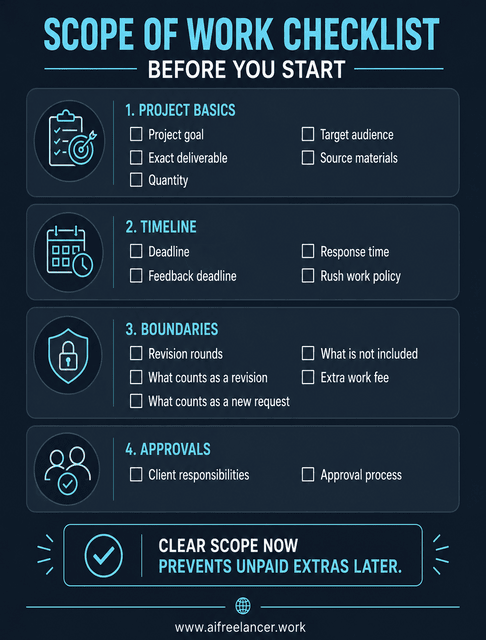
Use the scope of work paragraph for the agreement. Use the checklist before you send the agreement.
Before work starts, confirm:
- project goal
- exact deliverable
- quantity, such as word count, asset count, number of pages, or number of emails
- target audience
- required inputs from the client
- source materials
- deadline
- feedback deadline
- number of revision rounds
- what counts as a revision
- what counts as a new request
- what is not included
- response time
- rush work policy
- extra work fee
- approval process
This checklist prevents confusion. The client gets clarity. You get a project you can actually manage.
Set Revision Limits Before Feedback Begins
Revision limits prevent confusion when feedback starts coming in.
For writers, this is especially important because “revision” can mean different things to different people. One client may need a few clarifications. Another may mean a full rewrite after changing the target audience.
Use simple language:
- “This package includes one revision round.”
- “A revision covers changes to the approved draft.”
- “A new angle, new audience, or new deliverable will be quoted separately.”
This helps the client understand that feedback is welcome, but the project is not open-ended.
Set Response-Time Expectations Early
You do not need to reply instantly to be reliable.
In fact, response-time boundaries can make you look more professional because the client knows when to expect a reply.
You can say:
“I usually reply within one business day. For urgent requests, I’ll confirm whether the current timeline can accommodate them.”
Now the client knows when you reply and why rush work cannot simply slide into the same deadline. A three-part client reply structure can also help you respond with context, boundaries, and next steps instead of sending rushed answers that invite more unpaid work.
For longer projects, a simple project status update can reduce random check-ins by showing what is finished, what comes next, and what is waiting on the client.
The Boundary Rule That Makes Scope Creep Easier to Handle
A boundary should not sound like a punishment. It should sound like a process.
This matters because many freelancers wait until they feel annoyed before setting a boundary. By then, the message often comes out sharper than intended. A process keeps the conversation calmer.
Boundary 1: Define What “Done” Means
Every project needs an endpoint.
For a freelance writer, “done” may mean the final draft has been delivered. Or it may mean one revision round has been completed. Or it may mean the client has approved the changes requested within the agreed scope.
If “done” is not clear, the project can stay open forever.
A simple version might be:
“The project is complete once the final draft and one included revision round have been delivered.”
That gives the work a finish line.
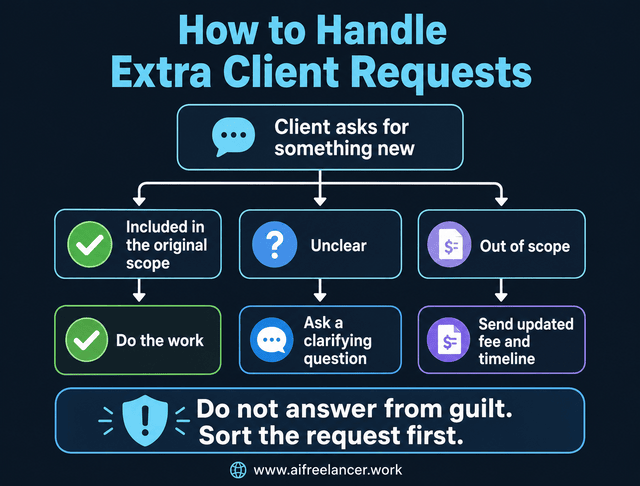
Boundary 2: Use a Simple Decision Rule for Extra Requests
When a client asks for something new, do not answer out of guilt. Sort the request first.
Ask yourself whether the request is:
- included in the original scope
- unclear and needs confirmation
- out of scope and needs a new quote
This rule helps you respond calmly instead of saying yes automatically.
If it is included, do it. If it is unclear, ask a clarifying question. If it is out of scope, quote it separately.
That is the whole system.
Boundary 3: Do Not Let Urgency Rewrite the Scope
Urgency can make extra work feel more important than it is. A rushed request may still be out of scope, even if the client needs it quickly.
You can be helpful without absorbing the cost.
Try:
“I can prioritize this, but since it adds new work, I’ll need to adjust the timeline and fee.”
That reply does not shame the client. It simply makes the tradeoff visible.
The decision rule tells you what kind of request you are dealing with. The next step is saying it in a way the client can accept.
How to Prevent Scope Creep When Clients Ask for Extras
A boundary lands better when it gives the client a next step. The goal is to stop unpaid extras without turning every request into a fight.
Use a Simple Change Request Process
When a client asks for something new, do not start the work immediately. Use the decision rule first, then confirm what changes.
Before you begin, confirm three things:
- fee
- deadline
- deliverable
For example:
“Happy to add this. Since it expands the original scope, I’ll send the updated fee and timeline first. Once you approve, I can add it to the schedule.”
That keeps what both sides agreed to clear.
Use Simple Scripts to Prevent Scope Creep Politely
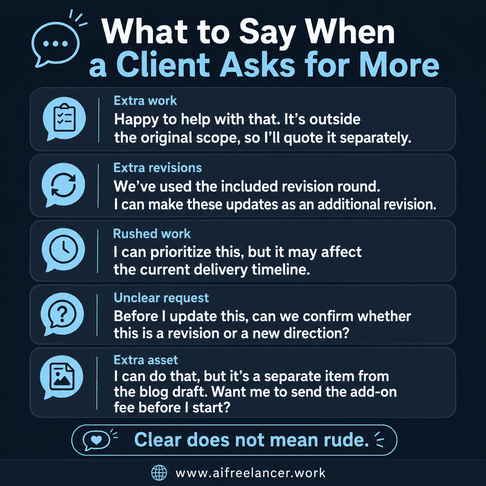
You do not need to memorize these. Keep a few as starting points and adjust them to your client’s tone.
Situation: Client asks for extra work
Say: “Happy to help with that. It’s outside the original scope, so I’ll quote it separately.”
Situation: Client asks for extra revisions
Say: “We’ve used the included revision round. I can make these updates as an additional revision.”
Situation: Client asks for rushed work
Say: “I can prioritize this, but it may affect the current delivery timeline.”
Situation: Client sends an unclear request
Say: “Before I update this, can we confirm whether this is a revision or a new direction?”
Situation: Client changes the direction
Say: “This sounds like a new direction rather than a revision. I can adjust the draft, but I’ll need to update the timeline and fee.”
Situation: Client sends scattered feedback
Say: “To keep the revision clean, please send all feedback in one document by [date].”
Situation: Client says it is just a small change
Say: “It may be small in the final draft, but it still affects the project scope and editing time.”
Situation: Client asks for an extra asset
Say: “I can do that, but it’s a separate item from the blog draft. Want me to send the add-on fee before I start?”
Situation: Client asks for a call that was not included
Say: “I can add a call if needed. Since it was not part of the project scope, I’ll price it as a separate consultation item.”
You can adjust the tone depending on the client.
Warm:
“Happy to help with that. It’s outside the original scope, so I’ll quote it separately.”
Firm:
“That part is not included in our current scope. I can add it as a new task if you want me to proceed.”
Relationship-friendly:
“That’s a good addition. It just changes the scope, so I’ll send a quick add-on quote before I start.”
Price Out-of-Scope Work Clearly
Saying “that is outside the scope” is only the first step. The next step is giving the client a path forward.
This is the part many freelancers avoid because naming the fee makes the boundary real.
Not every extra request needs a long estimate. Sometimes you can price it as a small add-on, an additional revision round, an hourly task, or a separate mini-project.
You can say:
- “I can add this section for $X.”
- “I can handle this as an additional revision round.”
- “This would be a separate mini-project.”
- “I can do this hourly if the scope is still unclear.”
- “I can add this to phase two so the current deadline stays intact.”
The goal is to connect the new request to a new agreement. That way, the client is not surprised, and you are not quietly giving away unpaid work.
Point Back to the Original Agreement
The original agreement is your neutral anchor.
Instead of making the conversation personal, point back to the project scope.
Try:
“Based on our original agreement, the current scope includes [deliverable]. The new request adds [extra task], so I can send an updated quote.”
This keeps the tone professional. You are not blaming the client. You are simply showing where the project has changed.
Offer Options Instead of a Flat No
Many good clients understand scope changes better when you give them choices.
You can say:
- “I can do this next week.”
- “I can add this for an additional fee.”
- “I can replace one current task with this.”
- “I can handle this in phase two.”
Options keep the client from feeling shut down, but you are no longer giving unlimited work away.
Know When Scope Creep Becomes a Red Flag
A client asking for something extra is not automatically a problem. Projects shift. Priorities change. Good clients may ask for add-ons and expect to pay for them.
The red flag appears when the client keeps pushing past written boundaries.
Watch for patterns like:
- refusing updated fees
- treating every clarification as resistance
- asking for urgent unpaid work repeatedly
- ignoring revision limits
- changing direction after approvals
- making you feel guilty for protecting the agreement
If a client keeps pushing after you have explained the scope clearly, the issue may not be your communication. It may be a mismatch.
You do not need to keep every client at the cost of your time, income, and energy.
How AI Can Help You Prevent Scope Creep
AI should not decide what is billable or create a new system for you. Use it to speed up the system you already use: compare the request, spot what changed, and draft a calmer reply.
This is where simple systems that keep client work organized can help. You are not using AI to become more available. You are using it to sort requests, protect the original agreement, and avoid replying under pressure.
How to Prevent Scope Creep With AI-Assisted Client Briefs
AI can help turn messy client notes into a clearer project brief.
Use it to identify:
- deliverables
- exclusions
- deadlines
- revision rules
- missing details
- questions to confirm before work starts
Try this prompt:
“Turn these client notes into a project brief. Separate deliverables, deadlines, client responsibilities, revision rules, exclusions, and questions I need to confirm before starting.”
This is useful when the client sends a long email, a transcript, or scattered notes. AI can help you see what is actually being requested before you commit.
Use AI as a Scope Checker
AI can also compare the original agreement with a new client request.
Try:
“Compare this client request with the original scope. Identify which parts are included, which parts are out of scope, and which parts need clarification before I reply.”
This helps when you feel unsure. Sometimes a request is partly included and partly new. AI can help you separate those pieces before you answer.
For example:
- Original scope: one 1,500-word blog post with one revision round.
- Client request: “Can you also make five LinkedIn posts from this?”
AI should flag the LinkedIn posts as a new deliverable, not part of the blog draft. You still decide what to charge, but you get a cleaner view of what changed.
You still make the final call. AI simply helps you organize the issue, so your reply is calmer and clearer.
Use AI to Turn Scope Checks Into Client Replies
Once AI has helped you sort the request, you can ask it to draft a reply.
Use this workflow:
- paste the original scope
- paste the client’s new request
- ask AI to classify what is included, unclear, or out of scope
- ask AI to draft a calm reply
- manually edit for accuracy and tone
Try:
“Use the scope check above to draft a calm, professional reply. Keep the client relationship warm, but make it clear which part of the request needs a new quote or timeline adjustment.”
This is where AI becomes useful for overloaded freelancers. Not because it decides for you, but because it helps you avoid replying while annoyed, tired, or pressured.
Common Mistakes to Avoid Before You Reply
The most expensive part of scope creep is often the two seconds before you reply, when you want to be helpful and type “Sure.”
That is the moment to pause.
Saying Yes Before Checking the Scope
A fast yes can create a long problem.
Before you agree, check the project agreement, your timeline, and your workload. Even a short pause can save you from promising free work.
Try:
“Let me check the original scope and timeline first, then I’ll confirm the best way to handle this.”
Treating Every Request as “Small”
Small changes still take time, attention, and context switching.
A two-sentence change may require rereading the brief, checking the angle, adjusting the structure, updating the intro, and reviewing the flow. The final change may look small, but the thinking behind it may not be small.
Look at the work behind the request, not only the size of the final change.
Waiting Until You Feel Frustrated
Boundaries work better when they are calm and early.
If you wait until you feel resentful, your reply may sound defensive even when your point is valid. It is better to set expectations before the project starts, then remind the client politely when needed.
You are not being difficult. You are protecting the agreement that both sides approved.
Final Thoughts on How to Prevent Scope Creep
Learning how to prevent scope creep is not about becoming rigid. It is about making your work easier to respect.
You do not need to be constantly available to be reliable. You need a clear scope, calm communication, revision limits, and a repeatable way to handle extra requests.
Good clients do not need unlimited access to trust you. They need clarity. They need to know what is included, what costs extra, and how changes affect the timeline.
The more clearly you define the project, the less you need to defend yourself later.
If you want more practical writing systems, AI workflows, and freelancer-friendly ways to protect your time, check my books on my Amazon Author page.
Frequently Asked Questions About How to Prevent Scope Creep
Scope creep in freelance work happens when a client asks for tasks, revisions, meetings, or deliverables beyond the original agreement without changing the fee or timeline. For writers, this can include extra revisions, added sections, CMS upload, or a new direction after drafting has started.
You prevent scope creep by defining the scope of work before the project starts. Confirm the exact deliverables, number of revisions, deadlines, client responsibilities, exclusions, response times, and process for extra requests. The clearer the agreement is at the start, the easier it is to handle changes later.
Use calm and direct language. You can say, “Happy to help with that. It’s outside the original scope, so I’ll quote it separately.” This keeps the relationship warm while making it clear that the extra work requires a new fee, timeline, or agreement.
Scope creep is often caused by vague proposals, unclear deliverables, no written exclusions, unlimited revision expectations, rushed requests, and poor change management. In freelance work, it can also happen when the freelancer is afraid to disappoint the client and says yes before checking the original scope.
No. Scope creep is not always the client’s fault. Sometimes, clients do not understand how much work is attached to a small request. Sometimes the freelancer did not define the scope, exclusions, timeline, or revision rules clearly enough. A better system helps both sides avoid confusion.
Sources
- Microsoft Work Trend Index. “Will AI Fix Work?” Used for the statistic that the average employee spends 57% of their time communicating in meetings, email, and chat, and 43% creating in documents, spreadsheets, and presentations.
https://www.microsoft.com/en-us/worklab/work-trend-index/will-ai-fix-work - Project Management Institute. “Pulse of the Profession 2018: Success in Disruptive Times.” Used for the statistic that 52% of projects completed in the previous 12 months experienced scope creep or uncontrolled changes to scope.
https://www.pmi.org/-/media/pmi/documents/public/pdf/learning/thought-leadership/pulse/pulse-of-the-profession-2018.pdf - Gallup. “Employee Burnout: The Biggest Myth.” Used for the statistic that 76% of employees experience burnout at least sometimes, with 28% saying they feel burned out very often or always.
https://www.gallup.com/workplace/288539/employee-burnout-biggest-myth.aspx
Florence De Borja is a freelance writer, content strategist, and author with 14+ years of writing experience and a 15-year background in IT and software development. She creates clear, practical content on AI, SaaS, business, digital marketing, real estate, and wellness, with a focus on helping freelancers use AI to work calmer and scale smarter. On her blog, AI Freelancer, she shares systems, workflows, and AI-powered strategies for building a sustainable solo business.