
You open the document, stare at the blinking cursor, and wonder how to overcome writer’s block before another writing session disappears. You type a sentence, delete it, rewrite it, then suddenly find yourself checking email instead. Thirty minutes have passed, and the draft still has not started.
For many professionals, learning to overcome writer’s block is no longer just a matter of creativity. It is a workflow issue. Freelancers, consultants, creators, and self-publishers are expected to produce content constantly. Yet, many writing sessions begin with the same frustrating problem: you know you need to write, but you do not know where to start.
A freelance writer may spend more time reopening client drafts than actually progressing through them. A consultant may know exactly what they want to say but struggle to organize the message into a usable article or LinkedIn post. A self-publisher may collect dozens of notes for a future chapter but still feel overwhelmed every time they open the manuscript.
The problem is often not a lack of ideas. The problem is repeatedly returning to unfinished work without a clear process for continuing it.
That constant restart drains focus, increases mental fatigue, and makes writing feel heavier than it actually is. The American Psychological Association explains that switching between tasks creates mental “switching costs,” especially when tasks are complex or unfamiliar. The more often your brain switches between unfinished tasks, the harder it becomes to sustain deep concentration.
The good news is that writer’s block is usually more manageable than it feels. Once you stop treating writing as a purely creative event and start treating it as a repeatable process, the blank page becomes far less intimidating.
One practical workflow is:
- Capture
- Clarify
- Structure
- Draft
- Refine
This kind of AI-assisted content workflow for independent professionals becomes much easier to sustain once each stage has a clear purpose.
Instead of trying to come up with the idea, organize it, write it, edit it, and polish it in the same sitting, each stage gives your brain one job at a time. That separation makes writing feel lighter because the draft no longer has to be perfect before it even exists.
Everything I’ve shared here—and more—is in my book, available on Amazon. Click the link if you’re ready to take the next step.
Why Writer’s Block Feels Worse When Every Draft Starts From Scratch
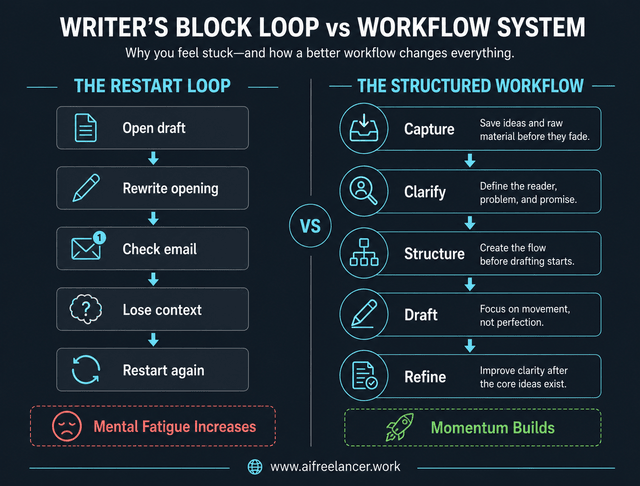
The blank page becomes exhausting when your brain has to rebuild direction, structure, and momentum every single time you sit down to write.
Many professionals unknowingly force themselves to make too many decisions at once. They try to figure out the topic, the structure, the introduction, the tone, and the wording simultaneously. That creates unnecessary pressure before the draft even has a chance to develop.
The Hidden Cost of Restarting Your Writing Process Daily
A freelance writer reopening a client article after several interruptions may spend fifteen minutes just remembering the original angle. A consultant trying to turn expertise into content may bounce between research tabs, notes, and partially written sections without a clear flow. A self-publisher may keep revising chapter openings without progressing deeper into the manuscript.
This creates mental drag because the brain repeatedly re-enters unfinished context. Instead of continuing momentum, the mind first has to reconstruct direction. Gloria Mark and colleagues at the University of California, Irvine found that interrupted work is associated with more stress, frustration, time pressure, and effort, while related research notes that it can take around 23 minutes to resume an interrupted task.
The writing itself may not even be the hardest part. Often, the hardest part is reopening the mental state required to continue the draft. A writer who already solved the structure yesterday may still spend twenty minutes rebuilding the context today because interruptions erased momentum overnight.
Why Perfectionism Creates More Resistance Than Clarity
Perfectionism also makes writer’s block worse than it needs to be. Many people try to sound polished before the core idea is even clear. A writer may rewrite the first paragraph repeatedly before defining the argument. A consultant may keep editing phrasing before deciding what problem the post is solving. A self-publisher may revise chapter openings endlessly while the rest of the manuscript remains unfinished.
Editing sentences before the structure exists slows execution because the brain keeps switching between creating and judging. One moment, you are trying to explore an idea. The next moment, you are evaluating sentence rhythm, transitions, or wording quality. That constant switching interrupts progress before the draft has room to develop naturally.
Writing becomes easier when drafting and editing stop competing for attention at the same time.
How to Overcome Writer’s Block When You Feel Mentally Overloaded
Writer’s block becomes harder to escape when unfinished tasks, interruptions, and mental clutter keep pulling your attention away from focused thinking.
Many professionals are not trying to write in calm conditions. They are writing between Slack messages, client revisions, invoices, emails, and dozens of unfinished responsibilities competing for attention.
The Real Reason Your Brain Keeps Avoiding the Blank Page
That mental fragmentation matters more than most people realize. Harvard Business Review, citing McKinsey analysis, notes that the average professional spends 28% of the workday reading and answering email. For writers, consultants, and creators, that means a large part of the workday may already be spent in reactive communication before any focused drafting begins.
This creates overload before the real writing session even starts. The brain is already carrying unfinished conversations, pending approvals, revisions, and small decisions from multiple directions.
You may notice patterns like:
- Reopening the same draft several times without progressing
- Feeling mentally tired before writing begins
- Struggling to hold the article direction clearly
- Avoiding difficult sections because your attention already feels stretched
Overloaded brains tend to avoid demanding thinking tasks because they already feel depleted. The draft itself starts feeling mentally expensive before the real writing even begins.
Why Content Creation Feels Harder After Constant Task Switching
Interruptions during writing create a different problem. Even when the direction is already clear, repeated context switching weakens continuity inside the draft itself.
A consultant writing a thought leadership article may stop midway to answer client messages, then return without fully remembering the original flow. A freelance writer may switch from outlining to research to editing within the same hour, creating fragmented attention instead of sustained focus.
This is why focused writing sessions usually feel easier than fragmented ones. Once the brain stays inside the same context long enough, resistance often decreases naturally because the thinking process no longer keeps resetting itself.
Many people mistake this for laziness or lack of discipline. In reality, the brain simply struggles to maintain depth when attention keeps getting interrupted from multiple directions.
How to Overcome Writer’s Block With a Repeatable Writing System
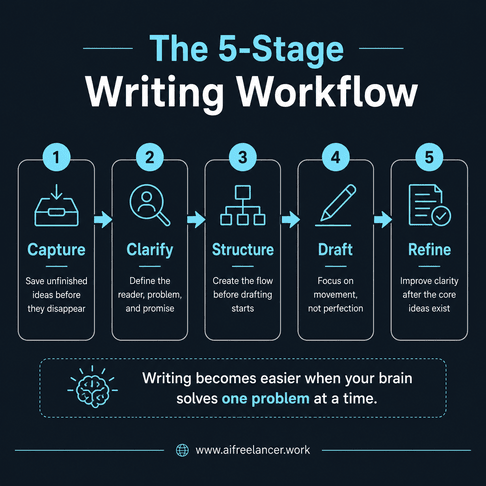
Most professionals are not blocked because they lack ideas. They are blocked because they try to think, structure, draft, edit, and refine all at the same time.
A repeatable workflow reduces that pressure because each stage has a clear purpose.
How to Overcome Writer’s Block by Capturing Ideas Before You Draft
Trying to organize every thought immediately creates unnecessary pressure. It is often more effective to collect raw material first without worrying about order.
That raw material might include:
- messy notes
- client comments
- voice memos
- screenshots
- research snippets
- unfinished ideas
A consultant might save common client questions for future content. A freelance writer might keep examples from previous projects. The same principle also helps freelancers who want repeatable client-writing workflows that reduce response time without rebuilding every proposal from scratch.
The goal of capture is not to organize ideas immediately. The goal is to preserve useful thoughts before they disappear once the writing session begins.
Writers often lose valuable ideas because they assume they will “remember it later.” In reality, unfinished ideas disappear quickly once attention shifts to client work, communication, or other tasks. Capturing first reduces the pressure to hold everything mentally.
Clarify the Reader, Goal, and Main Problem Before Writing
Many drafts stall because the writer has not fully defined who the content is for, what problem it solves, and what the reader should understand afterward.
A vague audience creates vague writing.
Before drafting, clarify:
- the reader’s frustration
- the article’s promise
- the primary takeaway
- the emotional angle
For example, a vague idea like:
“AI helps freelancers write faster.”
can become much clearer when refined into:
- Reader → overloaded freelance writers
- Problem → restarting client drafts repeatedly
- Promise → reduce blank-page friction using structured workflows
- Angle → AI works best as a structure tool, not a replacement writer
That clarification reduces uncertainty because the writing now has a defined audience, problem, and direction.
Without that clarity, writers often drift midway through the article. The introduction goes in one direction, the middle sections go somewhere else, and the conclusion feels disconnected from the original promise.
How to Overcome Writer’s Block by Structuring Before You Write
Structure solves a different problem: deciding what comes first, what comes next, and what does not belong.
The blank page becomes less intimidating when the flow already exists before drafting starts. Instead of opening a document and hoping clarity appears while writing, create the framework first.
This may include:
- H2 headings
- H3 sections
- section questions
- supporting examples
- logical transitions
For example, the clarified idea above might become:
- Why writers restart drafts repeatedly
- How workflow friction creates writer’s block
- The Capture → Clarify → Structure → Draft → Refine system
- How AI reduces startup resistance
- Long-term ways to make writing easier
Once the structure exists, writing becomes less about inventing and more about executing the next section clearly.
This is why experienced writers often outline heavily before drafting. The outline reduces sequencing decisions during the writing session itself, allowing more mental energy to go toward explanation, examples, and clarity.
Draft Without Editing Every Sentence Immediately
Drafting solves the problem of momentum.
One of the fastest ways to lose momentum is editing while drafting. Many writers stop after every paragraph to rewrite wording, improve transitions, polish sentences, or search for “better” phrasing. That constant interruption breaks the flow because the brain keeps switching between writing and judging.
A rough first draft is supposed to be incomplete. Many experienced writers rely on starting with unfinished drafts instead of polished openings because momentum usually matters more than perfection during early writing.
A writer who reaches the end of a rough draft usually has something usable to improve later. A writer who endlessly rewrites the opening may never reach the middle of the article at all.
Refine the Draft Only After the Core Ideas Exist
Refinement solves the problem of quality after the direction already exists.
Editing becomes significantly easier once the structure and argument already exist. Instead of generating ideas from nothing, you are improving something tangible:
- clarifying explanations
- tightening transitions
- improving tone
- simplifying wording
- strengthening examples
Refinement is easier than creation because the hardest part — forming the core direction — already happened earlier in the workflow.
This is also when stronger writing decisions become easier to spot. Weak examples become more obvious. Repetitive sections become easier to trim. Transitions become easier to smooth out because the entire article already exists in front of you.
How AI Can Help You Overcome Writer’s Block Without Replacing Your Voice
AI should not write the article for you before you know what you want to say. It should help you organize unfinished thinking into a usable starting point.
This distinction matters because many people use AI in ways that increase clutter instead of reducing it.
Use AI to Generate Working Outlines From Rough Notes
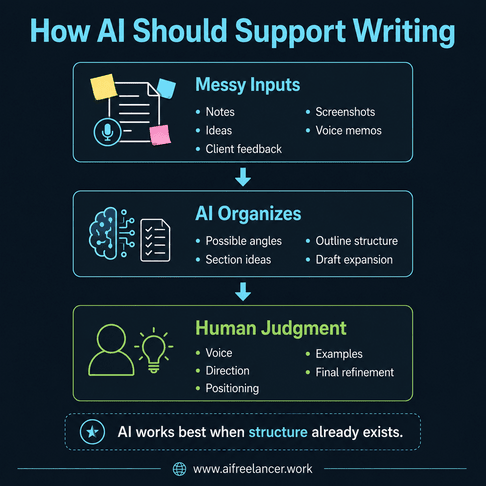
AI works best during the early organization stages of the workflow.
For example, imagine a consultant with:
- Messy meeting notes
- Unfinished LinkedIn ideas
- Screenshots from client feedback
- Random thoughts saved in a phone app
Instead of asking AI:
“Write a LinkedIn post about productivity.”
they could ask:
“Organize these notes into three possible article angles for overloaded consultants struggling with content consistency.”
That single change produces a much more useful starting point because the request already defines:
- the audience
- the problem
- the desired outcome
A simple AI-supported workflow could look like this:
- Messy input → client notes, article ideas, rough bullets
- Better prompt → ask AI to organize the notes into possible angles
- Usable outline → choose the strongest angle and build H2s/H3s
- Human decision → remove weak points, sharpen the promise, adjust the tone
- Drafting support → expand only the sections that need momentum
At this stage, AI supports clarification and structure. It helps organize messy inputs into something usable without pretending to replace the writer’s judgment.
How to Overcome Writer’s Block Using AI for Draft Momentum
AI can also support drafting momentum after the structure already exists.
For example, a writer may:
- Expand bullet points into rough paragraphs
- Generate temporary first-pass introductions
- Continue stalled sections
- Explore alternative article angles
A self-publisher struggling with a nonfiction chapter may paste rough bullet points into AI and ask:
“Expand these into possible talking points without changing the core idea.”
The result is not a finished chapter. The result is movement. That distinction matters because AI works best when it helps the writer continue thinking instead of replacing thinking entirely.
Used properly, AI behaves more like a workflow assistant than a replacement writer. It helps reduce startup hesitation, but the writer still controls the direction, emphasis, examples, and final judgment.
Why AI Works Better Inside a Structured Workflow
AI becomes much more effective when each stage of the workflow already has a clear purpose.
For example:
- Capture → organize scattered notes
- Clarify → compare possible angles
- Structure → build section flow
- Draft → expand rough ideas
- Refine → identify weak transitions or missing explanations
Without that structure, AI often creates more cleanup work later because the direction itself was never properly defined.
This is why structured workflows matter even more in the AI era. AI can accelerate organization and drafting, but it still depends on human refinement to make the content genuinely useful and original.
The Fastest Way to Reduce Writer’s Block Long Term
The goal is not to rely on motivation forever. The goal is to make starting easier because useful structures already exist before the writing begins.
Many professionals unintentionally make writing harder by rebuilding everything repeatedly.
Build a Reusable Writing Library Instead of Collecting Random Notes
Long-term improvement usually comes from building reusable assets over time. A writing library may include:
- successful outlines
- strong introductions
- reusable frameworks
- article templates
- saved examples
- research collections
Over time, reusable systems and pre-built content frameworks reduce the amount of mental effort required to start new drafts
For example, a freelance writer may save:
- successful client article structures
- email subject line formulas
- strong article introductions
- reusable transition phrases
A consultant may save:
- audience pain points
- common objections
- recurring client questions
- useful storytelling examples
The purpose of a writing library is not storage alone. It is reducing the amount of rebuilding required every time a new draft begins.
Over time, this dramatically lowers startup resistance because the writer is no longer beginning from an empty page every single session.
Create a Simple Pre-Writing Checklist Before Every Session
A simple checklist reduces friction because the decisions are already partially made before drafting begins.
For example:
- Define the audience
- Define the outcome
- Identify the structure
- Gather references
- Remove distractions
- Close unnecessary tabs
This preparation reduces uncertainty before the real writing session starts. Instead of figuring out direction mid-draft, the brain can focus primarily on execution.
Writers often underestimate how much energy is wasted on small decisions before the first paragraph even appears. A checklist removes many of those decisions upfront.
Batch Thinking Separately From Drafting Whenever Possible
Many professionals think more clearly when brainstorming happens independently from writing sessions. You may collect ideas throughout the week, outline during low-pressure periods, and reserve focused sessions primarily for drafting.
That separation protects momentum because the brain is no longer constantly switching between ideation, organization, and execution. The blank page feels less intimidating when the work has already partially started before the drafting session even begins.
This is one reason experienced writers often appear “faster” than beginners. In many cases, they are not thinking and drafting simultaneously. Much of the thinking had already happened earlier.
Final Thoughts
Learning how to overcome writer’s block is often less about forcing creativity and more about reducing unnecessary friction in the writing process.
Many professionals struggle because they repeatedly return to unfinished drafts without a clear system for continuing them. The blank page feels heavier when you are trying to choose the angle, arrange the points, and write polished sentences at the same time.
A repeatable workflow changes that experience. Capturing ideas early prevents useful thinking from disappearing. Clarifying the audience reduces uncertainty. Structure reduces sequencing decisions. Drafting protects momentum. Refinement improves quality after the direction already exists.
AI can support that process, but it works best when paired with clear systems instead of replacing human thinking entirely.
If you want more practical frameworks for writing workflows, AI-assisted systems, and sustainable content creation, explore the books and resources on my Amazon Author page and visit AI Freelancer for more workflow-focused insights.
Frequently Asked Questions About How to Overcome Writer’s Block
Many people freeze because the ideas are not yet organized into a clear structure. The brain struggles when it tries to think, organize, draft, and edit simultaneously.
Not always. For many freelancers, consultants, and creators, writer’s block is often caused by workflow friction, mental overload, perfectionism, or unclear structure.
Yes. AI works best as a support tool for outlining, organizing ideas, and expanding rough notes. Human direction and refinement are still essential for maintaining originality and voice.
Define the audience, clarify the goal, gather your references, and create a rough structure first. Starting with direction reduces blank-page pressure significantly.
Focus on completing the core argument before polishing individual sentences. Early drafting should prioritize momentum, not perfection.
Sources
- American Psychological Association — Multitasking and Switching Costs
- University of California, Irvine — The Cost of Interrupted Work
- Harvard Business Review — How to Spend Way Less Time on Email Every Day

Florence De Borja is a freelance writer, content strategist, and author with 14+ years of writing experience and a 15-year background in IT and software development. She creates clear, practical content on AI, SaaS, business, digital marketing, real estate, and wellness, with a focus on helping freelancers use AI to work calmer and scale smarter. On her blog, AI Freelancer, she shares systems, workflows, and AI-powered strategies for building a sustainable solo business.