
You reply to a client during dinner. Another message arrives before bed, so you answer that too. By morning, you are checking Slack before you have even started your own day. Nobody formally asked you to be available around the clock, but somewhere between being helpful and trying to keep every client happy, your working day stopped having an ending.
Learning how to set boundaries with clients means deciding when you are available, how quickly you respond, where project communication belongs, how many revisions are included, and what happens when feedback arrives late or the work expands.
A preference states what you would like the client to do. A boundary also explains what happens when the agreed condition is not met. “Please send feedback by Tuesday” is a preference. “Feedback received after Tuesday moves the delivery date” is a boundary.
Without those consequences, the same interruptions tend to continue, and work begins spilling into personal time. A Conference Board survey on remote-work boundaries found that 47% of fully remote workers were concerned about blurred boundaries between their jobs and personal lives.
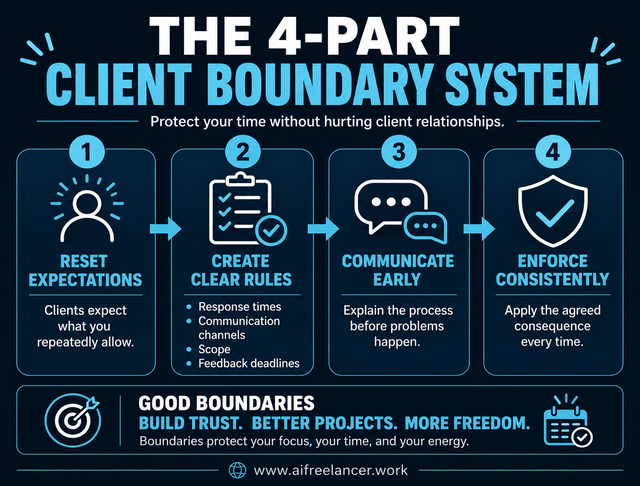
A practical four-part client boundary system is to:
- Change the expectations that created constant availability.
- Build clear communication, feedback, and scope rules.
- Explain those rules to new and existing clients.
- Maintain them when requests, exceptions, or pushback appear.
Everything I’ve shared here—and more—is in my book, available on Amazon. Click the link if you’re ready to take the next step.
Setting Client Boundaries Starts With Changing Expectations
A client sends a “quick question” at 9:47 p.m. You answer because it will only take a minute. Two evenings later, another message arrives. You reply again. Before long, answering at night no longer feels like an exception. It has become part of the service in the client’s mind, even though it never appeared in your agreement.
Why Clients Expect You to Reply Immediately
Clients often develop expectations from what repeatedly happens, not from what your contract says. When you regularly answer during evenings, weekends, vacations, or focused work sessions, you teach the client that they can expect a response during those times.
This does not mean the client is deliberately taking advantage of you. They may simply assume that your quick responses reflect your normal workflow. If they send a Google Docs comment at night and receive an answer five minutes later, they have little reason to think the message should have waited until morning.
Freelancers can also confuse responsiveness with reliability. Responsiveness is how quickly you react. Reliability is whether you communicate clearly, meet deadlines, document decisions, and deliver the agreed work. A reply sent in six minutes cannot compensate for a rushed draft or a missed deadline.
Even when freelancers understand that speed is not the same as reliability, slowing down their replies can still feel risky. They may fear that a slower response will make them look unprofessional, cost them future work, trigger a poor review, or push the client toward someone else.
A client may prefer faster replies, but that does not mean you are obligated to provide them without agreement.
Identify the Patterns That Keep You Permanently on Call
Before setting new client communication boundaries, examine the habits that shaped the current expectations. You may be replying within minutes regardless of urgency, checking several platforms throughout the day, or allowing clients to send instructions through whatever channel is most convenient for them.
You may also be accepting unscheduled calls, treating every request as an emergency, or beginning extra work before confirming whether it belongs in the original scope.
Ask yourself:
- Which messages interrupt my work most often?
- Which after-hours replies have become expected?
- Which “quick requests” regularly create extra work?
Look for the behavior you keep repeating. The expectation will not change while the client continues receiving the same response.
The Hidden Cost of Always Being Available
A client message may take only five minutes to answer, but the interruption often costs more than those five minutes.
Imagine that you are halfway through a 2,500-word article when a Slack notification appears. The client wants to know whether one sentence can be changed. You open the document, reread the surrounding section, respond, and return to the draft. The reply was brief, but the argument you were developing has disappeared from your working memory.
Research on interruptions across 4,910 recorded developer tasks found that contextual factors such as the interruption type, time of day, and task type were stronger determinants of disruption than task-specific factors such as priority. The researchers also found that self-initiated task switching could be more disruptive than external interruptions. Although the study focused on software development, the finding is relevant to writing, design, research, and other work that depends on sustained concentration.
A response-time policy works best when paired with scheduled inbox checks. The client knows when to expect an answer, and you are less likely to interrupt your own work every time a notification appears. This is one way to protect focused work from constant reply pressure instead of allowing every new message to reset your attention.
Constant interruptions can weaken concentration, slow drafting and revision, increase avoidable errors, and stretch the working day. They can also create greater decision fatigue and make it harder to mentally leave work even when no active task remains.
The effects can continue after the task itself is finished. A review of work-related smartphone use outside working hours found that 19 of the 23 included studies reported a significant association between greater off-hours smartphone use for work and increased work-life conflict.
A freelancer may appear highly responsive while quietly becoming less productive. You spend more hours working, yet fewer of those hours produce finished work.
Clients Need to Know When They Will Hear From You
The alternative to immediate replies is predictable communication.
A client who knows that routine messages receive a reply within one business day does not need to wonder whether you saw the email. A client who receives an update every Friday has less reason to send “just checking in” messages on Wednesday. A predictable weekly progress update can answer recurring questions before the client needs to ask them.
You can reduce communication pressure by giving clients a specific next point of contact:
I have received your feedback and will review it during tomorrow’s revision block. I’ll send the updated draft by Thursday afternoon.
That message tells the client what will happen, when it will happen, and whether the delivery schedule remains intact.
Build Clear Rules for Client Communication
Response times are only one part of the problem. The channels clients use can create just as many interruptions.
When feedback arrives through email, Slack, WhatsApp, Google Docs, and private messages, the client has too many ways to interrupt your working day.
Clear client boundaries turn communication into a written workflow instead of a stream of interruptions. You can also automate repetitive parts of your freelance workflow so acknowledgments, reminders, and routine updates do not require constant manual attention.
Set Response and Update Standards Clients Can Understand
Your response policy does not need to be complicated. It needs to answer three practical questions:
- When will routine messages be answered?
- How will issues that prevent the work from continuing be handled?
- What happens when client feedback or approval is delayed?
Routine questions may receive a response within one business day, while messages received after working hours can wait until the next working day. Genuine blockers should be sent through an agreed urgent channel, and progress updates can be delivered at set milestones instead of whenever the client asks.
Approval deadlines should also be clear. If the client submits feedback late, the delivery date may move rather than forcing you to absorb the delay.
There is no universal response time that works for every freelancer. Base your response standard on the service being sold, the risk created by delayed communication, your working schedule, the client’s time zone, and whether priority support is included in the price.
Choose a response window you can maintain during busy weeks, not one you can only meet when your workload is light. A one-business-day promise kept every time is more professional than a two-hour promise you regularly miss.
You should also define what urgency means. A genuine urgent issue may involve a serious legal or factual error in published content, an access failure preventing an agreed delivery, an approval needed for a scheduled launch or publication deadline, or a time-sensitive issue already covered by the client’s support arrangement.
A request is not urgent simply because the client sent it late or wants it completed quickly.
Urgency describes the consequence of waiting. It does not automatically create an after-hours obligation.
If a client regularly needs faster support, that level of access should be part of the service agreement rather than handled as a repeated favor. Same-day responses, launch-week availability, or priority revisions may require a higher-priced support arrangement rather than the standard project rate.
Keep Client Communication in Agreed Channels
Using more than one tool is not automatically a problem. The problem begins when nobody knows which tool should contain which information.
A practical system might use email for scope, approvals, and project decisions, Google Docs for line-level comments, and a project board for deadlines and deliverables. Texts, social media messages, and personal messaging apps can remain outside the project workflow.
Important decisions should be confirmed in one central record. Google Docs may hold sentence-level comments, while email records approval of a new deliverable or a change to the fee or deadline.
In my freelance work, separating comments from final approvals made project decisions easier to track. Clients could continue leaving line-level feedback in Google Docs, but any change affecting the scope, fee, or delivery date had to be confirmed through email.
For example, a client may leave a comment in Google Docs asking for a new section. Because that request affects the scope and delivery date, you can confirm the decision by email:
I saw the request for an additional case-study section in the document. Since this was not included in the approved brief, I’ll send the additional cost and revised delivery date before beginning that section.
Scattered communication can result in missed feedback, conflicting instructions, duplicate revisions, unclear approvals, repeated notification checking, and disputes about what was requested.
Redirect messages politely rather than scolding the client:
Thanks for sending this. To keep all project decisions documented, please add the feedback to the shared document. I’ll review it during the next revision round.
Decide Which Messages Require Action
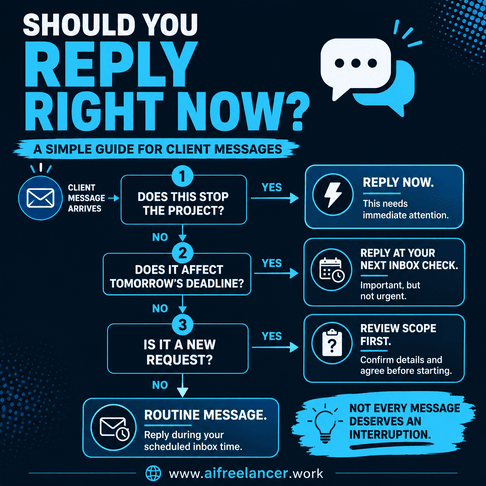
Not every message deserves an immediate reply. Before interrupting your current task, determine what kind of message you received.
Ask:
- Does this stop the work?
- Does it affect a deadline before the next business day?
- Is it a new request rather than a question?
- Is a reply needed, or should the information simply be recorded for later?
The answers help you distinguish between a work blocker, deadline issue, added-scope request, routine question, or administrative update.
A blocker may need prompt attention because you cannot continue until the client responds. A new deliverable needs a scope review, not a rushed yes. A note saying that a stakeholder will be unavailable next week can be recorded without abandoning the paragraph you are writing.
This message filter prevents false urgency from controlling your day. You respond based on the consequences for the project, not the number of exclamation marks in the message.
Separate New Requests From the Approved Scope
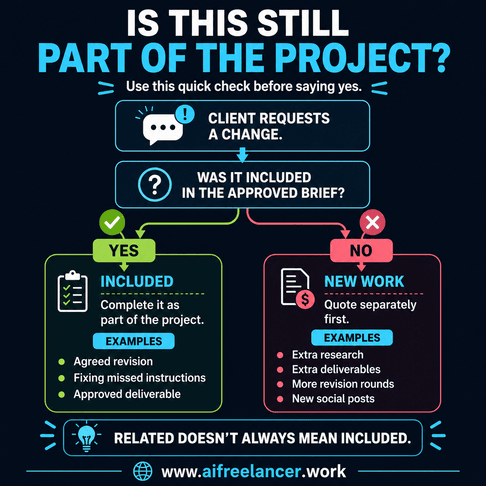
When the message contains a new request rather than a question, pause before treating it as part of the project.
Scope creep often arrives disguised as a small request.
A writing client may ask for “one quick section,” three LinkedIn posts, another revision round, or new research after approving the draft. A design client may request an extra file format after approving the original deliverables. Each request may sound minor when viewed alone. Together, they can add hours of work and place the original deadline at risk.
Before agreeing, check whether the request appeared in the approved brief, requires new research or another deliverable, affects the delivery date, or should replace existing work. If it does not fit the original agreement, quote it separately before beginning.
Suppose a client approved a blog-only brief and later asks for three LinkedIn posts. The request is related to the project, but it is still a new deliverable. It requires additional writing time and may affect other booked work.
A professional response could be:
I can create the three LinkedIn posts. They were not included in the original blog package, so I’ll send the added fee and updated delivery schedule for approval before I begin.
Communicate Boundaries Without Sounding Difficult
A boundary is easier to follow when the client hears it before a problem occurs. New clients should learn the process during onboarding, while existing clients may need a clear reset.
You do not need a long explanation or an apology. State the limit, then tell the client what happens next.
Introduce Boundaries During Client Onboarding
The easiest time to establish client expectations is before the work begins.
Include your core communication and project rules in your proposal or contract, repeat the most important points in your welcome message, and reflect them in the system used to manage work and feedback.
Your agreement might cover working hours, typical response times, revision limits, feedback deadlines, rush work, and the process for additional requests.
The welcome message can restate the most important details in plain language:
I review project emails Monday through Friday and respond within one business day. Please add draft feedback directly to the shared document. Feedback received after the approval deadline may move the final delivery date.
Repeating the same process at key points makes the boundary feel like part of your service rather than a personal restriction introduced during a disagreement.
You can reinforce it later through status updates, automatic email replies, calendar availability, and project reminders. However, you do not need to bury clients under a seven-page rulebook. Prioritize the information that prevents confusion.
Professional Scripts for Setting Client Boundaries
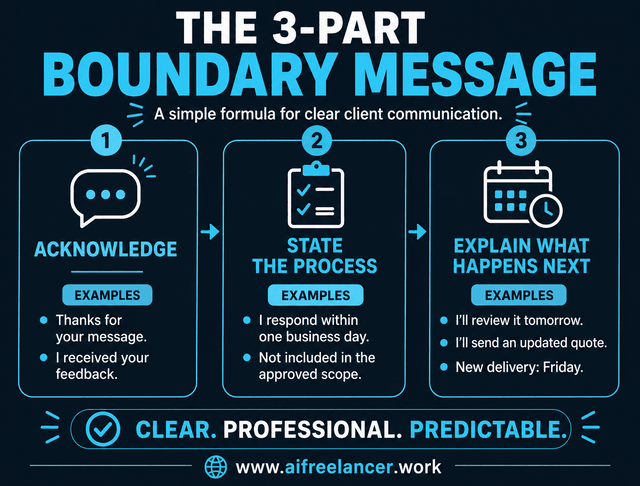
A strong boundary message usually acknowledges the request, states the relevant process or limit, and explains what will happen next.
Working Hours and Response Times
Thanks for your message. My client communication hours are Monday through Friday, and I respond within one business day. I’ll review this during tomorrow’s inbox block and update you by 2 p.m.
Redirecting Messages and Consolidating Feedback
Thanks for sending these notes. Please add all draft feedback to the shared Google Doc so I can review the comments together and avoid missing instructions. I’ll begin the revision once the consolidated feedback is ready.
After-Hours or Urgent Requests
I have received your message. I’m offline for the evening and will review it tomorrow morning. If the request changes the current delivery schedule, I’ll confirm the available options before proceeding.
For support outside your normal arrangement, you can add:
Weekend support is not included in the current project. If my schedule allows, I can send a separate rush-work quote for completion before Monday.
Added Scope and Rush Work
I can help with the additional request. Since it was not included in the approved scope and requires a shorter turnaround, I’ll send the added fee and revised schedule for confirmation before starting.
These scripts avoid long personal explanations and keep the focus on the agreement and the next action.
Reset Expectations With an Existing Client
The hardest clients to reset are often the ones you trained to expect instant access. You may already have a client who sends WhatsApp messages at night, calls without warning, or expects same-day answers because that is what you provided in the past.
Resetting the relationship can feel uncomfortable, but delaying the conversation usually makes the pattern harder to change.
Use this five-step process:
- Identify the behavior that is no longer sustainable.
- Choose the new rule.
- Explain what will change and what the client can expect.
- Introduce the change before the next conflict or at a natural transition point.
- Follow the rule consistently.
A project renewal, new contract, or workflow update creates a natural opportunity:
As we begin the next project, I’m updating my communication process so I can protect drafting time and keep delivery dates reliable. Going forward, I’ll review project questions through email during working hours. Please use the shared document for draft feedback. I’ll respond to routine messages within one business day.
The client may continue using the old channel at first. Redirect the message without restarting the entire conversation:
I saw your WhatsApp message. Please send the project details by email so I can keep them with the rest of the brief.
How to Set Boundaries With Clients When They Push Back
A client may agree to your process and still send late feedback, request extra work, or expect an exception when the deadline becomes inconvenient. What happens next determines whether your boundary is a real business process or merely a preference the client can ignore.
Decide When an Exception Makes Sense
Not every exception is harmful. A good long-term client may face an unusual launch problem, a genuine factual issue, or a time-sensitive approval. Helping once may strengthen the relationship.
The risk appears when the exception quietly becomes the new standard.
The first question is whether the client needs temporary access or wants you to rearrange the work itself. An exception temporarily changes your normal working hours or communication process. Rush work compresses production time, changes priorities, moves booked work, or adds deliverables.
Attending a pre-arranged weekend launch call may be an availability exception. Rewriting an entire sales page by Sunday may be rush work because it changes your production schedule.
State the exception clearly:
I can make a one-time exception and review the final approval on Saturday morning. My regular weekday availability will resume after the launch.
Documenting the exception prevents it from silently changing the ongoing agreement.
Respond Consistently When Clients Ignore the Agreement
You may not control when or where a client sends a message, but you do control when and where you act on it. Messages received outside working hours can wait until your next scheduled communication period. Feedback sent through WhatsApp can also be redirected to the agreed document before you act on it.
When clients continue ignoring the process, enforce the agreed consequence. Adjust deadlines after late approvals, quote added work before beginning it, and document repeated scope changes.
Suppose a client submits feedback three days late but still expects the original delivery date. Instead of silently working through the night, explain the impact:
I received the feedback today. Since the review arrived after Tuesday’s approval deadline, the revised delivery date is now Friday. I’ll confirm once the revision is underway.
The discussion stays on the delivery schedule instead of turning into an argument about attitude.
Create a Clear Rush-Work Policy
A rush request changes the time and schedule you originally priced. It may require you to move another task, work outside your normal hours, or decline new opportunities.
Your rush policy should explain what counts as expedited work, how much notice you normally require, whether a rush fee applies, and whether existing deadlines will move. It should also state when you may decline the request and how the client confirms acceptance.
You do not need a complicated pricing formula. The fee should reflect the disruption, the amount of work, the compressed timeline, and the commitments you may need to rearrange.
For example:
I can complete the rewrite by tomorrow. Because the new deadline requires me to reprioritize booked work, the rush fee is $75. Please confirm the updated fee and deadline by 3 p.m. so I can reserve the time.
The client can accept the new terms, choose the normal turnaround, or reduce the request.
Decline the request when meeting it would require you to break another commitment, deliver work below your normal standard, begin before the scope and fee are confirmed, or accept a deadline that is not realistically achievable. A rush fee compensates for disruption. It does not make an unrealistic deadline achievable or responsible.
Know When Better Boundaries Cannot Fix the Relationship
Most boundary problems can be corrected through clearer terms and consistent follow-through. Some patterns continue even after both have been tried.
A single mistake does not automatically make someone a bad client. People miss instructions, underestimate timelines, and send messages through the wrong channel.
One late message is a mistake. Repeated pressure after several reminders signals a problem with the working relationship.
A relationship may be unsustainable when a client repeatedly disregards written agreements, retaliates when you enforce a reasonable limit, uses abusive language, creates constant artificial emergencies, pressures you to perform unpaid work, or refuses revised pricing and timelines for added scope.
Before ending the relationship:
- Clarify the rule and the reason for it.
- Document the repeated problem.
- Explain the consequence if it continues.
- Enforce that consequence.
- Decline future work if the pattern does not change.
You may need to complete the current contract, provide the required notice, return relevant materials, and decline further work. Ending a poor-fit relationship is not a communication failure when the client repeatedly refuses reasonable professional terms.
Clear Boundaries Build Client Trust
Clear boundaries reduce surprises. Decisions are documented, deadlines move for stated reasons, and new requests follow an agreed process.
A client is more likely to remember a missed deadline than an email answered three hours later. Trust grows from what happens across the entire project, not from how constantly you monitor your phone.
Show Reliability Through Clear Boundaries
A Friday update explaining what is finished, what happens next, and whether anything is blocked may prevent several follow-up messages. Confirming a scope change in writing may prevent a disagreement during invoicing. Stating the next approval date may keep the project moving without daily check-ins.
Protected work time also improves the quality of what the client receives. Uninterrupted work blocks give you time to follow an argument through a full draft, evaluate sources carefully, notice inconsistencies, write more thoughtful revisions, and finish work within the planned schedule.
Clients see the difference in cleaner drafts, fewer mistakes, and deadlines that do not depend on late-night catch-up work.
Check Whether the New Process Is Working
Review the process after one month or at the end of a completed project. Look for fewer follow-up messages, clearer scope decisions, and more feedback arriving through the agreed channels. Your own working day should also contain longer periods of focused work and fewer evenings spent catching up.
If clients remain confused, the rules may need clearer wording. If you repeatedly miss your response commitment, the promised window may be unrealistic.
How Do You Politely Tell a Client Your Working Hours?
Tell the client when you are available, when messages will be reviewed, and when they can expect a response.
For example:
My client communication hours are Monday through Friday, and I respond to routine messages within one business day. Messages received outside those hours will be reviewed on the next working day.
Include your time zone when working with international clients.
How Do You Set Boundaries With an Existing Client?
Identify the current pattern that is no longer sustainable, choose the replacement rule, and explain the change before the next problem occurs.
A new project, contract renewal, or workflow update is a natural time to reset expectations. Tell the client what will change, what they can expect instead, and when the new process begins.
What Should You Do When a Client Crosses a Boundary?
Restate the agreed process and respond according to it. Redirect scattered feedback, delay after-hours replies until your next working period, adjust deadlines after late approvals, or quote added work before starting.
Avoid arguing about whether the client behaved badly. Focus on the agreement, the effect on the project, and the next action.
Final Thoughts
Learning how to set boundaries with clients gives both sides a clearer way to work. Clients know when they will hear from you, where to send feedback, and what happens when a request changes the scope or deadline. You regain the focused time needed to deliver good work without stretching every project into your evenings.
Start with the pattern causing the most disruption. It may be late replies, feedback scattered across several platforms, unpaid additions, or clients labeling every request as urgent. Choose one rule, explain what happens next, and keep using it when the old pattern returns.
You do not need to change every part of your business at once. Start by learning how to create practical limits around your work, fix the boundary that costs you the most time, then build from there.
For more practical systems that can help you manage freelance work, communicate with clients, and build a more sustainable business, explore my books on my Amazon Author page.
Sources
- The Conference Board — Remote Workers Struggle to Maintain Boundaries Between Work and Personal Life
https://www.conference-board.org/press/Remote-Workers-Struggle - arXiv — Task Interruptions in Software Development: What Makes Some Interruptions More Disruptive Than Others?
https://arxiv.org/abs/1805.05508 - PLOS Digital Health — Work-Related Smartphone Use During Non-Work Time and Work-Life Conflict: A Systematic Review
https://journals.plos.org/digitalhealth/article?id=10.1371/journal.pdig.0000554

Florence De Borja is a freelance writer, content strategist, and author with 14+ years of writing experience and a 15-year background in IT and software development. She creates clear, practical content on AI, SaaS, business, digital marketing, real estate, and wellness, with a focus on helping freelancers use AI to work calmer and scale smarter. On her blog, AI Freelancer, she shares systems, workflows, and AI-powered strategies for building a sustainable solo business.