
Most people searching for AI tools for content creation aren’t short on options—they’re buried in them. You open a list, test a few tools, and still end up rewriting half the draft—or worse, staring at something that sounds polished but says nothing. The problem isn’t access. It’s that the tools don’t match the way real content actually works.
According to research from the Content Marketing Institute, more than 70% of marketers say content creation is their most important activity, yet consistency remains a struggle. That gap shows up in the day-to-day work: rushed drafts, unclear messaging, and time lost fixing outputs that should have been usable.
This guide shows how to move from scattered tools to specialized AI systems that support how you actually write, think, and publish—and which tools actually fit each part of that process.
Everything I’ve shared here—and more—is in my book, available on Amazon. Click the link if you’re ready to take the next step.
Why Most AI Tools for Content Creation Lists Fail You
Most “best AI tools” lists look helpful until you try to use them on real work.
You open a list, see 25 tools, and pick three to test. One helps with drafting, another rewrites sentences, and another promises better structure. By the time you’ve switched between them, you’ve lost the thread of what you were trying to say. The draft takes longer, not less.
The issue is not the tools themselves. It’s how they’re presented. These lists compare features, not workflows. They tell you what a tool can do, but not when to use it or how it fits into the sequence of getting content done.
That mismatch shows up in very specific ways. You start drafting before the angle is clear, edit before the structure is stable, and run the same paragraph through multiple tools, hoping one will fix it. Instead of reducing work, the tools multiply it.
That’s why even strong tools like ChatGPT or Grammarly don’t fix the problem on their own. Without a clear place in your process, a tool becomes another decision point rather than a shortcut.
What Changes When You Choose AI Tools for Content Creation for Specialized Work
Once you stop relying on generic lists, a more practical question shows up: can the tool handle the kind of content you actually produce?
For many readers here, that content is not generic. It is tied to expertise, positioning, or conversion. That is where general tools start to show their limits.
Some writers start with ideas that already exist but struggle to turn them into clear, structured content. Others are rewriting landing pages or emails under time pressure and need sharper messaging, not more variations. In more technical or niche work, the priority shifts toward accuracy and logical flow rather than surface-level clarity.
Where General AI Tools Break Down in Real Content Work
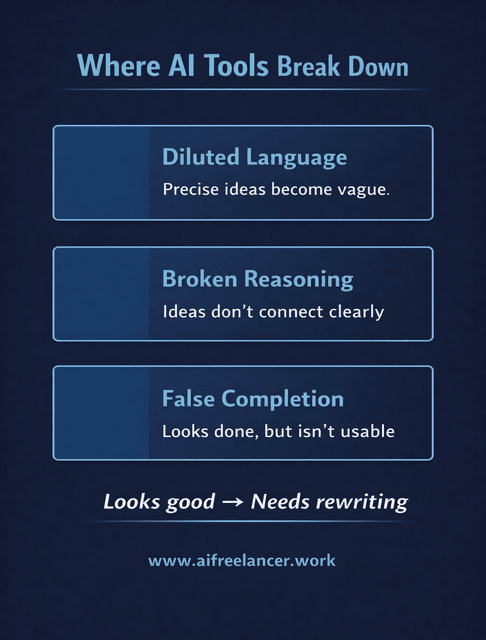
General AI tools tend to struggle in three predictable ways.
They dilute language. Precise terms get replaced with broader ones, which weakens authority. A sentence that should sound confident starts to sound safe. This is especially noticeable in technical or expert-led content, where one word change can shift meaning.
They break the flow of reasoning. Individual sentences read well, but the connection between them weakens. The content stops building toward a point and starts circling it. You see this when paragraphs feel complete on their own but don’t move the argument forward.
They create the illusion of completeness. The draft looks finished, so you move on—until you realize it doesn’t actually say what you meant. That’s where revision cycles begin, and where most of the “time saved” disappears.
Research from the National Bureau of Economic Research shows that generative AI can significantly improve writing productivity, but outcomes depend heavily on how the tool is used. Without a clear process, faster drafts often still require substantial revision.
When you use AI in a more controlled, context-aware way, the difference shows up in the work itself. You spend less time correcting terminology, less time rebuilding arguments, and less time questioning whether the draft holds up.
In one case, a consultant used AI to turn raw notes from a strategy session into a LinkedIn article. The first version captured the topic but missed the core argument. After tightening the input and guiding the structure, the second version preserved key terms, followed a clear line of reasoning, and required only light editing. The improvement came from control, not from switching tools.
Choosing AI Tools for Content Creation Based on Your Role
Once you start thinking in terms of output rather than features, the next step is straightforward: different types of work require different setups.
Matching Tools to How You Actually Work
Some writers are working from ideas that already exist but need help shaping them into structured content. In these cases, AI is most useful when it organizes thinking and reduces the number of revisions needed to reach a clear final version.
In practice, this often means using Notion AI to structure raw ideas and keep content organized, then using ChatGPT to expand and refine those ideas into a cohesive draft. The combination works because one tool handles structure while the other handles expansion.
Others are working under constant time pressure, writing content between tasks. This often leads to drafts that try to explain everything at once. A common example is a landing page that lists features but never makes the value clear. AI becomes useful when it helps isolate the core message and rebuild the content around it so it can be used immediately—whether that is a homepage section, a product description, or a sales email.
According to McKinsey & Company, generative AI has the potential to significantly improve productivity across marketing and sales functions. That improvement is most visible when the output is usable without multiple revision cycles. Tools like Jasper and Copy.ai are often used here because they are designed around marketing structure, making them better suited for conversion-focused content than general-purpose tools.
Some people are not struggling with quality—they are struggling with consistency. One session feels efficient, the next feels scattered. Time is lost deciding how to start and when to stop. AI tools for content creation become valuable when they reduce those decisions and support a repeatable flow from start to finish.
A typical setup here combines Notion AI for organizing the workflow, ChatGPT for drafting, and Grammarly for final refinement. Each tool has a defined role, which removes overlap and stabilizes the process.
How to Build a System Using AI Tools for Content Creation
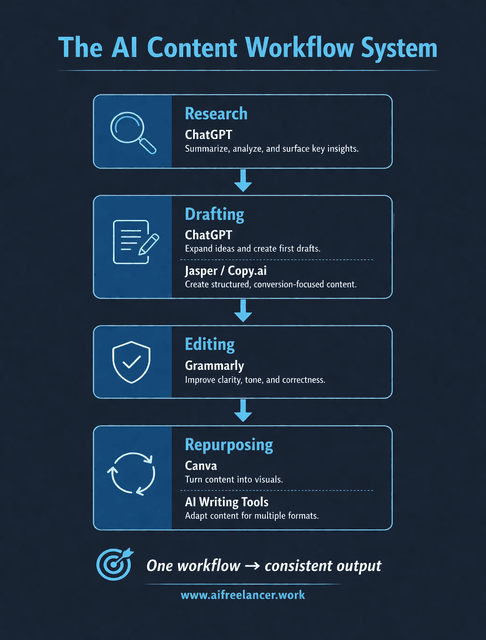
By this point, the pattern becomes clear. The problem is not which tool is “best.” It is how the work is structured—and which tools support each stage.
In the research stage, tools like ChatGPT can help summarize material and surface patterns, but they often compress nuance. If you rely on them too early without review, you risk building your content on simplified inputs. Used correctly, they accelerate discovery while keeping the direction intact.
The drafting stage is where most of the speed gains happen. Tools such as Jasper or Copy.ai take rough inputs—notes, partial ideas, fragments—and expand them into structured content. The advantage here is not just speed, but structure. These tools are trained around marketing and content formats, which helps produce drafts that require less rework.
Editing is where many workflows slow down. Tools like Grammarly help tighten language and improve clarity, but their real value lies in the constraint they impose. When used correctly, they reduce unnecessary variation and help you finalize a draft rather than reopen it.
Repurposing is where the system becomes more efficient over time. A single piece of content can be adapted into other formats using tools like Canva for visuals or AI writing tools to reshape the message. A long-form article can become a short email, a set of social posts, or talking points for a video. The work compounds instead of restarting.
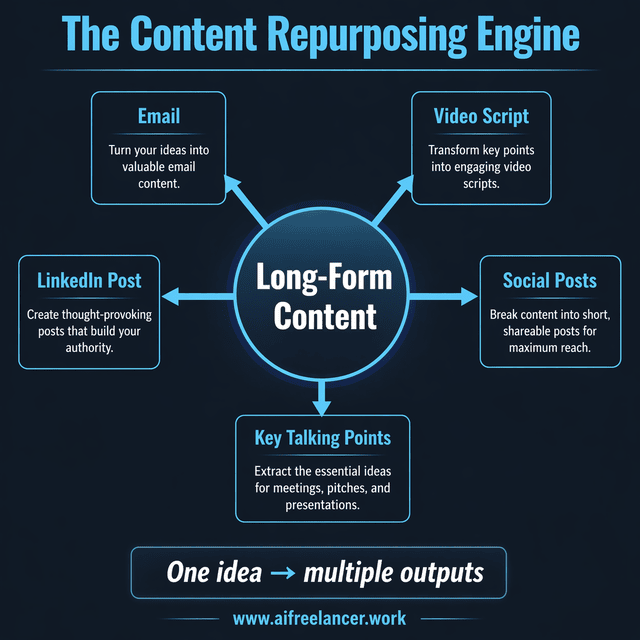
A system works when each tool has a defined role, and each stage has a clear endpoint. When tools overlap or stages blur together, the process becomes harder to follow. When the roles are clear, the workflow becomes easier to repeat and easier to trust.
Final Thoughts
At this point, the pattern should be clear. More tools do not solve the problem. Better alignment does.
The right AI tools for content creation are the ones that match how you actually work—whether you are structuring ideas, refining messaging, or producing content at scale. When that alignment is in place, you spend less time fixing drafts, fewer cycles rebuilding arguments, and more time publishing work that holds up.
If you want to build workflows like this—clear, repeatable, and grounded in real writing work—you can explore the frameworks and systems in my books on my Amazon Author page. They’re designed for freelancers, consultants, and founders who want to move faster without losing control of their process.
Frequently Asked Questions About AI Tools for Content Creation
The best tools depend on your workflow, not just the feature list. ChatGPT works well for drafting and expanding ideas, Jasper is stronger for structured marketing copy, and Grammarly helps tighten clarity and tone. Instead of searching for one all-in-one platform, build a small tool stack where each tool handles a specific job.
AI tools help move rough ideas into usable drafts faster by supporting research, outlining, drafting, and editing. They can summarize source material, turn notes into structure, and clean up awkward phrasing. The biggest advantage is not just speed, but reducing friction between stages, so you spend less time rewriting the same piece.
Yes, but beginners usually get better results when they keep the setup simple. Starting with one tool, such as ChatGPT for drafting or outlining, is more effective than juggling several tools at once. The real skill is learning how to give clear input so the output becomes easier to shape and improve.
They can, but only when used with structure and subject awareness. AI often generalizes language, which can weaken accuracy in technical or specialized topics. It works best as a drafting and organizing assistant, while you stay responsible for terminology, positioning, and final review.
Start by identifying the stage that slows you down most, whether that is research, drafting, editing, or repurposing. If getting started is the issue, use a drafting tool; if clarity is the issue, use an editing tool. Build your setup one bottleneck at a time so each tool has a clear role.

Florence De Borja is a freelance writer, content strategist, and author with 14+ years of writing experience and a 15-year background in IT and software development. She creates clear, practical content on AI, SaaS, business, digital marketing, real estate, and wellness, with a focus on helping freelancers use AI to work calmer and scale smarter. On her blog, AI Freelancer, she shares systems, workflows, and AI-powered strategies for building a sustainable solo business.