
If you’ve ever asked yourself why freelancers feel overworked, even when the work itself isn’t hard, it usually starts like this: you sit down, open your laptop, and expect a light day. A few emails, a quick draft, maybe some revisions—nothing complicated.
Then the day disappears.
You check messages, clarify a brief, start writing, stop halfway, re-read instructions, adjust the angle, reply to a client, jump to another task, then come back again. By the end of the day, you’re exhausted—but you can’t clearly point to what you actually finished.
You’re not alone, and more importantly, you’re not the problem. It’s not a lack of discipline or poor time management. It’s the invisible work you’re carrying every single day.
Everything I’ve shared here—and more—is in my book, available on Amazon. Click the link if you’re ready to take the next step.
Why Freelancers Feel Overworked (Even When Work Isn’t Hard)
The frustrating part is that the tasks themselves are not difficult. You know how to write, you’ve handled more complex projects, and you have the experience to get things done efficiently.
Yet the day still feels heavy.
Look at what actually happens during a typical work session. You open your laptop, check emails, respond, switch to a draft, recheck the brief, revise a section, reply to Slack, adjust a timeline, then return to writing. Each step seems small and manageable on its own, but together they create a constant cycle of interruption.
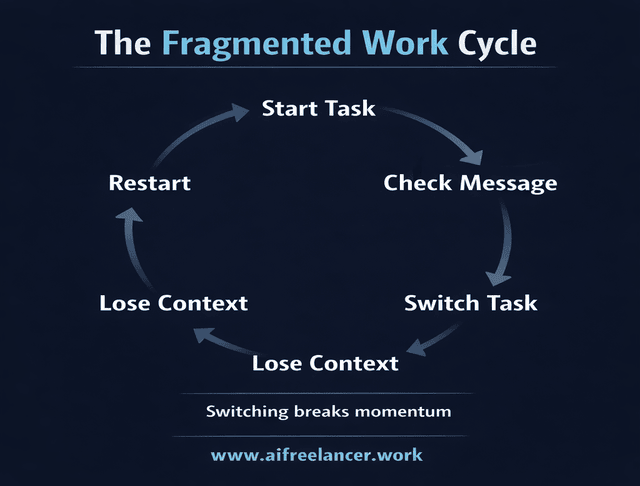
There’s a moment most freelancers recognize. You come back to a draft, stare at the screen for a few seconds, and realize you don’t remember what you were trying to say. Nothing is wrong with the work—you just lost the thread.
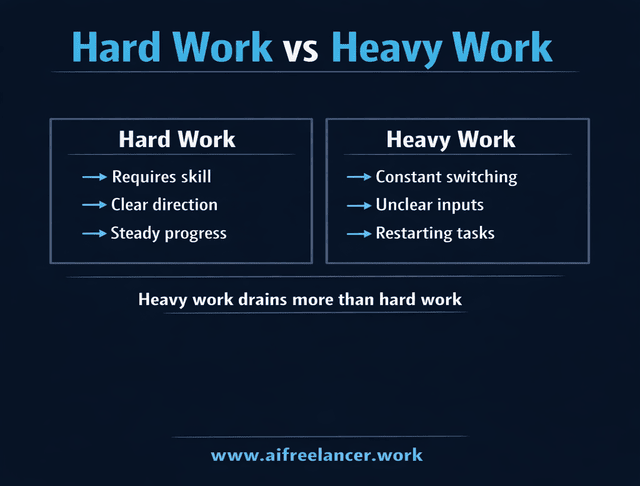
That’s the difference between hard work and heavy work. Hard work challenges your skill. Heavy work drains your energy because you keep having to restart.
Why Freelancers Feel Overworked: The Invisible Work Problem
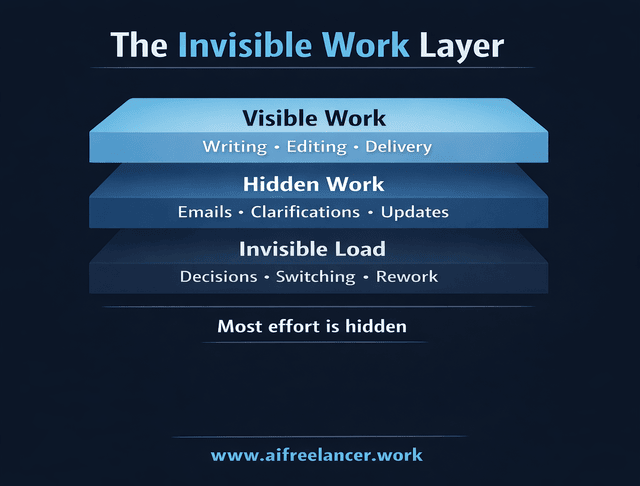
Most freelancers measure their workload based on visible output—writing, editing, and delivering content. But that’s only part of the picture. A significant portion of the workload happens behind the scenes, and that’s what creates the strain.
Invisible work includes unclear briefs you have to interpret, constant switching between tasks, revision loops that never feel complete, and the steady stream of emails and updates that interrupt your focus. None of these show up in your final output, yet they demand continuous attention. This is the same layer of effort often described as manual glue work—the small, necessary tasks that hold everything together but rarely feel like progress.
You feel it in small moments. You open a brief and hesitate because something feels missing, but you can’t immediately say what. You start writing anyway, then pause halfway through because the angle doesn’t feel quite right. You rewrite a paragraph, not because it’s wrong, but because you’re trying to align it with an expectation that hasn’t been clearly defined.
This kind of work builds quietly. It’s not one big task. It’s dozens of small adjustments layered on top of each other.
Over time, that creates different kinds of drag:
- deciding things that should have been decided upfront
- losing focus every time you check something “quick.”
- restarting work instead of continuing it
- second-guessing whether you’re on the right track
Research from the University of California, Irvine, found that after an interruption, it takes an average of about 23 minutes to return to a task, showing how frequent switching disrupts focus and increases mental fatigue.
Why Freelancers Feel Overworked Because of Context Switching
Every time you switch tasks, your brain has to reload context. Each client has a different tone, different expectations, and different standards.
You might go from writing a blog post to replying to a client, then to reviewing edits, then back to writing. None of these steps is difficult, but each one pulls you out of the previous task.
Even checking your inbox can do this. You read one message, then another, and before you know it, ten minutes are gone. When you return to your draft, it takes time to get back into it. That re-entry is where a lot of energy goes.
Why Freelancers Feel Overworked From Unclear Inputs
A clear brief lets you move forward without hesitation. You know the goal, the angle, and what “done” looks like.
An unclear brief does the opposite. It slows you down before you even begin.
You end up making decisions as you go—choosing structure, defining the message, and guessing what the client wants. Then, later, you revise based on feedback that reveals what should have been clear at the start.
That’s why some projects feel heavier than others, even when they’re similar in scope. It’s not the writing. It’s the uncertainty around it.
Why Freelancers Feel Overworked Despite Having “Easy” Tasks
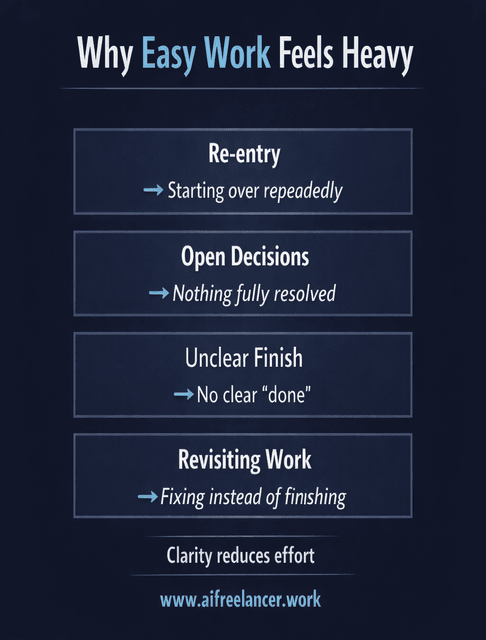
You can have a full day of simple tasks and still feel drained by the end of it. That’s because the issue isn’t difficulty. It’s how much thinking happens around the task.
When a task is clear, you can sit down and execute it. When it isn’t, the work stretches. You pause to think, adjust your direction, revisit earlier decisions, and keep part of the task in your head even when you’re not actively working on it.
That’s when “easy” work stops feeling easy.
You might finish several tasks and still feel like nothing is fully done. You might stay busy all day and still feel behind. A task that should take two hours stretches across the entire afternoon because you keep stepping in and out of it.
Easy work becomes heavy when:
- You keep re-entering the same task instead of finishing it
- Decisions stay open instead of being resolved
- You’re unsure what a finished version actually looks like
- You revisit the same work more than once
This is also why traditional productivity tools can feel ineffective. A simple list cannot capture this kind of hidden effort, which is exactly why your to-do list isn’t working once you notice what’s actually happening during your day.
Research from MIT Sloan found that when work is supported by structured systems, people complete tasks faster and with less effort, largely because fewer decisions need to be made during the process.
Why Freelancers Feel Overworked When Everything Feels Urgent
When everything feels urgent, you don’t get to settle into a task. You keep moving.
You respond to one request, then another. You shift priorities mid-task. You try to keep everything moving at once.
At the end of the day, you’ve done a lot—but it doesn’t feel like progress. It feels like you’ve been catching up all day without ever actually getting ahead.
Why Freelancers Feel Overworked Is Not a Time Problem
At this point, most freelancers try to fix the problem with better time management. They organize their schedule, block out hours, and try to be more disciplined.
But the problem doesn’t go away.
That’s because the issue isn’t time. It’s what you’re trying to manage.
When the work itself is unclear or constantly interrupted, organizing your time won’t fix it. You’re still dealing with the same underlying problem, just arranged differently.
You are not managing time. You are managing unclear work.
According to McKinsey & Company, productivity gains come from redesigning how work is done and structuring tasks more effectively—not simply from trying to work faster.
The Real Cause: Workflow Friction and Hidden Tasks
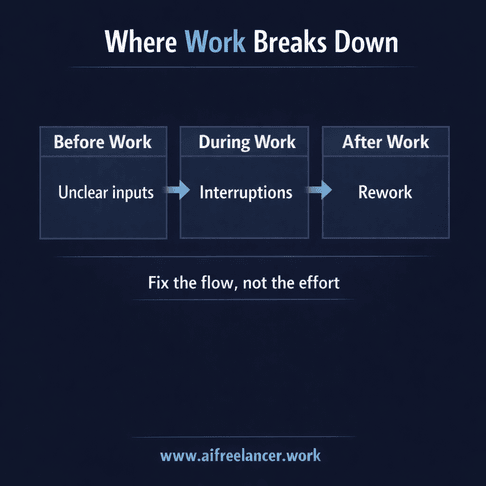
If time management isn’t the solution, the next step is to look at where things start to break down. Once you see the pattern, it becomes easier to spot it in your own day.
This layer of effort is easy to miss while you’re in it, but it compounds over time. It’s the same pattern explored in hidden work, killing your productivity, where small inefficiencies quietly build into bigger problems.
Instead of thinking about individual problems, look at how they show up across your workflow.
- Before the work starts, you may not have full clarity, so you begin with uncertainty
- During the work, you stop and restart because of messages, edits, or shifting priorities
- After the work, you revisit things that could have been clarified earlier
This sequence—unclear inputs, interruptions, and rework—is what creates the feeling of being constantly busy but never fully caught up.
How to Reduce Invisible Work and Mental Load
Once you recognize this pattern, the next step is to remove the drag instead of pushing yourself harder. The changes are simple, but they only work if you apply them to real situations in your day.
Start by noticing where your time actually goes. Look at your last few hours of work. How much of that time went into writing, and how much went into emails, clarifications, or small adjustments that didn’t move the work forward?
Next, pay attention to how often you switch tasks. If your day looks like writing, replying, checking, then writing again, you are constantly breaking your own momentum. Try grouping those actions instead—write first, then respond, instead of mixing them.
Clarity is where most of the wasted effort comes from. If a brief feels incomplete, pause and ask the questions upfront. It may feel like a delay, but it removes the need to rewrite later.
Finally, look at how often you check messages. If you’re opening your inbox every few minutes, your work will always feel fragmented. Giving yourself even one uninterrupted block of time can change how the work feels.
Build a Workflow That Removes the Overload
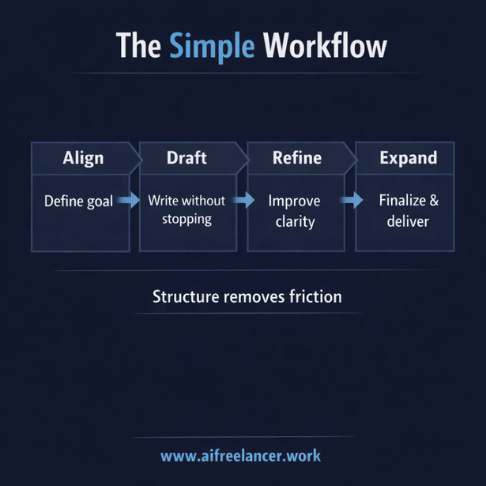
Small adjustments help, but the real shift happens when your work follows a consistent path from start to finish. Instead of reacting to each task, you move through it in stages. This is the foundation of a more structured system, like the one outlined in an AI workflow for freelancers, where each step supports the next.
A simple structure—Align, Draft, Refine, Expand—does exactly that.
Align means you take a moment to understand the goal before starting. You define what the piece needs to do, so you’re not guessing later.
Draft is where you write without stopping to edit. You stay in one mode and let the ideas come through without interruption.
Refining is where you step back and improve the work. Because you’re no longer guessing the direction, revisions become cleaner and faster.
Expand is where you finalize and deliver. At this point, you’re polishing something that already works instead of fixing something unclear.
When you work this way, you stop switching between thinking, writing, and editing all at once. The process becomes easier to follow, and the work feels lighter because you’re no longer restarting at every step.
Final Thoughts
If you’ve been trying to understand why freelancers feel overworked, the answer isn’t that you’re doing too much. It’s that too much of your work is invisible.
You’re not inefficient. You’re working in a way that forces you to restart, rethink, and revisit the same tasks more than necessary.
When you remove that hidden work and replace it with a clearer structure, the difference is immediate. Work feels more manageable, progress becomes easier to see, and you stop ending your day wondering where your time went.
If you want to build workflows like this and use AI without losing your voice, explore my books on my Amazon Author Page. They’re designed to help you write faster, reduce revisions, and build systems that actually support the way you work.
Frequently Asked Questions About Why Freelancers Feel Overworked
Because fewer clients don’t reduce the hidden workload. Each project still comes with emails, clarifications, revisions, and context switching. You may have less visible work, but the invisible work—figuring things out, adjusting direction, and managing communication—remains, and that’s what builds up over time.
Focus on removing the friction inside your workday, not just organizing it. Reduce unnecessary switching by separating writing from communication, clarify briefs before you start, and protect uninterrupted time so you can actually finish tasks instead of constantly restarting them.
Not always. Burnout often comes from unclear expectations, interruptions, and repeated adjustments rather than the total amount of work. When tasks require constant decision-making and rework, they drain more energy than a heavier but well-defined workload.
Because simple tasks often carry hidden decisions. When you are unsure about direction, tone, or what “done” looks like, you keep pausing, adjusting, and revisiting the same work. That repeated re-entry and lack of closure is what makes easy work feel heavy.
A structured process like Align → Draft → Refine → Expand works because it separates thinking, writing, and editing. You clarify direction first, write without interruption, revise with a clear goal, and finalize once the work is cohesive. This reduces unnecessary decisions and makes it easier to move from start to finish without getting stuck.

Florence De Borja is a freelance writer, content strategist, and author with 14+ years of writing experience and a 15-year background in IT and software development. She creates clear, practical content on AI, SaaS, business, digital marketing, real estate, and wellness, with a focus on helping freelancers use AI to work calmer and scale smarter. On her blog, AI Freelancer, she shares systems, workflows, and AI-powered strategies for building a sustainable solo business.