
You sit down to work with a clear plan. A few hours later, you’ve answered emails, clarified instructions, fixed parts of a draft, and jumped between tasks—but the main work still isn’t done. You scroll back through what you did and realize none of it moved the actual deliverable forward in a meaningful way. If you’ve been asking yourself why tasks take so long, this is exactly what it looks like in real life.
It’s not just about distractions or poor time management. The real issue is that your workday includes a layer of effort you don’t track—work that happens around the task but doesn’t visibly move it forward. Over time, that invisible layer becomes the reason your day feels full while your output stays limited.
Everything I’ve shared here—and more—is in my book, available on Amazon. Click the link if you’re ready to take the next step.
Why Tasks Take So Long Even When You’re Working All Day
You’re not idle, and you’re not avoiding your work. The problem is that the task you planned to complete is only one part of what you actually do. The rest of your time is spent on small, necessary actions that never show up as progress.
You open a document to start writing. Before you type anything, you check the brief again. Something feels unclear, so you reread it. You open another tab to confirm a detail. Then a message comes in. You reply quickly, thinking you’ll go back right after. When you return, you don’t continue—you reread what you already saw just to get your bearings.
That reset happens more often than you notice, especially when your day is filled with scattered inputs and fragmented tasks—something a clear system like an AI workflow for freelancers can help you reduce over time.
Why Tasks Take So Long When the Task Isn’t the Only Work
A task that looks simple on paper expands quickly in practice. Writing a blog post, for example, is rarely just writing. It includes reviewing the brief, clarifying expectations, gathering information, organizing ideas, drafting, editing, and formatting.
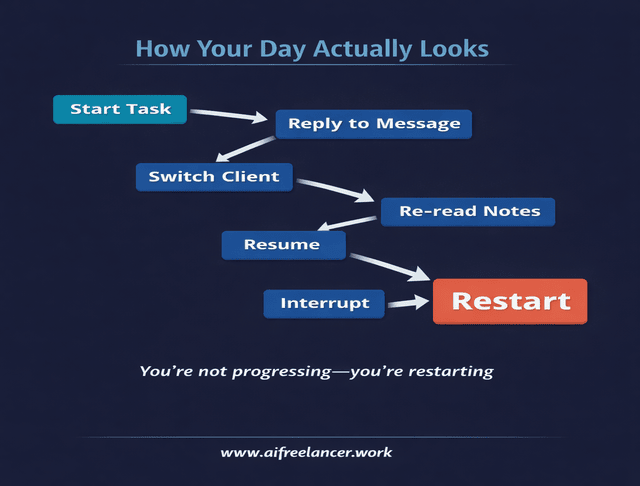
What makes this difficult is not the number of steps, but how they are spread across your day. You rarely move through them in one uninterrupted flow. Instead, you start, pause, switch, return, and restart. Each restart costs time, even if it only takes a few minutes.
Why Tasks Take So Long Because of “Work Between the Work”
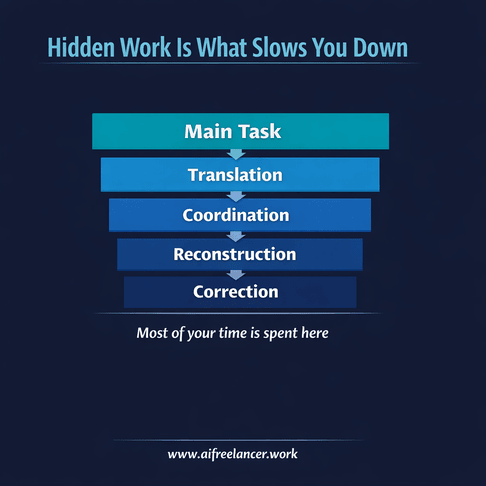
There is a layer of effort that sits before, between, and after your main tasks. This is what creates the feeling of constant activity without meaningful progress. Instead of moving from start to finish, your work is broken into smaller segments that require repeated setup and adjustment.
This is often referred to as manual glue work—the small but necessary actions that hold tasks together but quietly consume a large part of your day.
Types of Hidden Work That Slow You Down
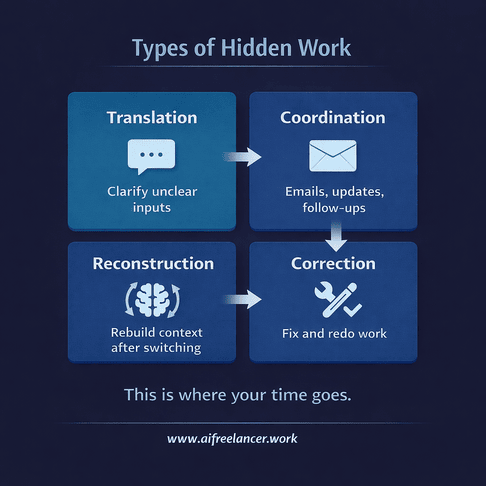
- Translation work involves turning a vague client message into clear, actionable steps. You read it once, then again, then rewrite it into something usable before you even begin.
- Coordination work includes replying to messages, confirming details, and sending updates. These moments feel quick, but they interrupt whatever you were doing before.
- Reconstruction work happens when you return to a task and need to figure out where you left off. You scroll, reread, and mentally retrace your steps.
- Correction work appears when you need to fix the structure, rewrite unclear sections, or adjust based on feedback. This often means revisiting work you thought was already done.
Why Tasks Take So Long in Fragmented Freelance Workflows
Freelance work rarely moves in a straight line. You might start writing for one client, pause to check another project, respond to a message, then come back later. Each switch pulls you out of the task, and when you return, you’re not continuing—you’re restarting.
That’s also why constant switching feels so draining. It’s not just the interruption—it’s the mental effort required to re-enter the task each time, which is exactly why context switching is exhausting for freelancers juggling multiple clients.
Research from the Harvard Business Review shows that frequent context switching reduces efficiency and increases cognitive load, often leading to hours of lost productivity each week. That lost time doesn’t feel obvious while it’s happening, but it shows up when your day ends and the main work is still unfinished.
The Hidden Workflow That Explains Why Tasks Take So Long
Most people underestimate how much actually happens inside a single task. What looks like a straightforward deliverable expands into multiple steps that each require attention, decisions, and adjustments.
What You Think vs What Actually Happens
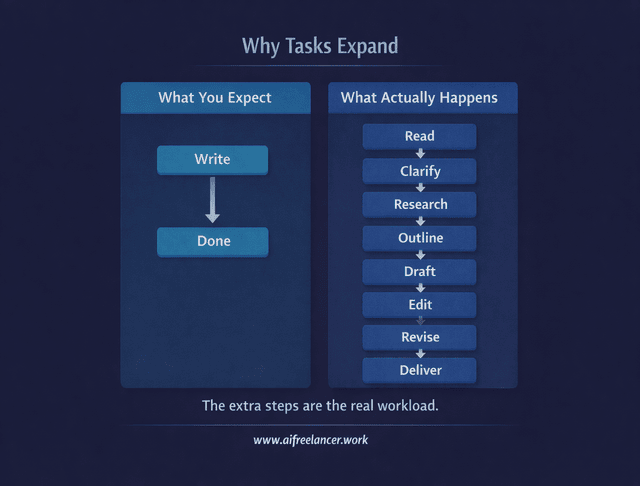
You might think writing an article is a single task, but in practice, it involves reviewing the brief, clarifying unclear points, gathering information, organizing notes, outlining, drafting, editing, revising, formatting, and delivering.
That list alone doesn’t show the full picture. What matters is how those steps are spread out across your day.
A client sends a brief that looks clear at first. You start reading, pause at a section that feels vague, and try to interpret what it means. You open another tab to check something related. Before you finish, a message comes in. You reply, then switch to another task while waiting for clarification. When you return, you reread the brief because you no longer remember exactly where you were. You outline, but halfway through, something doesn’t fit, so you adjust it. You draft, then pause again to respond to another message. Each return requires a quick reset.
Why Tasks Take So Long When Every Step Creates Friction
The delay doesn’t come from one big interruption. It comes from small breaks in continuity. You move information between tools, fix unclear inputs before progressing, and stop mid-task to handle something else. Each time, you spend a few minutes getting back into the work.
A study from the University of California, Irvine, found that it can take more than 20 minutes to regain focus after an interruption. When that happens multiple times a day, even simple tasks stretch far beyond what you expected.
Why Tasks Take So Long Isn’t a Time Problem—It’s a Structure Problem
At a certain point, it becomes clear that the issue isn’t how you manage your time but how your work is set up. More specifically, it’s how tasks enter your day, where they live, and how often they get interrupted before they’re finished.
If a task arrives as a vague message, gets rewritten into notes, then moved into another tool, and is interrupted several times before completion, it will take longer, no matter how efficient you try to be.
The Compounding Effect of Hidden Work
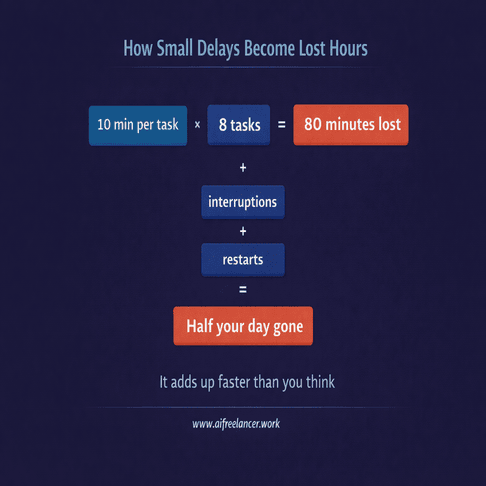
Each task carries additional steps that extend beyond the main work. If you spend 10 to 15 minutes clarifying, switching, or rebuilding context for each task, and you handle several tasks in a day, that time adds up quickly. By the end of the day, you may have spent hours on work that never shows up as completed output.
This is why your day feels full while your progress remains limited. The time isn’t lost—it’s being used on work that surrounds the task instead of completing it.
According to McKinsey & Company, productivity improves most when tools and processes are integrated into workflows rather than added on top. The same principle applies here: improving how your work is structured has a greater impact than simply working longer.
The Real Cost of Hidden Work (What You’re Not Seeing)
This pattern doesn’t just affect your output. It changes how your work feels.
You go through the day completing small things—replying, adjusting, checking—but the main task stays unfinished. That creates a quiet pressure that builds over time. You know you’ve been working, but it doesn’t feel like you’re getting ahead.
Why It Feels Exhausting
The fatigue doesn’t come from the task itself. It comes from constantly stopping and restarting. Each time you return to a task, you need to remember what you were doing, what matters, and what comes next. That repeated effort builds up over time.
Why It Affects Output and Leads to Burnout
When most of your time goes into setup, adjustment, and coordination, completion becomes rare. You start to feel like you’re always working but rarely finishing anything that matters. That gap between effort and results is what leads to frustration and, eventually, burnout.
How to Reduce the Hidden Work Slowing You Down
You don’t need to overhaul your entire workflow immediately. The first step is reducing the unnecessary work surrounding your tasks so you can stay on the task longer.
Immediate Fixes You Can Apply Now
- Clarify what the task actually requires before starting, so you don’t spend time interpreting vague instructions
- Keep tasks and notes in one place so you don’t need to search or rebuild context
- Batch communication so messages don’t interrupt your work every few minutes—especially if you don’t yet have a system for managing your inbox as a freelancer
- Avoid recreating the same information across tools, so tasks don’t restart from zero
These changes don’t eliminate hidden work, but they reduce how often it pulls you away from the main task.
Build a Workflow That Removes the Overload
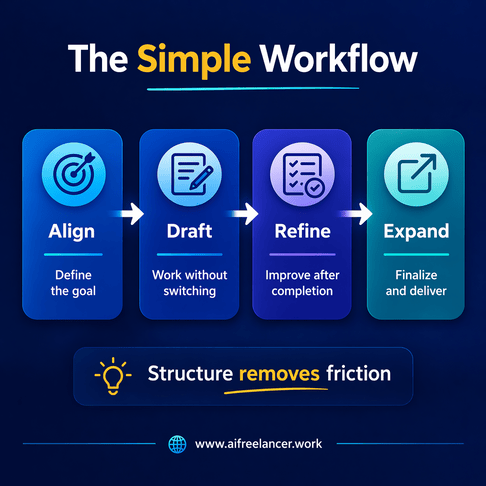
Short-term fixes help, but long-term improvement comes from structure. When your workflow is clear, you don’t need to constantly decide what to do next.
A simple approach can make a difference. Start by aligning on the goal, so the task is clear from the beginning. Move into drafting without interruption so you can maintain continuity. Refine only after the draft is complete to avoid switching between writing and editing. Then finalize and deliver.
This sequence keeps your work moving forward instead of looping back on itself.
Final Thoughts
If you’ve been asking why tasks take so long, the answer is not that you’re working too slowly. A large part of your time is spent on work that supports the task but doesn’t move it forward.
Once you see that pattern clearly, you can start to change it, not by pushing harder, but by reducing the steps that keep interrupting your progress.
If you want a structured way to apply this and build a workflow that reduces revisions, speeds up your writing, and keeps your voice intact, explore my books on my Amazon Author page. They walk you through practical systems you can use to simplify your process and produce better work with less friction.
Frequently Asked Questions About Why Tasks Take So Long
Tasks take longer because they include steps you don’t initially account for, such as clarifying instructions, switching between tasks, and fixing unclear work. These steps add time before and after the actual task.
You may be spending most of your time on supporting actions like communication, coordination, and setup. These keep you busy but don’t directly complete your main tasks.
Each time you switch tasks, you lose focus and need time to regain it. This repeated reset increases the total time needed to complete your work.
Hidden work refers to the effort surrounding a task, including planning, clarifying, adjusting, and transitioning between tasks. It is necessary but often untracked.
By reducing unnecessary steps, minimizing interruptions, and using a structured workflow, freelancers can spend more time completing tasks and less time preparing or restarting them.

Florence De Borja is a freelance writer, content strategist, and author with 14+ years of writing experience and a 15-year background in IT and software development. She creates clear, practical content on AI, SaaS, business, digital marketing, real estate, and wellness, with a focus on helping freelancers use AI to work calmer and scale smarter. On her blog, AI Freelancer, she shares systems, workflows, and AI-powered strategies for building a sustainable solo business.