
You put in a full day—clearing emails, replying to messages, updating files, maybe even starting a draft. But when you look back, nothing feels truly done. If you’ve been wondering why you feel busy but not productive, that disconnect is the problem. The effort is there, yet the results don’t match it, which makes the day feel incomplete.
The issue isn’t that you’re doing too little. It’s that much of your time is spent on tasks that keep work moving without actually bringing it to completion. Busy, in this sense, is often just maintenance disguised as progress.
Everything I’ve shared here—and more—is in my book, available on Amazon. Click the link if you’re ready to take the next step.
Why You Feel Busy But Not Productive (It’s Not What You Think)
Most productivity advice points to focus. It tells you to eliminate distractions or plan your day better. But if that were enough, disciplined, experienced freelancers wouldn’t end their day feeling stuck. The real problem isn’t effort—it’s how your work keeps getting broken into pieces.
Why You Feel Busy but Not Productive Even After a Full Day
A typical workday doesn’t collapse all at once. It breaks slowly. You start writing, then pause to answer a message. That message leads you to check something else. You open another tab, then another. When you return to your draft, you spend a few minutes figuring out where you were before you can even continue.
That pattern repeats. Not dramatically, but consistently.
By the end of the day, you’ve touched everything once, sometimes twice. But nothing feels done. The work didn’t stall—it just kept resetting.
The Real Problem Isn’t Focus, Discipline, or Motivation
The issue isn’t that you lack focus. It’s that your workflow demands constant reorientation. Every time you switch tasks, you’re not just changing what you’re doing—you’re rebuilding context.
That cost is easy to ignore because it happens in small bursts, but it adds up. Harvard Business Review notes that what we often call multitasking is really task switching, and the constant switching makes it harder to stay effective. Research summarized by the American Psychological Association also shows that switching between tasks carries measurable time costs.
The Hidden Layer Behind Why You Feel Busy But Not Productive
What you see as your workload is only the surface. Underneath every task is a layer of smaller actions—checking, clarifying, switching, following up—that quietly take up most of your time. This layer is easy to miss because none of it looks like the “main task.”
More importantly, this layer isn’t random. The same types of actions show up again and again across different kinds of work. If you want a deeper breakdown of this idea, take a closer look at the hidden work that quietly drains your productivity.
Why You Feel Busy but Not Productive Comes From Invisible Work
Think about what happens before real work begins. You reread a brief to understand what the client meant. You scan old messages to confirm a detail. You open notes, then switch to another tab to double-check something. None of this produces output, but it feels necessary.
That’s the pattern: input, interpretation, action, and then another round of follow-up. It repeats across every task. The problem isn’t one step—it’s how often you cycle through them.
The Difference Between Visible Output and Hidden Effort
Finished work is easy to recognize. It’s the draft you submit or the project you deliver. What’s harder to see is everything that supports that outcome. That includes digging through messages to clarify scope, rewriting rough ideas into something usable, or reopening a task after waiting on feedback.
This is where time disappears. Not in one big block, but in small pieces that never quite feel like the main work. Over time, those pieces start to dominate your day—and because they follow repeatable patterns, they can be understood and addressed directly.
Manual Glue Work: The Real Reason You Feel Busy but Not Productive
Once you start seeing those patterns, the problem becomes easier to name. These recurring support tasks form a distinct layer in your workflow—one that keeps everything connected but rarely produces output on its own. That layer is what we call Manual Glue Work.
What “Manual Glue Work” Actually Means
Manual Glue Work is the work that sits around your main task. It includes gathering inputs, clarifying expectations, converting material into usable form, coordinating with others, and closing out work properly.
These tasks are necessary. The problem is not that they exist, but how often they interrupt and fragment your workflow. When too much of your day is spent in this layer, progress slows—even when you’re working continuously.
The 5 Categories of Manual Glue Work
- Capture is where everything starts. Ideas, notes, client messages, and research come in from different places. Before you begin, your attention is already split. The more you collect without filtering, the harder it becomes to see what actually matters.
- Clarify is where time stretches. A vague brief can cost more time than a difficult assignment. You reread instructions, scroll through conversations, and try to piece together what’s expected. This is where repeated interpretation creates mental drag.
- Convert is where raw material becomes usable work. This includes turning notes, rough ideas, or AI output into something client-ready. It often feels like progress, but it can involve reworking the same content multiple times before it settles.
- Coordinate is where your flow breaks. Messages, follow-ups, and tool-switching pull you out of focused work. The interruption itself is short, but reconnecting to the task takes longer.
- Close is where work lingers. A task feels finished, but it still needs formatting, final checks, or approval. These “almost done” items stay open longer than expected, quietly carrying over into the next work session.
How Manual Glue Work Compounds
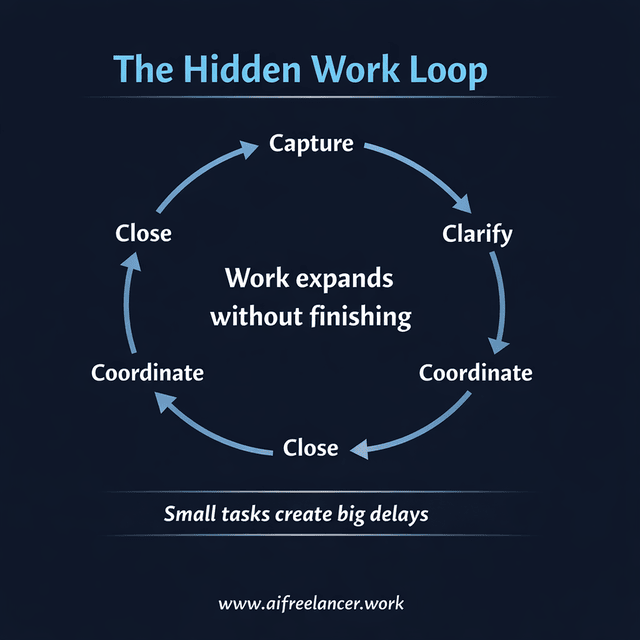
These categories form a loop. Capture leads to Clarify, which leads to Convert, then Coordinate, then Close—and then back again. Each stage creates additional actions, even when the main task remains the same.
The effect is gradual. Work doesn’t pile up all at once. It accumulates in small increments—an extra clarification here, a follow-up there, a restart after an interruption. Over time, these small additions expand your workload without producing more output.
Why You Feel Busy But Not Productive Even With Good Systems
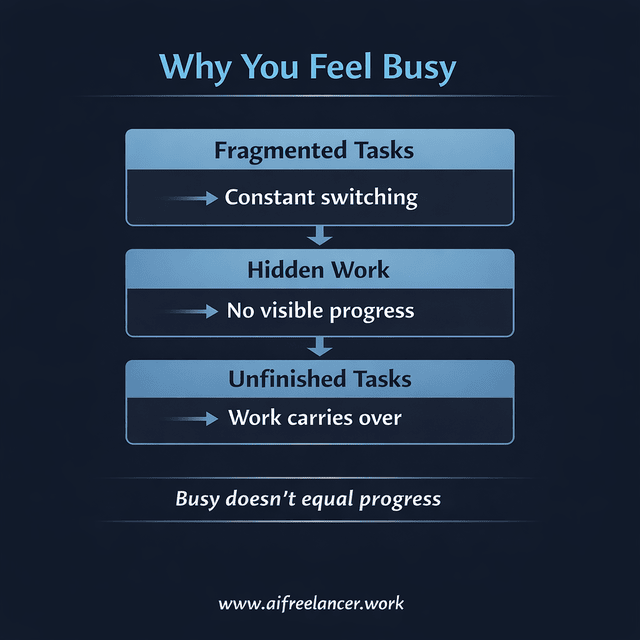
At this point, it’s natural to assume the solution is better organization. If your tools are cleaner and your tasks are structured, things should improve. But this is where many people get misled.
If you’ve tried organizing your tasks but still feel overwhelmed, it’s worth understanding how to organize your tasks without feeling overwhelmed, because organization alone doesn’t fix workflow problems.
What “Good Systems” Usually Look Like
Most systems are built to track work. They show you what needs to be done and help you organize it. That visibility is useful—but it can also create a false sense of control.
A clean to-do list can still hide a messy workflow. You can see everything clearly, but still struggle to finish anything.
The Compounding Effect of Hidden Tasks
This is where Manual Glue Work continues to operate beneath the surface. Each interruption creates a restart. Each restart requires you to rebuild context before moving forward.
According to the American Psychological Association, task switching can reduce productivity by up to 40%. That loss reflects the effort required to repeatedly re-enter tasks.
Context Switching and Cognitive Overload
When work is spread across tools, messages, and tasks, your attention is constantly divided. Even when you’re focused, part of your attention is waiting for the next interruption.
McKinsey & Company highlights that productivity improves when tools are integrated into structured workflows. Without that structure, tools increase complexity rather than reduce it.
This is where the difference becomes clear: organization helps you see your work, but only workflow design helps you finish it.
The Simple Workflow That Fixes Why You Feel Busy But Not Productive
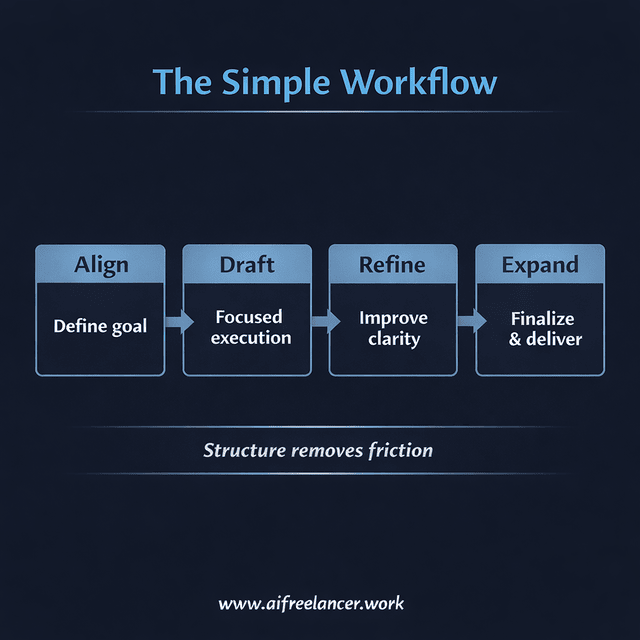
If hidden work scatters your attention, the solution is to reduce how often your attention has to scatter. That means structuring your workflow so fewer decisions happen during execution.
If you want to go deeper into building systems like this, explore AI Workflow for Freelancers.
Shift From Task Management to Workflow Design
Managing tasks individually keeps you reactive. You’re constantly deciding what to do next. A structured workflow removes many of those decisions by grouping similar types of work.
Instead of jumping between tasks, you move through stages—and that changes how work feels. Instead of restarting constantly, you stay in one mode long enough to actually finish something.
The 4-Step Workflow System (In Practice)
Imagine receiving a client brief. In the Align stage, you define the goal and clarify expectations. This reduces repeated interpretation later and limits Clarify work.
In the Draft stage, you focus only on writing. You’re no longer checking messages or editing mid-sentence. This is where work finally moves forward without interruption.
In the Refine stage, you improve clarity and structure. Instead of fixing things as you go, you handle all improvements in one place—cleanly and efficiently.
In the Expand stage, you finalize and deliver the work. Instead of leaving tasks “almost done,” you close them fully.
The difference is noticeable. Work stops feeling scattered. Progress becomes visible. You don’t just stay busy—you actually complete things.
How to Reduce Hidden Work in Your Daily Workflow
You don’t need a complete reset. The goal is to reduce the amount of Manual Glue Work that interrupts your workflow.
Audit Your Workflow
Instead of just tracking tasks, notice patterns. How often do you reopen the same draft? How many times do you reread a message to understand it? These moments reveal where your time is actually going.
Eliminate Unnecessary Steps
Pay attention to how many places you check before starting work. If you’re opening multiple tools just to confirm one detail, you’re adding friction. Reducing those inputs simplifies your entire workflow.
Batch and Standardize Tasks
Look at when interruptions happen. If you’re responding to messages throughout the day, you’re constantly breaking your focus. Grouping these tasks into specific windows reduces repeated switching.
Use AI as a Support Layer
AI is most useful where repetition happens. Drafting rough content, restructuring ideas, or cleaning up formatting are all areas where it can reduce the Convert and Close work. The goal isn’t to replace your thinking—it’s to remove the parts that slow you down.
Final Thoughts
If you’ve been asking why you feel busy but not productive, the answer isn’t that you’re doing too little. It’s that too much of your effort is going into work that never fully closes.
Manual Glue Work explains why your day feels full, but your output stays low. Once you see it, you can start removing it. When you reduce switching and structure your workflow, work begins to move differently. You don’t just stay active—you actually finish things.
If your current system still relies heavily on lists, it may be worth revisiting why your to-do list might not be working to see where things start to break down.
If you’re ready to move beyond managing tasks and start finishing them consistently, my books walk you through the exact workflows behind this shift. Explore them on my Amazon Author page and start building a system that actually supports how you work.
Frequently Asked Questions About Why You Feel Busy But Not Productive
You feel busy but not productive because your time is filled with work that supports tasks instead of completing them. These small actions—checking, clarifying, switching—add up and prevent real progress.
Being busy means you’re constantly active. Being productive means your work leads to completed outcomes. The difference is not effort, but whether tasks actually reach completion.
Start by reducing how often you switch tasks. Structure your workflow into stages so you can stay focused long enough to finish work instead of restarting it repeatedly.
Yes. Multitasking forces constant context switching, which reduces efficiency. According to the American Psychological Association, this can lower productivity by up to 40%.
This usually happens when most of your time is spent on Manual Glue Work—tasks that keep work moving, but don’t complete them. These tasks make you feel busy while leaving important work unfinished.

Florence De Borja is a freelance writer, content strategist, and author with 14+ years of writing experience and a 15-year background in IT and software development. She creates clear, practical content on AI, SaaS, business, digital marketing, real estate, and wellness, with a focus on helping freelancers use AI to work calmer and scale smarter. On her blog, AI Freelancer, she shares systems, workflows, and AI-powered strategies for building a sustainable solo business.